"Follow-up Policies Needed to Support Tariffs and US Investments"
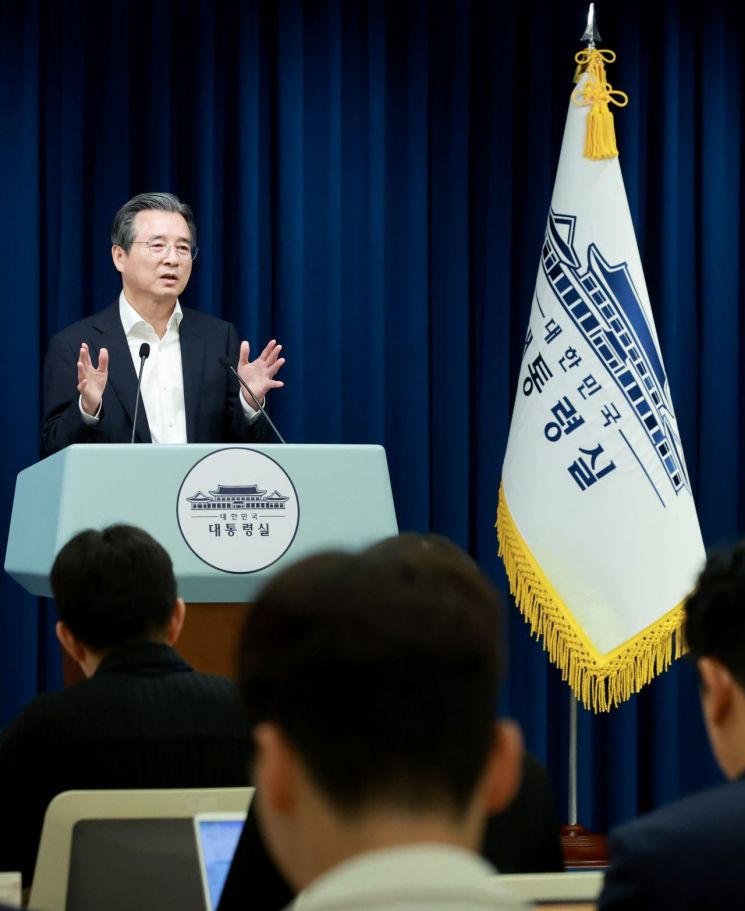 Yongbeom Kim, Chief of Policy Office at the Presidential Office, is answering reporters' questions after a briefing on the conclusion of the Korea-US tariff negotiations at the Presidential Office building in Yongsan, Seoul, on the 31st. Photo by Yonhap News
The Gwangju business community has evaluated the agreement between Korea and the United States on a 15% tariff rate as a development that will enable stable business operations.
The Gwangju Employers Federation (hereafter referred to as Gwangju Gyeongchong) issued a statement on July 31 regarding the conclusion of the Korea-US tariff negotiations, expressing relief that "the greatest uncertainty weighing down the economy has been resolved."
Gwangju Gyeongchong stated, "Above all, we highly appreciate the efforts of the government negotiation team for avoiding the worst-case scenario, which would have been the imposition of a catastrophic 25% reciprocal tariff as initially feared, and for extinguishing this urgent crisis by reaching an agreement on a 15% tariff rate between the two countries. With this agreement, our companies have avoided the worst crisis and can now plan their business activities on a stable foundation."
They added, "If a 25% tariff had been imposed, it was obvious that not only regional finished product manufacturing plants but also numerous parts suppliers would have suffered a chain reaction of damage and employment instability. Now that the immediate crisis has been averted, the regional automobile and home appliance industries will be able to accelerate their transition to future vehicles based on a stable trade environment."
Furthermore, "However,a 15% automobile tariff is by no means a low level. For our automobile industry, which is already facing fierce global competition, it will pose a considerable burden," and "the $350 billion (approximately 487 trillion won) investment commitment to the United States presents a new challenge for our companies. In order for this investment not to end as a mere burden but to become an opportunity for advanced technology cooperation and new market development, systematic government-level support and multifaceted policies such as financial and tax benefits must be provided," they added.
The Gwangju Chamber of Commerce and Industry also issued a statement on the same day, saying, "We welcome the conclusion of tariff negotiations with the United States at the 15% level. This not only resolves the uncertainty faced by local companies and the business community, but also raises expectations for improved bilateral relations, including economic cooperation with the United States."
They continued, "However, the fact that a 15% tariff rate has been equally applied to vehicles produced in Korea, Japan, and the EU is somewhat disappointing, considering that Japanese and European vehicles had previously been subject to a 2.5% tariff, while Korean vehicles had been exempt from tariffs under the FTA agreement," and "it is also concerning that, as a result of this tariff measure, local production in the United States is expected to expand, which could negatively impact the regional economy by reducing sales at domestic finished vehicle plants and numerous partner companies, as well as shrinking new investment and employment."
Gwangju Chamber of Commerce further stated, "We request that the government and local authorities closely cooperate in the future to carefully monitor the industry-specific impacts of the US tariff application and provide preemptive support for business stability and employment retention in sectors expected to be affected. We also hope that policy support will be further expanded so that local companies can secure innovative technological competitiveness through systematic research and development and investment, and establish a foundation for growth by pioneering new markets."
© The Asia Business Daily(www.asiae.co.kr). All rights reserved.
![Clutching a Stolen Dior Bag, Saying "I Hate Being Poor but Real"... The Grotesque Con of a "Human Knockoff" [Slate]](https://cwcontent.asiae.co.kr/asiaresize/183/2026021902243444107_1771435474.jpg)
















