Pharmaceutical and Biotech Industries Avoid Worst-Case Scenario
"Closely Monitoring the Situation"
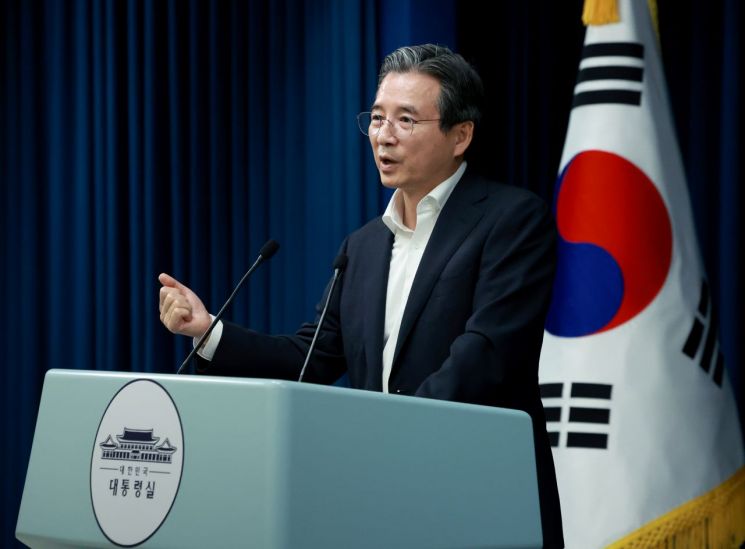 Yongbeom Kim, Director of Policy Office at the Presidential Office, is answering reporters' questions after a briefing on the conclusion of the Korea-US tariff negotiations at the Presidential Office building in Yongsan, Seoul, on the 31st. Photo by Yonhap News
Kim Yongbeom, Chief Policy Officer at the Presidential Office, stated at a Korea-US tariff negotiation briefing held at the Yongsan Presidential Office in Seoul on the 31st, "The 25% reciprocal tariff that the United States had announced would be imposed on Korea starting August 1 will be reduced to 15%," adding, "Tariffs on semiconductors and pharmaceuticals, which are scheduled to be imposed later, will also be subject to treatment that is not disadvantageous compared to other countries."
The pharmaceutical and biotech industries had previously feared the worst-case scenario after US President Donald Trump announced on July 8 that tariffs as high as 200% could be imposed on pharmaceuticals. While this outcome has been avoided, the industry believes that even if a low tariff rate is newly imposed on pharmaceuticals?which had previously been exempt from tariffs under the Korea-US Free Trade Agreement (FTA)?it will inevitably impact corporate profitability.
Lee Seungkyu, Vice Chairman of the Korea Biotechnology Industry Organization, pointed out, "Although the United States has promised most-favored-nation treatment, it remains uncertain whether the pharmaceutical tariff rate will be set at 15% or at a different level," adding, "It is difficult to say that the uncertainty has been resolved."
The industry estimates that if Europe is subjected to a 15% tariff on pharmaceuticals imported into the United States, costs could reach up to $19 billion (approximately 26.25 trillion won). Last year, Korea's pharmaceutical exports to the US totaled $1.49 billion (about 2 trillion won).
Domestic pharmaceutical and biotech companies are cautiously relieved but intend to closely monitor market developments. A Celltrion official said, "We are currently working to minimize the impact of tariffs by securing local production facilities in the US, expanding cooperation with local companies, and stockpiling inventory." Celltrion was recently selected as the preferred bidder in the acquisition of a biopharmaceutical production plant in the US and is expected to sign the final contract in early October. SK Biopharm, which is selling a domestically developed epilepsy drug in the US, has also secured a contract manufacturing organization (CMO) in Puerto Rico, a US territory.
Meanwhile, some predict that if President Trump imposes ultra-high tariffs on pharmaceuticals from other countries, it could present a relative opportunity for Korea. Vice Chairman Lee said, "Korea has the second highest number of FDA-approved biosimilars after the US, and its contract development and manufacturing organization (CDMO) industry is also among the leaders. Therefore, Korea is well positioned to help the US achieve its goals of lowering drug prices and expanding domestic production. We should leverage this to strengthen cooperation with the US and use it as an opportunity to enhance our international competitiveness."
© The Asia Business Daily(www.asiae.co.kr). All rights reserved.
![Clutching a Stolen Dior Bag, Saying "I Hate Being Poor but Real"... The Grotesque Con of a "Human Knockoff" [Slate]](https://cwcontent.asiae.co.kr/asiaresize/183/2026021902243444107_1771435474.jpg)
















