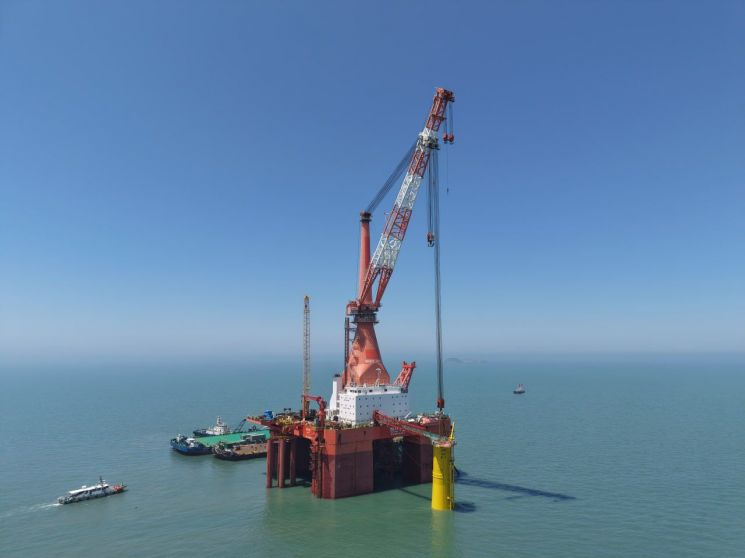
Samhae E&C, which is responsible for the offshore construction of the Nakwol Offshore Wind Power Project (364.8MW), announced on July 31 that it has signed a contract with Hyundai Steel Industries to utilize the offshore wind turbine installation vessel (WTIV) Hyundai Frontier for the installation of the upper structures (WTG) of the Nakwol Offshore Wind Power Project.
According to the contract, Hyundai Frontier will be deployed to the Nakwol Offshore Wind Power site starting in September to begin the installation of WTGs, including towers, turbines, and blades.
Currently, the Nakwol Offshore Wind Power Project has 20 monopiles installed as the lower structures, while four sets of Vensys 5.7MW WTGs have been unloaded at Mokpo New Port and are being prepared for installation.
Samhae E&C stated that it plans to deploy both Hyundai Frontier and Hansan 1, the only two WTIVs in Korea, and achieve the target of partial commercial operation of 16 units (91.2MW) by the end of December through organic cooperation with the existing installation fleet.
For the Nakwol Offshore Wind Power Project, Hansan Maritime, in which Samhae E&C holds a stake, introduced the WTIV Hansan 1, which has been engaged in offshore construction since May. Hansan 1 has been rapidly installing lower structures such as monopiles (manufactured by GS Entec) and TPs (manufactured by Samil C&S), and the construction progress rate has reached 54.5%.
Samhae E&C plans for Hansan 1 to be solely responsible for lower structure construction until the end of this year, aiming to complete the installation of all 64 lower structures in the fourth quarter. Meanwhile, Hyundai Frontier, which has just been contracted, will be solely responsible for the installation of upper structures (WTG), thereby dividing roles to accelerate offshore construction. After Hansan 1 completes the lower structure construction, it will also participate in the installation of upper structures (WTG).
Both the Nakwol Offshore Wind Power Project and Samhae E&C expect that utilizing Hyundai Frontier, a WTIV designed and built with domestic technology, will contribute to revitalizing Korea's underdeveloped offshore wind equipment and vessel infrastructure, while also enabling the accumulation of extensive construction technology experience and capabilities.
Of the two WTIVs registered as domestic vessels, Hyundai Frontier uses the traditional jack-up method, while Hansan 1 employs a new method where the hull is submerged to the seabed for installation. This difference allows for flexible adaptation to various seabed geological structures.
In addition, as a domestically manufactured WTIV, Hyundai Frontier has experience and skilled technical personnel from participating in the Jeju Hallim Offshore Wind Power Project and the Jeonnam Offshore Wind Power Project. Hansan 1 is characterized by its extensive construction experience and skilled technical personnel in overseas offshore wind projects. These complementary strengths are expected to enhance efficiency and safety during the installation of both upper and lower structures, creating synergy effects.
Samhae E&C, which is in charge of offshore construction for the Nakwol Offshore Wind Power Project, stated, "By utilizing the offshore wind construction technology and experience accumulated through Hansan 1 and Hyundai Frontier, we will not only contribute to the successful implementation of the Nakwol Offshore Wind Power Project, but also participate in the Hanbit Offshore Wind Power Project and various other domestic offshore wind projects."
© The Asia Business Daily(www.asiae.co.kr). All rights reserved.

















