Negotiations Accelerate at Scotland Meeting
Before Meeting Trump, Secretary Lutnick Offers Negotiation Tips
Full Support from Business Leaders Including Lee Jaeyong, Chung Euisun, and Kim Dongkwan Plays a Key Role
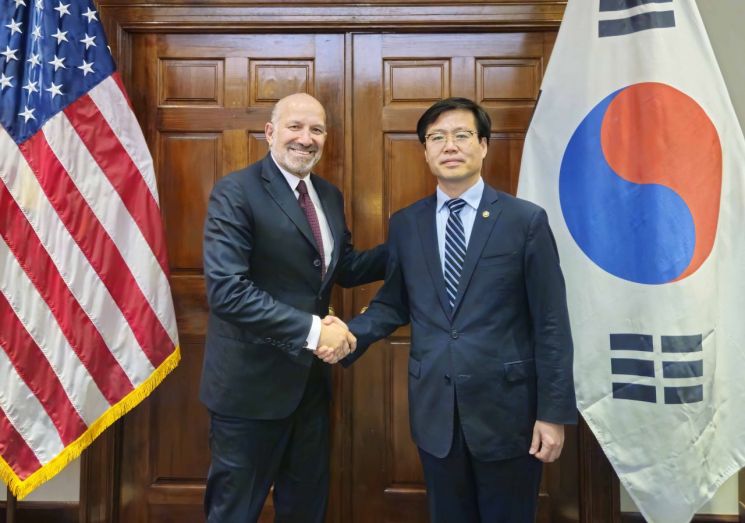
On July 30 (local time), South Korea and the United States officially announced the conclusion of negotiations after agreeing to a 15% tariff reduction. It has been reported that the turning point in the final stage of the negotiations was a meeting in Scotland. After concluding negotiations with Japan, U.S. Secretary of Commerce Howard Lutnick proposed to the Korean side, "Let's meet again to discuss," which accelerated the pace of the talks. Negotiations continued past midnight, moving between a private residence in New York and Scotland. The final agreement was reached when U.S. President Donald Trump personally intervened at the negotiation table.
On July 31, Yeo Han-koo, South Korea's Trade Minister, told reporters via video conference, "Secretary Lutnick contacted us immediately after concluding negotiations with Japan and suggested we meet, which led to rapid progress in the talks. In particular, Secretary Lutnick gave us various pieces of advice on how to persuade President Trump and on negotiation strategies, and thanks to that, we were able to find a breakthrough in the final phase of the negotiations."
Yeo continued, "We negotiated late into the night at both Scotland and the New York residence, adjusting the terms and amounts. President Trump intervened directly at the last minute, which led to the final conclusion."
Regarding the possibility of further negotiations in the future, he said, "This agreement is the result of sufficient consultation between both sides," but emphasized, "Since the global trade environment will continue to change, it is necessary to strengthen corporate competitiveness and prepare institutionally."
The support of the Korean business community also played a significant role in these negotiations. In fact, it has been reported that Lee Jae-yong, Chairman of Samsung Electronics, Chung Eui-sun, Chairman of Hyundai Motor Group, and Kim Dong-kwan, Vice Chairman of Hanwha, mobilized their networks locally to persuade the U.S. Congress and business circles. Yeo evaluated, "The public and private sectors worked together in full force, and this kind of support was of practical help in reaching the agreement."
The shipbuilding cooperation project 'MASGA' (Make American Shipbuilding Great Again) is also said to have played a key role in the negotiations. Yeo explained, "Shipbuilding is an industry where Korea has a comparative advantage. In close consultation with the Presidential Office, we developed this into an idea that could appeal to the United States."
Regarding automobile tariffs, Yeo said, "Korea strongly insisted on 12.5% based on the FTA, but the United States maintained its political stance that the rate should be 15%, the same as Japan and the EU." After Japan first agreed to 15%, Korea also accelerated the process, considering potential political backlash, which ultimately became the background for the agreement.
Yeo also expressed regret that the 50% steel tariff was excluded from the negotiation table. He said, "Since the establishment of the Section 232 steel quota, we have consistently and strongly requested reductions and exemptions, but President Trump firmly maintained the 50% steel tariff. Steel was excluded not only from the negotiations with Korea, but also with Japan and the EU."
According to Yeo, the agreement can be summarized in three main points. First, the country-specific tariff rate, which was scheduled to take effect on August 1, will be reduced from 25% to 15%. Tariffs on automobiles, Korea's main export item, will also be lowered from 25% to 15%. In addition, semiconductors and pharmaceuticals, which were expected to be subject to future tariffs, will receive most-favored-nation treatment, ensuring they are not disadvantaged compared to other countries.
Secondly, a total of $350 billion in investment funds for the United States will be established. Of this, $150 billion will be allocated to the Korea-US Shipbuilding Cooperation Fund, which will be invested in both countries' shipbuilding industries and the overall U.S. shipbuilding ecosystem. The remaining $200 billion will be used in strategic industries such as semiconductors, batteries, biotechnology, and nuclear energy. Yeo stated, "We plan to provide support through various methods such as equity investment, loans, and guarantees."
Furthermore, over the next four to five years, $100 billion worth of U.S. energy will be purchased. However, the agreement does not include specific details regarding participation in the Alaska LNG project.
Regarding the distribution of investment fund profits, Yeo responded to concerns that the United States might take 90% of the profits, as in the case of Japan, by saying, "This refers to reinvestment within the United States, and the structure will be specified during the fund's operation." He added, "The Korea Trade Insurance Corporation and the Export-Import Bank of Korea will support the operation of the fund through loans and guarantees, and the structure will be designed to ensure commercial viability and soundness to avoid excessive burdens on companies."
Yeo also expressed his gratitude to the negotiation team. He said, "An employee in charge of non-tariff barriers in the negotiation team was unable to stay until the end due to the passing of his father. Today's outcome was possible thanks to the dedication of the staff at the Ministry of Trade, Industry and Energy and the Trade Ministry, who worked behind the scenes."
© The Asia Business Daily(www.asiae.co.kr). All rights reserved.


















