Same Profit-Sharing Ratio as Japan
Greater Burden When Measured Against GDP
Differences in Further Opening of Rice and Other Markets
Coordination of Details and Domestic Persuasion Remain Tasks
Amid the threat of a 25% tariff, South Korea secured a trade agreement by offering large-scale investments in the United States and energy purchases in exchange for tariff reductions, following the example set by Japan and the European Union (EU). The automotive tariff was set at 15%, falling short of the 12.5% target, but the agreement is seen as having alleviated short-term trade uncertainty. Foreign media noted that while South Korea, an export-driven economy, has reduced short-term uncertainty through this agreement, challenges remain regarding actual implementation, coordination of details, and domestic persuasion.
Same 15% Tariff as Japan and the EU... Automotive Tariff Target of 12.5% Not Achieved
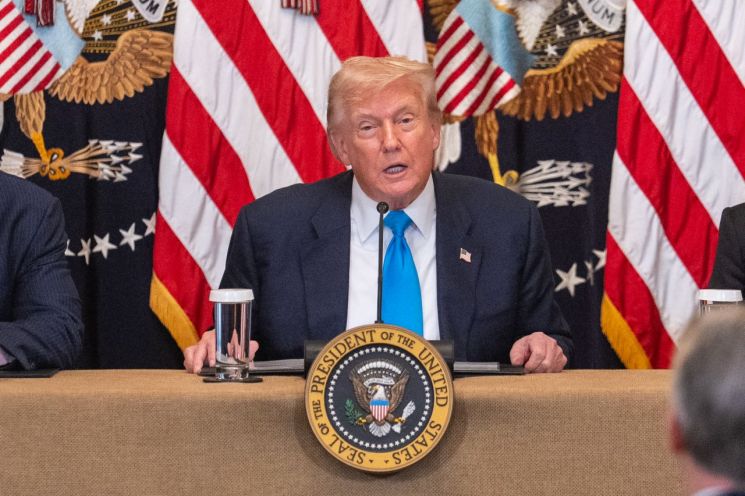
On the 30th (local time), U.S. media outlet Axios reported, "The United States has signed a trade agreement with South Korea under the same framework as with Japan and the European Union (EU)," stating that a 15% tariff will be applied to South Korean products, while U.S. products will be exempt from tariffs. This rate is lower than the 25% warned by President Trump and matches the level set for Japan and the EU.
The core issue, the automotive tariff, was set at 15%, meaning the government failed to achieve its target of 12.5%. Both Japan and the EU also have automotive tariffs set at 15%. However, for the EU and Japan, this figure includes the existing 2.5% tariff, whereas South Korea previously enjoyed zero tariffs under the FTA, making the reduction relatively smaller. Tariffs on steel and aluminum products will remain at the existing 50%, as is the case for Japan and the EU.
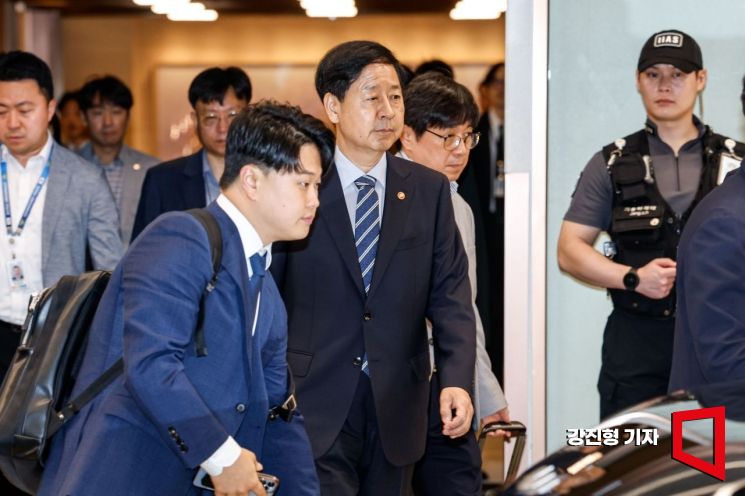 On July 24, when the US requested a sudden postponement of the Korea-US 2+2 trade talks, Deputy Prime Minister and Minister of Economy and Finance Koo Yoonchul canceled his departure and left Incheon International Airport Terminal 2. 2025.7.24. Photo by Kang Jinhyung
$350 Billion Investment in the U.S.... President Lee to Announce Additional Plans
The South Korean government, which had to enter urgent negotiations immediately after the launch of the new administration, offered large-scale investments and energy purchases in the United States?similar to the deals made by Japan and the EU?in exchange for tariff reductions.
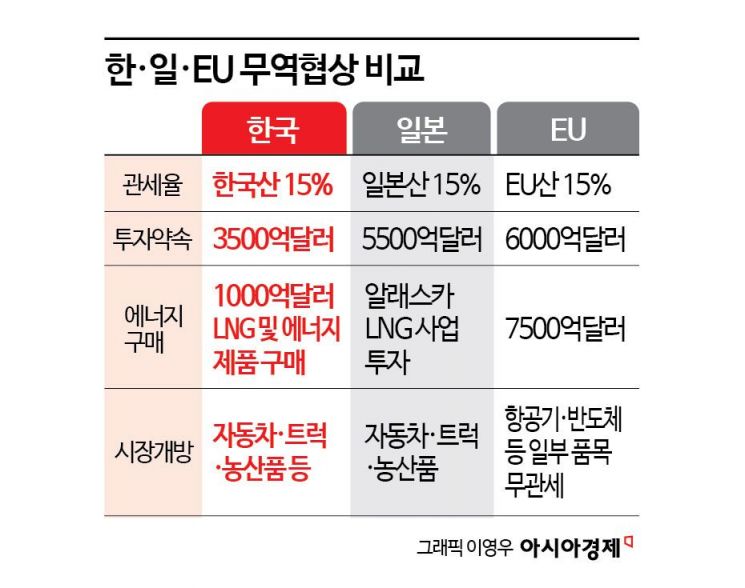
Howard Lutnick, U.S. Secretary of Commerce, stated on X (formerly Twitter) following President Trump's announcement of the trade deal, "South Korea will invest $350 billion in the United States at President Trump's direction, and 90% of the profits will return to Americans." This amount is less than the $400 billion demanded by the U.S., but significantly higher than the initial $100 billion proposed by South Korea, indicating that the U.S. exerted considerable pressure for increased investment during the negotiations. President Trump also increased the investment amount on the spot in previous negotiations with the EU and Japan.
The profit-sharing ratio is the same as Japan's, but the investment amount may change in the future. Like the EU and Japan, South Korea also promised U.S. investments in exchange for tariff reductions, but a formal written agreement has not yet been reached. President Trump mentioned South Korea's investment plans, stating, "President Lee Jaemyung will visit Washington within two weeks to make an additional announcement."
Greater Burden for South Korea When Measured Against GDP... $100 Billion in Energy Purchases Also Required
When the U.S. investment amount is measured against nominal GDP, the burden on South Korea is greater. Japan's nominal GDP last year was about $4.026 trillion, and its U.S. investment accounts for 13.6% of GDP. South Korea's nominal GDP is $1.87 trillion, making the U.S. investment equivalent to about 18.7% of GDP. Although the two countries have different economic scales, South Korea's burden is relatively greater within the same trade framework.
To reach a deal with the United States, South Korea, like Japan and the EU, offered a "gift package" of large-scale U.S. investments and energy purchases. Secretary Lutnick stated, "South Korea has also agreed to purchase $100 billion worth of liquefied natural gas (LNG) and other energy products from the United States over the next three and a half years." The EU agreed to import $750 billion over three years to replace Russian supplies, while Japan did not announce a direct energy import plan but pledged to invest in the Alaska LNG project.
No Further Opening of Rice and Beef Markets... Differences in Detail with Trump
In these negotiations, South Korea made it clear that there would be no further opening of its politically sensitive rice and beef markets. However, President Trump announced after the talks that "South Korea has agreed to accept all U.S. products, including cars, trucks, and agricultural goods," revealing a difference in detail from the position of the Blue House. Kim Yongbum, Policy Chief of the Presidential Office, stated in a briefing, "There will be no further opening of the domestic rice and beef markets."
Similarly, President Trump claimed that Japan had fully opened its rice market to the U.S., while Japan downplayed this by stating it would maintain its World Trade Organization (WTO) tariff-rate quota (TRQ) of about 770,000 tons, only increasing the share of U.S. rice.
Regarding semiconductors and pharmaceuticals, which President Trump had previously mentioned, Secretary Lutnick promised, "South Korea will not be treated less favorably than other countries."
Some issues within the South Korea-U.S. alliance, such as defense cost-sharing, were not included in this agreement. The New York Times (NYT) reported, "The South Korean government stated that the agreement is limited to trade issues," adding, "Other issues are expected to be discussed when the two leaders meet in the coming weeks."
South Korea Resolves Short-Term Trade Uncertainty... Coordination of Details and Implementation Remain Tasks
Foreign media assessed that South Korea, one of the United States' top six trading partners, has resolved short-term trade uncertainty through this agreement. The South China Morning Post (SCMP) in Hong Kong commented, "After weeks of intense negotiations and mounting economic anxiety, the U.S. and South Korea reached a comprehensive trade agreement that significantly lowers threatening tariffs and secures tens of billions of dollars in investment," adding, "South Korea has protected its key export industries and secured a foothold in the new U.S.-led global trade order."
Axios interpreted, "This agreement is a textbook example of the Trump-style tariff-investment swap model, and in the medium to long term, it marks the process of major East Asian export countries being incorporated into the U.S.-led global trade framework."
However, the process of coordinating key details?such as how the investment funds will be spent, the scope of market opening, and the selection of U.S. investment projects?as well as persuading domestic stakeholders, remain as post-negotiation challenges. Reuters pointed out, "Uncertainty remains regarding the investment structure and the future scope of automotive tariffs, and the Blue House needs to clarify its policy interpretation and develop concrete implementation plans."
Bloomberg reported, "This negotiation was a particularly sensitive issue for South Korea's new administration," adding, "The Lee Jaemyung government was considering expanding U.S. access to the Korean beef and rice markets, which is a highly sensitive political topic."
© The Asia Business Daily(www.asiae.co.kr). All rights reserved.
![Clutching a Stolen Dior Bag, Saying "I Hate Being Poor but Real"... The Grotesque Con of a "Human Knockoff" [Slate]](https://cwcontent.asiae.co.kr/asiaresize/183/2026021902243444107_1771435474.jpg)


















