Democratic Party Lawmakers Express Unanimous Support on Social Media
Jung Chungrae and Park Chandae: "Korea Receives Most-Favored-Nation Treatment"
People Power Party: "Tariff Rates Appropriate... Investment Amount Exceeds Foreign Exchange Reserves"
Calls for Clarification on Differing US-Korea Interpretations of Agricultural Market Opening
On the 31st, when the South Korea-US tariff negotiations were dramatically concluded, the ruling Democratic Party of Korea unanimously welcomed the outcome, calling it "an achievement of pragmatic diplomacy centered on national interests." In contrast, the People Power Party assessed that, while the tariff rates are at an appropriate level compared to the European Union (EU) and Japan, the amount of investment pledged to the United States was a significant concession made under the pressure of the negotiation deadline.
Kim Byungki, acting leader and floor leader of the Democratic Party of Korea, wrote on Facebook that morning, "The conclusion of the South Korea-US tariff negotiations is a valuable achievement of pragmatic diplomacy by a government that upholds national sovereignty," and added, "This was only possible because the people trusted us. The public anxiously hoped for the success of the negotiations. I bow my head in deep gratitude."
Kim also expressed his thanks to officials such as Deputy Prime Minister and Minister of Economy and Finance Koo Yooncheol, who participated in the negotiations, and business leaders such as Samsung Electronics Chairman Lee Jaeyong. He said, "This is truly the Republic of Korea. In the face of crisis, we always stand as one. I am deeply moved by our remarkable strength," and promised, "Now it is time for the National Assembly to respond. We will cooperate more closely with the government and actively support the Lee Jaemyung administration."
Candidates running for party leader and supreme council member in the Democratic Party's August 2 convention also posted on social media, sharing the news of the government's successful negotiations and expressing their willingness to offer strong support. Representative Jung Chungrae, a candidate for party leader, said, "Despite difficult conditions, compared to Japan and the EU, we performed well and received relatively most-favored-nation treatment," and added, "The president is the last bastion of diplomacy. I thank the president for his hard work in leading the combination of details and the big picture in a nerve-wracking diplomatic negotiation."
Representative Park Chandae also wrote on Facebook, "We have blocked further opening of the agriculture and livestock sectors, which the public was concerned about, and the controversy over the Online Platform Act (Onple Law) now seems to be coming to an end. Most-favored-nation treatment was also specified for the semiconductor and pharmaceutical sectors, which had been the subject of heated debate over tariff issues," and evaluated, "The Lee Jaemyung administration has successfully concluded negotiations with the world's largest market, the United States, providing a foundation for our companies to compete on fair terms." Representative Hwang Myungseon, the sole candidate for supreme council member, praised, "The Lee Jaemyung administration has achieved both national interest and alliance with the conclusion of the US tariff negotiations," and called it "a victory for pragmatic diplomacy that protected the national interest."
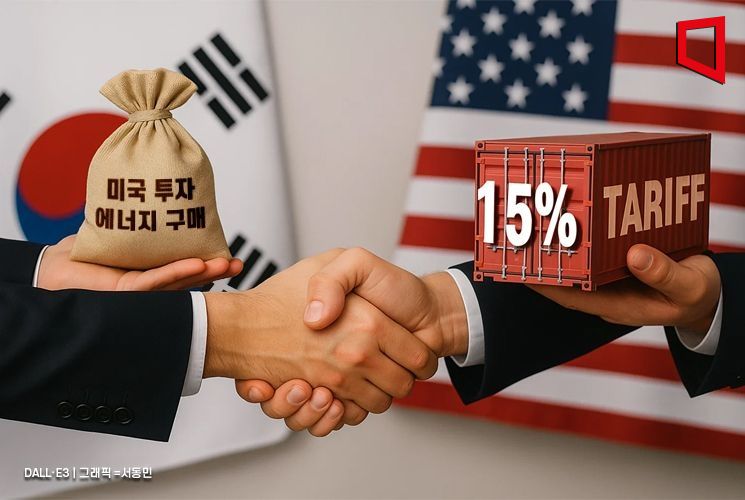
On the other hand, the People Power Party stated that, although the tariff rates are at an appropriate level since they are on par with those of Japan and the EU, the amount of investment pledged to the United States is burdensome. In particular, they demanded a clear explanation regarding the discrepancy between the explanations provided by the South Korean government and US President Donald Trump concerning the opening of the agricultural and livestock markets.
Song Eonseok, interim leader and floor leader of the People Power Party, said at an emergency committee meeting at the National Assembly that day, "A US investment of $350 billion and $100 billion in energy purchases such as LNG means that $450 billion in investment and purchases is required, which is an excessive amount exceeding our foreign exchange reserves," and criticized, "It feels as though we made too many concessions due to the pressure of the negotiation deadline."
Regarding the opening of the agricultural market, he said, "The government announced that there will be no further opening of agricultural and livestock products, including rice and beef, but President Trump said 'open to trade,' which includes agriculture and even mentioned zero tariffs. Please clarify whether imports of grains or fruits other than rice and beef will be greatly expanded, or whether President Trump's remarks are simply political rhetoric."
© The Asia Business Daily(www.asiae.co.kr). All rights reserved.

















