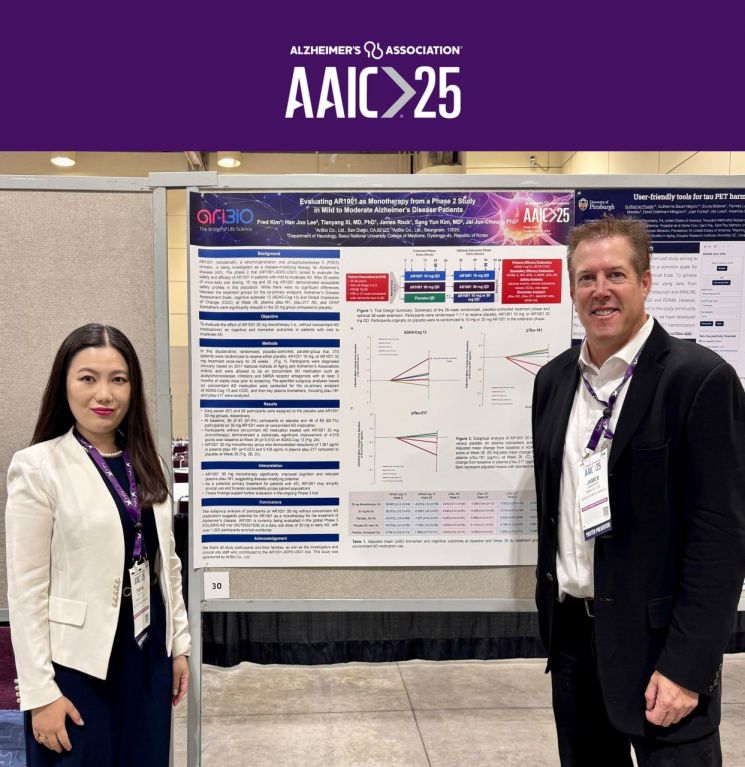
 Jim Rock, Vice President of Global Clinical Operations at Aribio's U.S. branch (right), and Tanya Xi, Director of Development Strategy, participating in the 2025 AAIC. Aribio
Aribio announced on July 31 that four of its research achievements related to Alzheimer's disease treatments were accepted and presented at the "Alzheimer's Association International Conference (AAIC 2025)" held in Toronto, Canada, starting from July 27 (local time).
AAIC is the largest international conference in the field of Alzheimer's and dementia research. It serves as a prestigious venue where leading scholars, pharmaceutical companies, and biotech industry representatives from around the world gather to discuss the latest scientific advancements and therapeutic innovations.
At AAIC 2025, Aribio presented the following research achievements: ▲A study confirming the potential of AR1001 as a monotherapy ▲A study confirming neurologists' positive expectations for oral dementia treatments ▲Demonstration of AR1001's multiple neuroprotective effects in a human mini-brain model (in collaboration with Professor Han-Sang Cho's research team from the Department of Biophysics at Sungkyunkwan University) ▲Reliability analysis and validation of the clinical phase 3 diagnostic platform Fujirebio LUMIPULSE (in collaboration with Fujirebio).
The company stated, "The therapeutic efficacy and clinical reliability of the oral Alzheimer's treatment AR1001 have been scientifically validated in the field of central nervous system disorders," adding, "These research achievements have been widely recognized by the international academic community."
Among the detailed presentations, a study confirming the potential of AR1001 as a monotherapy in the ongoing global phase 3 clinical trial attracted particular attention. Based on a sub-analysis of AR1001 phase 2 clinical data, it was observed that in the patient group taking 30 milligrams (mg) of AR1001 alone, without any combination with other Alzheimer's treatments, there was a significant improvement in cognitive function after 26 weeks and a marked decrease in plasma biomarker 'phosphorylated tau protein (pTau-181, pTau-217)' levels. Notably, blood pTau-181 and pTau-217 levels showed statistically significant improvement across all patient groups, but the effect was observed to be more than twice as great in the AR1001 monotherapy group. This suggests that AR1001 can be expected to provide sufficient and satisfactory therapeutic effects as a monotherapy in the future.
In addition, a survey confirmed that neurologists treating early-stage Alzheimer's patients showed a high willingness to adopt safe and convenient oral small-molecule disease-modifying therapies (DMTs) such as AR1001. This study is expected to serve as a key benchmark for establishing reimbursement strategies and market entry plans for AR1001's future commercialization.
Fred Kim, Head of Aribio's US branch, stated, "As we approach the topline announcement of the global phase 3 clinical trial in the first half of 2026, international academic interest in the scientific basis and clinical efficacy of AR1001 is rising. The research results we continue to present through our own studies and collaborations with partners will serve as a crucial foundation for securing AR1001's competitive edge in future global exclusive licensing agreements and commercialization with big pharma."
Meanwhile, Aribio signed an exclusive licensing agreement for the Greater China region with Fuxing Pharmaceutical on July 28. The company is also pursuing a merger with Kosdaq-listed Solux, with the merger date set for November 4.
© The Asia Business Daily(www.asiae.co.kr). All rights reserved.

















