Song Eonseok: "Returning Broadcasting to the People? Just an Empty Justification"
Joo Hoeyoung: "Democratic Party Will Create Broadcasts Praising One-Party Dictatorship"
On July 30, the People Power Party strongly condemned the Democratic Party of Korea for accelerating the passage of the so-called "Three Broadcasting Laws" (amendments to the Broadcasting Act, the Foundation for Broadcast Culture Act, and the Korea Educational Broadcasting System Act), warning that "the independence of broadcasting will collapse and the country will head down the path of dictatorship." The party also announced plans to launch a filibuster (unlimited debate) to block the legislation.
Song Eonseok, interim leader and floor leader of the People Power Party, criticized the move at a forum titled "Emergency Review of the Unconstitutionality of the Lee Jaemyung Administration's Three Broadcasting Laws" held at the National Assembly Members' Office Building on the same day. He stated, "The claim that broadcasting is being returned to the people is nothing more than a pretense," and argued, "Government intervention in private broadcasters through legislation constitutes a violation of the Constitution in terms of independence in personnel matters."
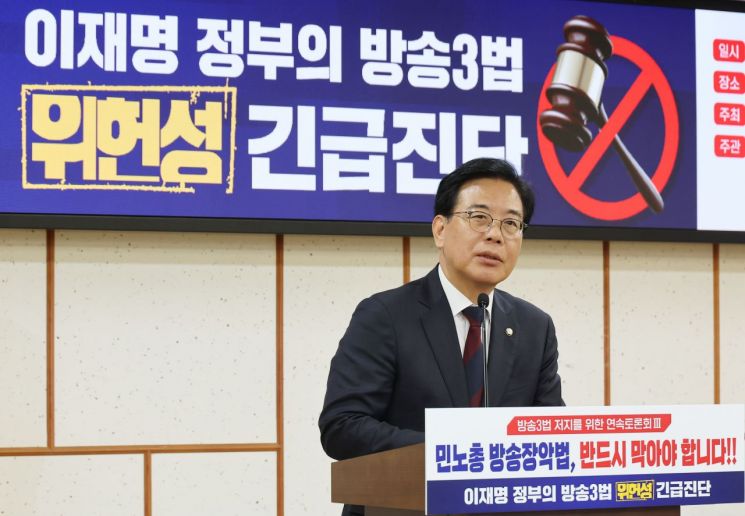 On the 30th, Song Eonseok, Emergency Response Committee Chairman and Floor Leader of the People Power Party, is speaking at a continuous forum held to block the three broadcasting laws, hosted by the People Power Party Policy Committee and others, at the National Assembly Members' Office Building in Yeouido, Seoul. Photo by Yonhap News
Regarding the provision that the president of a public broadcaster would be selected through a national recommendation committee consisting of more than 100 members, he countered, "There is a high risk of bias toward one side overall, and since the members lack any expertise, it would be difficult to control the process appropriately."
The People Power Party plans to launch a filibuster if the Democratic Party pushes through the Three Broadcasting Laws. Song stated, "If the bills are brought to the plenary session on August 4, the only parliamentary means of resistance available to a minority opposition party is the filibuster," adding, "We will have no choice but to intensify our struggle to block the Three Broadcasting Laws."
He further claimed, "The scope for political circles to intervene in the board of directors has been reduced, while the scope for direct intervention by labor unions has been greatly expanded," warning, "There is a significant risk that broadcasting itself will become permanently entrenched in favor of the unions and the ruling party."
Joo Hoeyoung, Deputy Speaker of the National Assembly from the People Power Party, also targeted the Democratic Party, stating, "They are trying to revise the Three Broadcasting Laws to seize control of the media." Joo argued, "The first sign of a one-party dictatorship is media control, and the second is control of the judiciary," asserting, "The Democratic Party has already begun such actions." He went on to say, "The media is an essential mechanism for forming balanced public opinion in a democracy," and criticized, "They are plotting to seize control of the board of directors and create broadcasts that praise a union-centered, Democratic Party-led one-party dictatorship."
He particularly took issue with the legislative process, saying, "The process of handling this law has been rushed without sufficient deliberation," and sharply criticized, "They are breaking the principle that the National Assembly should not directly intervene in broadcasting and are creating laws to allow the majority to control everything."
Kim Taegyu, former vice chairman of the Korea Communications Commission, also described the Democratic Party and the Lee Jaemyung administration's push for the Three Broadcasting Laws at the forum as "an attempt at rapid and permanent control of broadcasting." He questioned, "They want to replace all management of each broadcaster and even change the law governing the Korea Communications Commission to replace its chairperson, but since the current law makes this difficult, are they not trying to fundamentally change the entire broadcasting sector by amending the law?"
Kim further raised issues with ▲the regulation to establish programming committees, ▲the regulation to establish president recommendation committees, and ▲the speed at which the Democratic Party is amending the law. He especially pointed out, "Not only is the state intervening in corporate management by making the president recommendation committee mandatory, but the unions are also being given veto power over its composition," adding, "This constitutes a serious infringement on management rights for news channel operators, which are not even public broadcasters."
The core of the Three Broadcasting Laws is to increase the number of board members at public broadcasters, require the president recommendation committee for public broadcasters to consist of more than 100 members, and implement a "chief editor appointment consent system" for both public broadcasters and news channels. The Democratic Party plans to pass the Three Broadcasting Laws, along with other contentious bills such as the Commercial Act and the Yellow Envelope Act (amendments to Articles 2 and 3 of the Labor Union Act), at the final plenary session of the July extraordinary session of the National Assembly on August 4.
The forum was co-hosted by lawmakers Joo Hoeyoung, Kim Kihyun, Bae Hyunjin, and Kim Jangkyum, along with the party's Policy Committee. Lawmakers Chu Kyungho, Lee Inseon, Shin Dongwook, Kwak Gyutaek, Cho Baesook, and Cho Jiyeon were among those in attendance.
© The Asia Business Daily(www.asiae.co.kr). All rights reserved.
![Clutching a Stolen Dior Bag, Saying "I Hate Being Poor but Real"... The Grotesque Con of a "Human Knockoff" [Slate]](https://cwcontent.asiae.co.kr/asiaresize/183/2026021902243444107_1771435474.jpg)
















