Ruling Party Pushes for Passage of Key Bills at August 4 Plenary Session
Song Eonseok: "For Minority Opposition, Filibuster Is the Only Option"
The ruling party has announced its intention to push through key contentious bills, including the so-called 'Yellow Envelope Act' (amendments to Articles 2 and 3 of the Trade Union Act) and the 'Three Broadcasting Laws' (amendments to the Broadcasting Act, the Foundation for Broadcast Culture Act, and the Korea Educational Broadcasting System Act), at the National Assembly plenary session scheduled for August 4. This move is setting the stage for an intense standoff between the ruling and opposition parties. While the People Power Party has left open the possibility of direct negotiations between the floor leaders of both parties, it is also preparing for a filibuster in case talks break down.
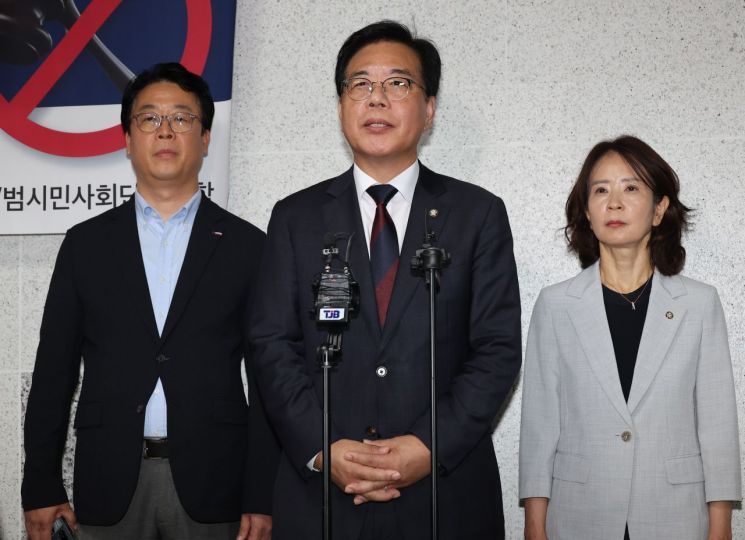 People Power Party's Song Eonseok, Emergency Response Committee Chairman and Floor Leader, is answering reporters' questions at the National Assembly Members' Office Building in Yeouido, Seoul, on the 30th. Photo by Yonhap News
Song Eonseok, acting chairman and floor leader of the People Power Party, met with reporters at the National Assembly Members' Office Building on the morning of July 30 and said, "I expect that the contentious bills will be brought to the plenary session as they are on August 4. If negotiations fail, the only option available to a minority opposition party is a filibuster, so the People Power Party plans to continue unlimited debate on each bill if they are introduced."
Song stated, "I conveyed to Kim Byungki, the Democratic Party floor leader, our proposal to coordinate and reach an agreement on the Three Broadcasting Laws, the Commercial Act, and the Yellow Envelope Act," adding, "However, we have not received a positive response from the Democratic Party."
Earlier that day, Song convened senior party members at the National Assembly to discuss countermeasures against the Democratic Party's move to push through the bills. After the meeting, People Power Party lawmaker Ahn Cheolsoo told reporters, "There was talk of a filibuster," and added, "The specific methods will probably be decided at the party caucus on Monday morning next week."
The contentious bills that the Democratic Party plans to pass at the plenary session on August 4 include the Yellow Envelope Act, which strengthens the three basic labor rights (the right to organize, the right to collective bargaining, and the right to collective action); the Three Broadcasting Laws, which restructure the governance of public broadcasters; and the amendment to the Commercial Act, which includes measures such as expanding cumulative voting and the separate election of audit committee members. In addition, the amendments to the Grain Management Act and the Agricultural and Fishery Products Distribution and Price Stabilization Act (Nongan Act), which passed the full session of the National Assembly's Agriculture, Food, Rural Affairs, Oceans and Fisheries Committee the previous day, will also be introduced.
Regarding the specifics of the filibuster plan, Song said, "We expect the contentious bills to be introduced at the plenary session on August 4, but we do not know which of the Three Broadcasting Laws, the Commercial Act amendment, or the Yellow Envelope Act will be brought up first. Since the July extraordinary session ends at midnight on the 5th, and both we and the Democratic Party are considering convening another extraordinary session in August, I suspect we will continue the filibuster from the 6th onward."
The People Power Party has made it clear that it will launch a filibuster if the Three Broadcasting Laws are introduced at the plenary session, but has not yet decided whether to do so for the Commercial Act amendment and the Yellow Envelope Act. Song explained, "The best solution is to discuss the issues between the ruling and opposition parties and handle them based on what is agreed upon. That is why I met with floor leader Kim Byungki once, and I intend to continue communicating to narrow our differences."
Although the People Power Party has announced its intention to filibuster, this can only delay legislation, not block it. Under the National Assembly Act, the Democratic Party can end debate and proceed to a vote 24 hours after the filibuster begins if three-fifths of all members vote to do so. Given that the July session ends on August 5, the People Power Party can only delay some bills until the August session. As a result, there is a sense of helplessness within the party. One People Power Party lawmaker said, "With our approval rating dropping to the 10% range, it is questionable whether a public opinion campaign will have any effect," adding, "Internal reform must come first."
© The Asia Business Daily(www.asiae.co.kr). All rights reserved.

















