A domestic research team has established and experimentally verified the 'Measurement Protection (MP)' theory, which enables quantum key distribution (QKD) without measurement calibration of quantum states. Quantum key distribution technology refers to distributing cryptographic keys that are fundamentally immune to eavesdropping based on the principles of quantum mechanics.
The Electronics and Telecommunications Research Institute (ETRI) announced on July 30 that, in collaboration with KAIST, it has developed a world-first technology enabling stable quantum communication in dynamic environments such as satellites, ships, and drones.
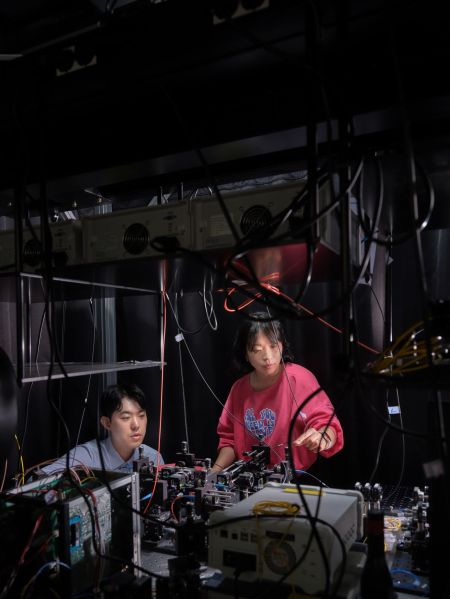 ETRI researchers are conducting research related to quantum technology. Photo by Electronics and Telecommunications Research Institute
Quantum communication is a high-precision technology that transmits information using the quantum state of light. However, when communicating with moving objects wirelessly, such as aircraft, communication stability has been compromised due to weather and environmental changes.
In particular, maintaining stable quantum communication in environments affected by real-time weather, such as in the sky or at sea, has remained a significant challenge.
This research is meaningful in that it has opened up the technical possibility of stably transmitting and receiving quantum information even when drones and other platforms are in motion, overcoming such limitations.
As a result, it is expected that quantum technology can be applied in various fields?such as secure satellite-to-ground communication, drone communication, and maritime communication?without being affected by weather conditions.
During the research process, the joint team established the 'Measurement Protection (MP)' theory for quantum key distribution (QKD) without measurement calibration of quantum states and experimentally verified it. The theoretical framework was developed by Professor Bae Junwoo's team at KAIST, and ETRI was responsible for the experimental implementation.
Conventional quantum key distribution protocols required repeated calibration of the receiver's measurement devices whenever the channel state changed. However, this study demonstrated that stable key distribution is possible regardless of channel conditions through simple local operations alone.
For the experiment, the joint research team implemented a long-distance transmission environment with up to 30dB loss over a 10-meter free-space section, inserted various polarization noises to simulate harsh long-distance wireless conditions, and verified that quantum transmission and measurement were smooth even under such adverse circumstances. Additionally, three wave plates were installed at both the transmitter and receiver to enable local operations.
Through this, the measurement protection (MP)-based quantum key distribution system was able to raise the system's maximum allowable quantum bit error rate (QBER) to 20.7%, compared to previous systems. The quantum bit error rate refers to the proportion of errors among the transmitted quantum bits.
If the error rate among the received quantum bits is less than 20.7%, stable quantum key distribution is possible without separate measurement calibration. This means that reliable quantum communication can be achieved by generating stable keys in various noisy channel environments without measurement calibration.
Yoon Cheonju, Director of the Quantum Technology Research Division at ETRI, stated, "Achieving quantum key distribution independent of channel changes will dramatically enhance the flexibility of quantum cryptography communication," and added, "We will expand this into long-distance free-space link technology to establish the foundation for a global quantum network."
Meanwhile, the results of this research (paper) have been selected as the cover article for the international journal 'Advanced Quantum Technologies.'
© The Asia Business Daily(www.asiae.co.kr). All rights reserved.

















