Development of Attack and Defense Framework to Enhance MARL Robustness by Professor Han Seungyeol's Team at UNIST
Utilized for Evaluation and Robustness Improvement of Swarm Drone and Swarm Robot AI Models, Paper Accepted at ICML
For technologies such as flying drones forming an alliance to surround an enemy, or multiple robots working together in smart factories, cooperation among individual AI agents embedded in each drone or robot is essential.
However, this cooperative structure can easily collapse in situations such as severe weather or sensor failures. A new technology has been developed that creates strong crisis scenarios and allows AI to "pre-train" for them, thereby maintaining a robust cooperative system even in real-world situations.
On July 30, the team led by Professor Han Seungyeol at the UNIST Graduate School of Artificial Intelligence announced that they have developed both the "Wolfpack Attack," an artificial malfunction attack strategy that gradually breaks down the multi-agent cooperative structure, and "WALL," a defense framework that utilizes this strategy for training.
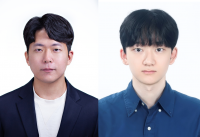 Professor Han Seungyeol (left), Researcher Lee Seonwoo. Provided by UNIST
Reinforcement learning is a training method in which AI learns behavioral strategies autonomously by experiencing various situations. In Multi-Agent Reinforcement Learning (MARL), where several AI agents cooperate, even if one agent encounters a problem, the others can compensate and maintain overall performance.
Because of this, existing attack methods that randomly disrupt a single agent are insufficient to properly assess the vulnerabilities of the cooperative system, and the effectiveness of training for real-world crisis situations such as sensor failures, weather changes, or intentional hacking is also limited.
The "Wolfpack Attack" developed by the research team first causes a malfunction in one agent, then sequentially triggers problems in the agents that attempt to assist, ultimately collapsing the entire cooperative structure. This strategy mimics the hunting method of wolves, who isolate a weak member and then successively subdue the companions that come to help.
In this attack model, a transformer-based prediction model automatically selects the timing of the initial attack by calculating future losses, and subsequent attack targets are determined in order by analyzing the behavioral changes of agents that are highly sensitive to cooperation.
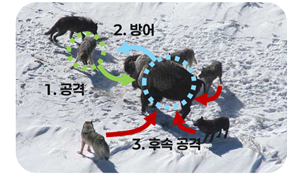 When a single wolf first attacks the prey, the prey group responds by taking defensive actions. At this time, the other wolves participate in subsequent attacks, dispersing the prey's defense and increasing the overall hunting success rate.
Lee Sunwoo, the first author of the study, explained, "Previously, we only checked how well AI performed in predetermined situations. However, this attack strategy creates crisis scenarios that continuously change and are difficult to predict, allowing us to evaluate how well AI can respond within them."
The defense framework developed alongside, WALL (Wolfpack-Adversarial Learning for MARL), introduces this disruption strategy into the AI training environment.
Experimental results showed that AI trained with WALL demonstrated high adaptability and stable cooperative performance, such as reaching target points without colliding even in situations like location errors or communication delays, or maintaining formation while pushing objects together.
Professor Han Seungyeol stated, "This newly developed technology can be used for accurate performance evaluation of cooperative AI models and for building cooperative AI models that are robust in crisis situations. It is expected to contribute to the advancement of swarm robotics industries in fields such as autonomous drones, smart factories, military, and disaster sites."
This research was supported by the Ministry of Science and ICT and the Institute for Information & Communications Technology Planning & Evaluation (IITP) through the "Regional Intelligence Innovation Talent Development Project," "Core Fundamental Technologies for Human-Centered Artificial Intelligence," and the "AI Graduate School Support (Ulsan National Institute of Science and Technology)" projects.
The research results were accepted at the International Conference on Machine Learning (ICML), the most prestigious conference in the field of machine learning.
At the 2025 ICML, held in Vancouver, Canada from July 13 to 19, approximately 12,107 papers were submitted from around the world, of which only 3,260 were accepted.
© The Asia Business Daily(www.asiae.co.kr). All rights reserved.
![Clutching a Stolen Dior Bag, Saying "I Hate Being Poor but Real"... The Grotesque Con of a "Human Knockoff" [Slate]](https://cwcontent.asiae.co.kr/asiaresize/183/2026021902243444107_1771435474.jpg)















