Gyeonggi Province will conduct its first human rights survey targeting foreign seasonal workers.
On July 30, Gyeonggi Province announced that it will visit 115 farms in 19 cities and counties within the province by August 30 to survey 420 foreign seasonal workers. The survey will cover a wide range of human rights issues, including the drafting of employment contracts, delayed wage payments, housing conditions, verbal abuse and sexual harassment, and problems related to illegal brokers.
To assist foreign seasonal workers in understanding the survey, Gyeonggi Province has prepared questionnaires translated into six languages: Vietnamese, Lao, Cambodian, Filipino, Thai, and Nepali. Interpreters will accompany the survey teams to listen to various difficulties, including Korean language proficiency and adaptation to life in Korea.
Foreign seasonal workers are foreigners who are legally employed for a short period due to a shortage of agricultural labor caused by a declining rural population, aging, and rising labor costs. The government supports immigration and worker management, and seasonal workers can stay for up to eight months.
The government receives applications for the required number of workers from each local government, reviews them, and then allocates foreign seasonal workers to each region. In Gyeonggi Province, the number of workers has increased each year, with 1,497 in 2023, 2,877 in 2024, and 5,258 in 2025.
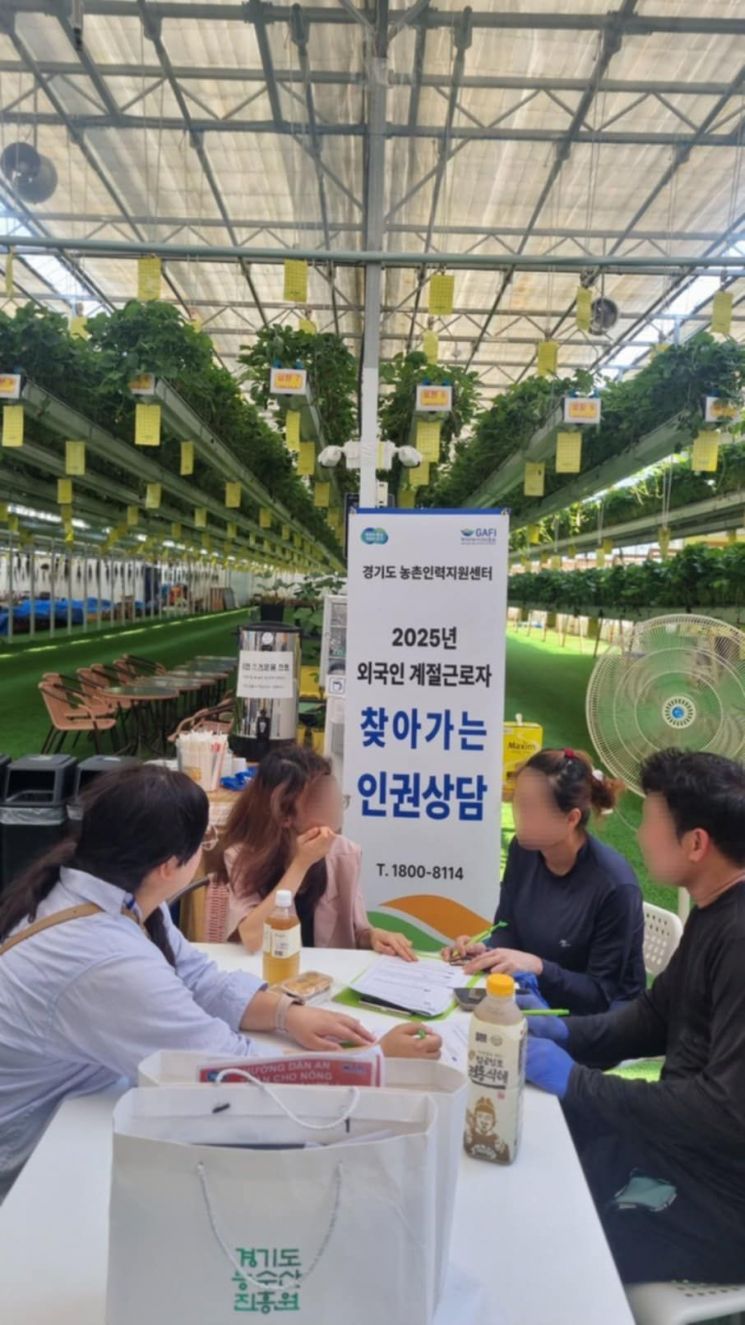 Gyeonggi Province is conducting a field survey on seasonal foreign workers. Photo by Gyeonggi Province
The problem is that, since these workers stay for less than a year, there has been a growing number of cases where they cannot immediately report unfair treatment or human rights violations, or are unable to respond appropriately.
Gyeonggi Province plans to use the results of this survey as basic data for a policy recommendation report to be submitted to the Gyeonggi Province Human Rights Committee in December, along with materials for establishing a sustainable system for the foreign seasonal worker program.
Separately, Gyeonggi Province is also distributing heat safety guide posters and prevention kits to workers, and is supporting the prevention of heat-related illnesses and safe farming activities.
Starting in September, Gyeonggi Province will also collect opinions for improving the system by surveying not only foreign seasonal workers but also 100 employers, 30 city and county officials, and Nonghyup employees about the current status of the seasonal worker program and difficulties faced in the field.
Choi Hyunjung, the human rights officer of Gyeonggi Province, said, "We will accurately identify the human rights situation of foreign seasonal workers in the province and establish practical measures to improve human rights," and added, "We will strive to make Gyeonggi Province a place that helps both foreign seasonal workers struggling with life in Korea and the farms that employ them."
© The Asia Business Daily(www.asiae.co.kr). All rights reserved.

![A Woman with 50 Million Won Debt Clutches a Stolen Dior Bag and Jumps... A Monster Is Born [Slate]](https://cwcontent.asiae.co.kr/asiaresize/183/2026021902243444107_1771435474.jpg)















