7.437 Million Job Openings in June, Down 275,000 from Previous Month
Companies Hesitate to Hire Due to Tariff Uncertainty
CB Consumer Confidence Index for July Rises to 97.2 from Previous Month
The number of job openings in the United States decreased in June compared to May, falling short of market expectations. This is interpreted as a sign that the labor market is gradually slowing down, as companies have become more cautious about new hiring due to uncertainty surrounding tariff policies.
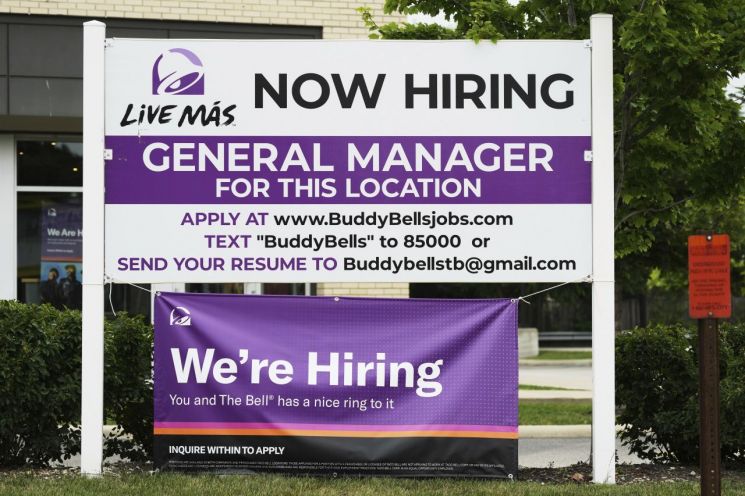
According to the Job Openings and Labor Turnover Survey (JOLTs) released by the U.S. Department of Labor on the 29th (local time), the number of job openings in June was recorded at 7.437 million. This figure is a decrease of 275,000 from May's 7.712 million, and it also fell below the market forecast of 7.51 million.
By industry, job openings decreased by 308,000 in accommodation and food services, by 244,000 in healthcare and social assistance, and by 142,000 in finance and insurance, indicating an overall decline in hiring demand. On the other hand, job openings increased by 190,000 in retail trade, by 67,000 in information, and by 61,000 in state and local government education.
Hires stood at 5.2 million, and the hiring rate was 3.3%, maintaining a similar level to May (5.5 million hires, 3.4% hiring rate).
The number of separations was 5.1 million, with a separation rate of 3.2%. Among these, voluntary quits were 3.1 million, and the quit rate was 2.0%, showing little change from the previous month. Layoffs and discharges, which refer to involuntary separations, were 1.6 million, with a layoff rate of 1.0%, the same as in May.
Due to the impact of U.S. President Donald Trump's tariff policies, some companies have postponed new investments and hiring, raising concerns in the market about a slowdown in employment. However, with the expiration of the mutual tariff suspension approaching on August 1, and following the conclusion of trade agreements between the United States and Japan and the European Union (EU), as well as ongoing negotiations with countries such as South Korea, there are also views on Wall Street that the impact of tariff policies on the labor market and inflation may be less severe than initially feared.
A more accurate picture of the labor market will be available in the July employment report to be released by the Department of Labor on the 1st of next month. Nonfarm payrolls are expected to increase by 108,000, a slowdown from June's 147,000, and the unemployment rate is projected to rise slightly from 4.1% to 4.2%.
Meanwhile, U.S. consumer sentiment improved this month. On this day, the Conference Board (CB) announced that the Consumer Confidence Index for July rose by 2 points from the previous month to 97.2. This figure is 1.3 points higher than the market forecast of 95.9, and it is interpreted that the series of trade agreement announcements by the United States has eased concerns over the tariff war and boosted consumer sentiment.
Stephanie Guichard, Senior Economist for Global Indicators at the Conference Board, explained, "The Consumer Confidence Index rebounded after a sharp decline in April and has remained stable since May, but it still has not reached last year's peak. Consumers evaluated the business environment more positively in July than in June."
© The Asia Business Daily(www.asiae.co.kr). All rights reserved.

















