Accompanying the Investigation Team to Verify Damage and Restoration Costs
Kang Gijung Meets with Ministry of the Interior and Safety Director... "Practical Support for Affected Areas"
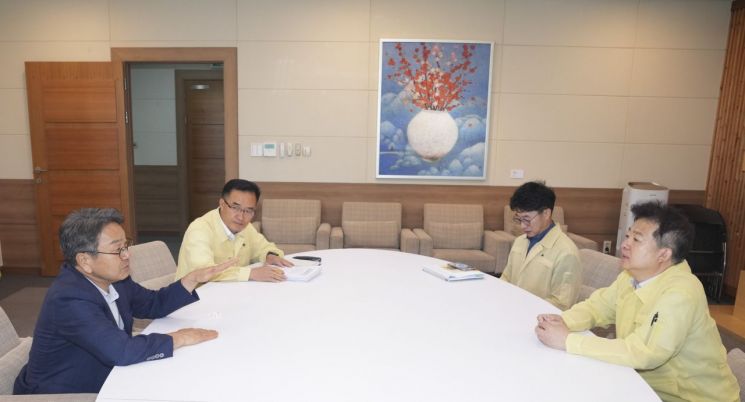 Gwangju Mayor Kang Gijeong emphasized the need for the prompt designation of the affected area as a special disaster zone and the necessity of national treasury support during a meeting with Kim Yonggyun, Director of Safety Policy at the Ministry of the Interior and Safety, and Lee Seonmu, Head of the Gwangju Central Joint Investigation Team, at the city hall reception room on the morning of the 29th. Photo by Gwangju City
On July 29, Gwangju Mayor Kang Gijung met directly with Kim Yonggyun, Director of Safety Policy at the Ministry of the Interior and Safety and Head of the Integrated Support Center for Gwangju and Jeonnam heavy rain victims, as well as Lee Seonmu, Head of the Gwangju team of the Central Joint Investigation Team (and Director of the Agricultural, Livestock, and Marine Disaster Response Division at the Ministry of the Interior and Safety), to emphasize the urgent need for the swift designation of Gwangju’s affected areas as special disaster zones and for national funding support.
The Gwangju city government is providing full cooperation with the Central Joint Investigation Team (hereafter referred to as the investigation team) in its on-site investigation of the heavy rain damage in the Honam region. The city is focusing its administrative resources to ensure that the most severely affected areas, such as Buk-gu, can be declared special disaster zones.
The Central Joint Investigation Team, organized by the Ministry of the Interior and Safety, has set up an office at Naju Sports Park in Jeonnam. Since July 27, the team has been conducting a seven-day on-site investigation of damaged areas in each autonomous district of Gwangju, verifying the appropriateness of the damage and restoration costs registered in the NDMS (National Disaster Management System).
In order to ensure the effectiveness of the investigation team’s work, the city has assigned officials from each relevant department to accompany the team one-on-one at the damage sites. The city is operating a support system to ensure that the reported damage figures are accurately reflected according to on-site conditions.
For natural disaster damage, the damage and restoration costs are entered simultaneously into the NDMS by the facility manager on site, and the investigation team makes its final determination on eligibility for national funding support based on this data.
Buk-gu, which suffered the most severe damage from the recent heavy rains, appears to meet the criteria for declaration as a special disaster zone, making its designation highly likely. In contrast, it remains uncertain whether Dong-gu, Seo-gu, and Nam-gu will exceed the threshold required for national funding support.
Mayor Kang stated, "After Gwangju was excluded from the 'priority declaration of special disaster zones,' the city government, autonomous districts, and local National Assembly members have been working together to support the Ministry of the Interior and Safety’s inspections and preliminary reviews, striving for the designation of special disaster zones. If designated as a special disaster zone, it will provide comfort and great encouragement to the affected residents and the volunteers working hard on restoration."
He added, "Along with comprehensive administrative support for the investigation team's on-site work, we are actively requesting large-scale budget support from the central government for areas requiring structural improvements, such as around Shinan Bridge."
Meanwhile, the city plans to continue providing support to increase the accuracy of damage assessments and the reflection rate of restoration costs during the remaining investigation period, and will do its utmost in follow-up measures so that affected residents can quickly return to their daily lives.
© The Asia Business Daily(www.asiae.co.kr). All rights reserved.

















