From Steel to Marine Tourism... Pohang City to Transform Korea's Marine Tourism Landscape
Yeongilman Tourism Special Zone Emerges as a Marine Tourism Hub
Combining Private Investment, MICE, and Leisure Tourism
Large-Scale Projects such as POEX, Luxury Hotels, and Marina
Create Synergy for Stay-Type Tourism
Pohang City has been finally selected for the government’s “Complex Marine Leisure Tourism City” project, which will invest 1 trillion won, establishing itself as the leading force ushering in a new era for marine tourism on Korea’s East Coast.
On July 29, the city announced that the Yeongilman Tourism Special Zone has been chosen as the final site for the “Complex Marine Leisure Tourism City” project, as announced by the Ministry of Oceans and Fisheries.
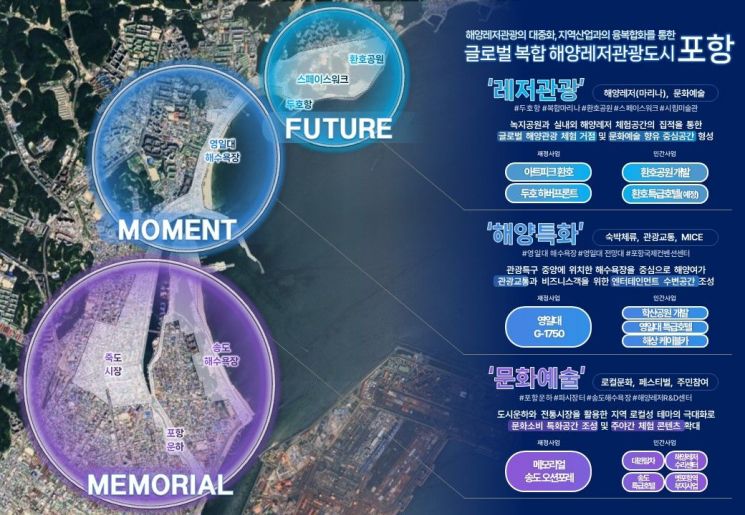
This public contest is a large-scale national project aimed at attracting new private investment to regions with existing marine leisure and tourism infrastructure, fostering them as national hubs for marine tourism.
The city submitted a plan totaling 1.3523 trillion won, which includes 1.1523 trillion won in private investment and 200 billion won in government and local government funding, and plans to implement the project in phases through 2034.
A total of nine local governments participated in the contest, including Pohang, Gyeonggi (Siheung), Incheon (Songdo), Chungnam (Boryeong), Busan (Dadaepo), Gyeongnam (Tongyeong), Jeonnam (Yeosu), Jeonbuk (Gochang), and Gangwon (Yangyang). After a rigorous process including document and presentation evaluations and on-site inspections, Pohang and Gyeongnam (Tongyeong) were finally selected.
Pohang received high marks for its unique location where the city center meets the coastline, a population of 500,000 in its living sphere, extensive land, sea, and air transportation networks, and an ecosystem where tourism, marine leisure, and new industries are integrated. In particular, the structure of the Yeongilman Tourism Special Zone, with large-scale private and public investment projects such as POEX, luxury hotels, and a complex marina, demonstrated the feasibility of establishing a year-round stay-type marine tourism destination.
This selection is seen as the result of close cooperation between the administration, political sector, and private sector. Mayor Lee Kangdeok personally led the project planning and evaluation response together with North Gyeongsang Province, overseeing the practical work. National Assembly members Kim Jungjae and Lee Sanghwi provided full support through consultations with the central government. The participation of local resident representatives in the on-site evaluation further strengthened the collaboration between the private sector, government, and political circles, leading to Pohang’s final selection.
In the second half of the year, once 1 billion won in national funding is allocated, the city will begin the basic planning service and prepare an implementation plan reflecting local residents’ opinions. To apply a global standard of marine city design, international design competitions will also be held for key projects.
The main projects of the contest will unfold along the tourism route from Hwanho Yeongildae to the old city center of Songdo.
Planned fiscal projects include: ▲ Establishment of Hwanho Park as a marine art hub ▲ Construction of a complex marina ▲ Specialization of global marine landscapes ▲ Construction of a complex marine cultural tourism facility in Songdo ▲ Development of Songdo Solsup and Pohang Canal as attractions. Private investment projects include: ▲ Marine leisure support center ▲ Ferris wheel ▲ Luxury hotel ▲ Redevelopment of the old Pohang Station (Districts 1 and 2), among nine linked projects in total.
The city plans to expand the scope and impact of the project by linking the Yeongilman Tourism Special Zone, which was selected in this contest, with four private projects (worth about 1.3 trillion won) such as golf courses, resorts, and tourism facilities attracted to the Homibando area.
In addition, the city will strengthen the collaborative structure between the public and private sectors to create a successful model of a locally-led project. Through this, the city aims to expand the tourism route throughout the entire city and complete the foundation for transforming into a stay-type marine tourism city.
The selection is also expected to have a significant ripple effect on the local economy. Analysis shows that when the project is fully underway, it will generate approximately 270 billion won in production inducement, create jobs for about 16,000 people, and induce value-added effects worth around 110 billion won.
In particular, once year-round stay-type tourism infrastructure is established, industries such as accommodation, commercial districts, transportation, and marine leisure are expected to be revitalized in succession, enabling Pohang to leap forward as a highly advanced global tourism city.
Mayor Lee Kangdeok stated, “The selection of this project is a valuable achievement made possible by strategically attracting private investment and building a marine leisure tourism base over the 6th, 7th, and 8th popularly elected administrations. Through this large-scale project jointly implemented by the public and private sectors, I will elevate Pohang to become Korea’s leading complex marine leisure tourism city.”
In connection with this selection, the city will also promote the advancement of related projects such as: ▲ Operation of the Advanced Marine R&D Center ▲ Fostering the smart marine leisure e-mobility industry ▲ Operation of the APEC cruise floating hotel ▲ Designation as an international conference complex zone ▲ Promotion of Homibando as a marine tourism special zone, further expanding the global marine leisure tourism ecosystem.
© The Asia Business Daily(www.asiae.co.kr). All rights reserved.

















