"The Optimal Location for Carbon Neutrality,
Energy, Food Security, and Balanced Development"
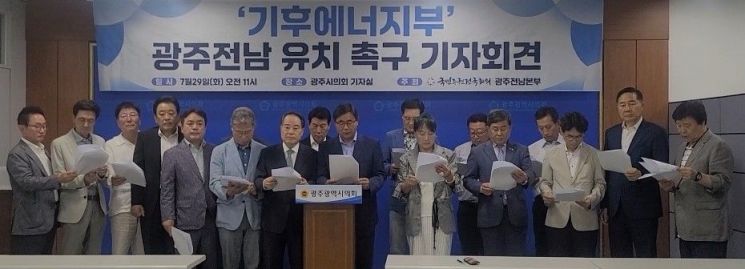 The National Sovereignty National Assembly Gwangju Jeonnam Headquarters held a press conference at the Gwangju City Council on the 29th, urging the establishment of the Climate Energy Department in the Gwangju-Jeonnam Joint Innovation City. Provided by the National Sovereignty National Assembly Gwangju Jeonnam Headquarters
The Gwangju-Jeonnam Headquarters of the National Assembly for People’s Sovereignty (Co-Chairs Choi Youngho and Choi Hyungsik, hereinafter referred to as the Headquarters) held a press conference at the Gwangju City Council on the 29th, urging that the newly proposed Ministry of Climate and Energy be established in the Gwangju-Jeonnam Joint Innovation City.
The Headquarters asserted, "In order to overcome the complex crises of the climate crisis, energy transition, food security, and regional imbalance, the Ministry of Climate and Energy must be located in a place where a demonstration-based approach and a strategic hub are combined."
They continued, "Germany has placed its Federal Environment Agency in Bonn, Sweden has located its Environmental Protection Agency in Ume?, and Norway operates with a multi-core city system. Globally, climate and environmental policies are pursued not as simple administrative functions, but as initiatives that combine regional demonstration and implementation."
Regarding why the Gwangju-Jeonnam Joint Innovation City is considered the optimal location, the Headquarters explained, "Key energy-related infrastructure is concentrated here, including Korea Electric Power Corporation, Korea Power Exchange, Korea Institute of Energy Technology (KENTECH), and the RE100 Industrial Complex." In addition, public institutions related to agricultural life sciences such as Korea Rural Community Corporation, Korea Agro-Fisheries & Food Trade Corporation (aT), and Korea Institute of Planning and Evaluation for Technology in Food, Agriculture and Forestry are also located here, making it the most suitable place for integrated planning and operation of climate, energy, and food policies.
Jeonnam, in particular, is the nation’s largest energy production base, with the world’s largest offshore wind farm under development, as well as concentrated resources in solar, hydrogen, and bio-based renewable energy. Gwangju has established a digital energy administration model based on AI and energy ICT, drawing attention as a testbed for future-oriented administration such as smart grids and energy regulation free zones.
It is analyzed that if the Ministry of Climate and Energy is established in this region, it could function as a policy testbed capable of overseeing the national blue carbon strategy encompassing the southern and western coasts, energy maritime clusters, and integrated marine-land climate response systems.
The Headquarters also stated, "Gwangju, Jeonnam, and Jeonbuk are not only centers of renewable energy but also key areas for food security, as they account for half of the nation’s rice paddy area," and argued, "Climate and energy policies cannot function without a sustainable agricultural base."
Referring to the government’s recent relocation of the Ministry of Oceans and Fisheries as a strategy for southeastern regional development, they explained, "The relocation of the Ministry of Climate and Energy to the southwest is not a matter of regional self-interest, but rather a strategic functional redistribution and a demand of the times."
The Headquarters called on the government and the National Assembly to: ▲ establish the Ministry of Climate and Energy in the Gwangju-Jeonnam Joint Innovation City, ▲ reflect the designation of Gwangju, Jeonnam, and Jeonbuk as an ‘Energy and Agro-Bio Mega City’ in the national plan, and ▲ design a new balanced development strategy to overcome the current capital-centric system.
Meanwhile, the Headquarters reiterated, "Attracting the Ministry of Climate and Energy to the Gwangju-Jeonnam Joint Innovation City will provide a practical space to comprehensively address the four national tasks of carbon neutrality, energy transition, food security, and balanced development," and emphasized, "Now is the time for decisive action."
© The Asia Business Daily(www.asiae.co.kr). All rights reserved.

















