Establishing an AI-Based Advanced Technology Hub
in the Hwawon and Okpo Areas of Dalseong, Daegu
The project to establish the "Daegu Future Smart Technology National Industrial Complex" (tentatively named Daegu Second National Industrial Complex), which will drive Daegu's future industries, has passed the preliminary feasibility study by the Ministry of Economy and Finance.
The "Daegu Second National Industrial Complex Project," which Daegu City has been actively promoting, is the first among the 11 new national industrial complex candidates nationwide to pass the preliminary feasibility study. It is also the first time Daegu City has passed such a study for an industrial complex project on its own.
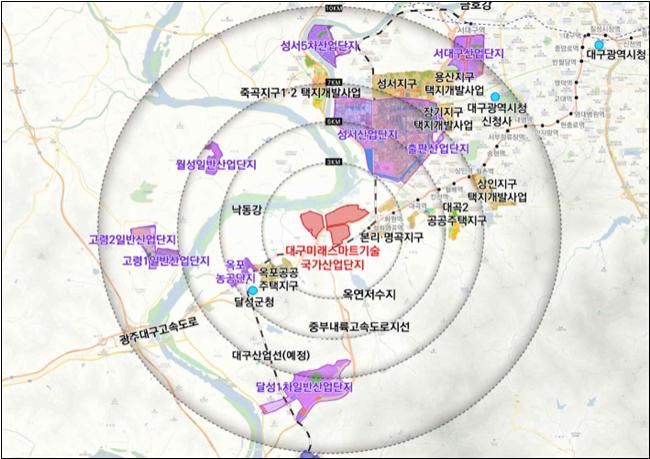
After being selected as a target for the preliminary feasibility study in December last year, the project underwent on-site inspections and corporate demand surveys starting in January this year, and it was confirmed to have passed on July 28.
According to the Korea Development Institute (KDI) preliminary feasibility study, the project achieved a B/C (Benefit-Cost) ratio of 1.05, which is considered excellent economic feasibility for an industrial complex development. The comprehensive evaluation (AHP), which considered policy effectiveness and balanced regional development, also scored 0.524 (above 0.5 is considered feasible), indicating that the project is viable for implementation.
The Daegu Second National Industrial Complex will be developed as a large-scale national project with a total area of 2.55 million square meters in the Hwawon-eup and Okpo-eup areas of Dalseong-gun, with 1.8 trillion KRW in national funding. It will serve as a hub for AI-based future mobility and advanced robotics, focusing on future smart technologies.
Daegu City has operated a task force in cooperation with related organizations, led by the Deputy Mayor for Economic Affairs, making every effort to pass the preliminary feasibility study for the Second National Industrial Complex, which is expected to become a milestone in the innovation of Daegu's industrial structure.
To secure tenant demand, which is the core of the preliminary feasibility study, the city signed investment MOUs and letters of intent with over 240 companies, visiting each company directly to actively promote the necessity, excellent business potential, and favorable location of the Second National Industrial Complex.
In addition, during the process of responding to the preliminary feasibility study, Daegu City presented its accumulated industrial capabilities, comprehensive support systems, and specialized development policies, emphasizing its strong commitment to success as a leading model for national industrial complex development. These continuous efforts ultimately led to the successful outcome.
Since the designation of the Daegu National Industrial Complex in 2009, Daegu City has confirmed its second national industrial complex project after 16 years, fully embracing this new opportunity. As a national industrial complex designated by the central government, it is expected to have a much greater impact on the regional economic and industrial development than general industrial complexes, including attracting national projects, government policy support, fostering high-tech strategic industries, and attracting large-scale enterprises.
The Second National Industrial Complex demonstrated outstanding business feasibility, with a B/C ratio exceeding 1, and achieved the meaningful result of passing the preliminary feasibility study on its first attempt.
Currently, the Daegu National Industrial Complex in Guji-myeon, Dalseong-gun is being smoothly sold to anchor companies (a total of 207 companies, 1.16 million pyeong). With the confirmation of the preliminary feasibility study, the city has secured a future growth base of 500,000 pyeong of industrial land, enabling uninterrupted supply of industrial sites to meet corporate investment demand through 2030.
In particular, the preliminary feasibility study results demonstrated both tangible tenant demand and future growth potential by proactively signing MOUs with regional mid-sized companies. If designated as an Opportunity Development Zone in the future, the synergy in attracting investment will be further amplified by expanding opportunities to attract leading domestic and international companies.
The Second National Industrial Complex boasts excellent conditions in terms of transportation, logistics, and location, including the Hwawon-Okpo IC on the Jungbu Inland Expressway within the site, as well as proximity to the Gwangju-Daegu Expressway, Outer Ring Expressway, and National Route 5, providing a highly connected regional transportation network.
Furthermore, the area offers residential, educational, and cultural amenities within the city, making it an optimal location favored by both companies and workers. Additional advantages include a sales price about 70% of nearby industrial complexes, an industrial land ratio of 65% within the complex focused on business activities, and a variety of other benefits that create favorable conditions for attracting companies. The expected sales price is 3.5 million KRW per 3.3 square meters.
Moreover, the synergy effect is expected to be even greater with ongoing projects such as the Daegu Industrial Line, extension of Subway Line 1, and the redevelopment of the former Daegu Prison site as a cultural complex near the area.
Most importantly, passing the preliminary feasibility study has given significant momentum to the full-scale project, and Daegu City plans to accelerate follow-up measures with the goal of timely completion by 2030.
First, in close cooperation with the project implementers, Korea Land and Housing Corporation (LH) and Daegu Urban Development Corporation, the city will promptly order the design service for the Second National Industrial Complex in August, and proceed with industrial complex planning, Ministry of Land approval, compensation, and commencement of construction without delay.
Although the original plan was for a 3.04 million square meter site, 490,000 square meters of the southern area, which is separated by expressways, rivers, and National Route 5 and poses maintenance challenges, were excluded during the LH management investment review and the preliminary feasibility study. Instead, 83,000 square meters of industrial land were added, and administrative procedures such as changes to land transaction permission zones will proceed soon.
Daegu City plans to focus on four specialized strategies to develop the Second National Industrial Complex as a hub for future smart technologies: establishing a new industry belt, creating convergence bases, attracting strategic companies, and building a smart green industrial complex.
Based on excellent transportation infrastructure such as the opening of the Daegu Industrial Line and extension of Subway Line 1, the city will establish a new industry belt linked with existing manufacturing bases in Seongseo, Dalseong, and the National Industrial Complex, creating a complete industrial ecosystem.
Additionally, the city will create a specialized national high-tech strategic industry complex as a convergence base for future mobility and robotics industries, actively supporting technological advancement in cutting-edge industries such as AI-based humanoid robots, autonomous driving, and smart manufacturing.
In the area of corporate attraction, the city will strengthen strategic investment attraction for leading and anchor companies in the fields of future mobility, advanced robotics, and AI by seeking additional designation as an "Opportunity Development Zone," which offers various incentives such as corporate and acquisition tax exemptions and expanded investment subsidies.
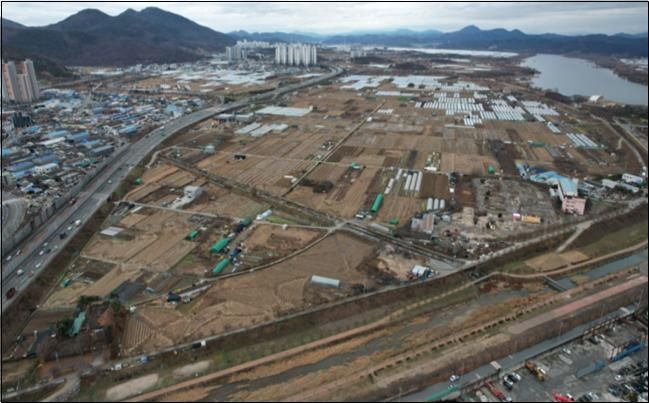
Furthermore, in line with the transition to a low-carbon and eco-friendly society, the city plans to create a sustainable industrial complex by establishing a digital-based smart green industrial complex that incorporates smart technologies and renewable energy.
Kim Jeongki, Acting Mayor of Daegu, stated, "With the passing of the preliminary feasibility study, we have created an opportunity to establish a new national industrial complex after 16 years, making a leap forward as a leading hub for future smart technologies." He added, "We will do our utmost to ensure the swift commencement and successful development of the Second National Industrial Complex so that it can become a new growth engine for Daegu."
© The Asia Business Daily(www.asiae.co.kr). All rights reserved.


















