Publication of the "2024 Statistical Analysis Report on Foreign Patient Attraction Performance"
The Era of 1 Million Foreign Patients Begins in Dermatology, Korean Medicine, and Dentistry
Japanese, Chinese, and Taiwanese Patient Numbers Double or Triple
"Qualitative Growth More Important Than Quantity"
Last year, the number of foreign patients visiting Korea reached a record high of approximately 1.17 million, and it was found that the number of foreign patients is increasing at a faster rate than the number of foreign tourists.
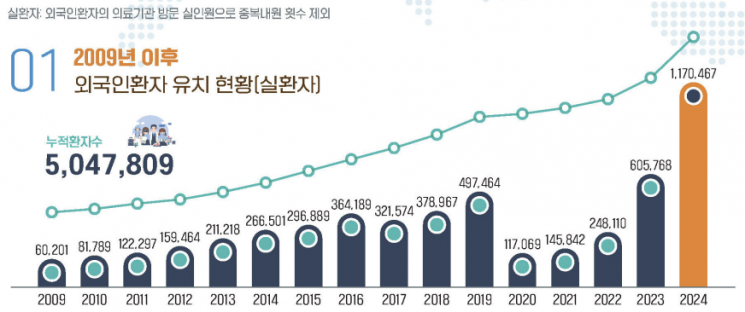
The Korea Health Industry Development Institute announced on the 29th that it had published the "2024 Statistical Analysis Report on Foreign Patient Attraction Performance," which was compiled based on data from registered medical institutions attracting foreign patients.
The report includes trends in the number of foreign patients who used Korean medical services from 2009 to 2024, broken down by major factors such as gender, age, nationality, type of treatment, type of medical institution, region, and medical department.
According to the report, the number of foreign patients who visited Korea last year was 1.17 million actual patients (1.7 million cumulative visits), which is about 1.9 times higher than the previous year's figure of 610,000, setting a new all-time record. Since the start of the attraction project in 2009, the cumulative number of patients has reached 5.05 million.

Last year, foreign patients visiting Korea came from a total of 202 countries, with the largest numbers from Japan (441,000), China (261,000), the United States (102,000), Taiwan (83,000), and Thailand (38,000). In particular, the number of patients from Japan and Taiwan increased by 135% and 550% respectively compared to the previous year, indicating a sharp rise in demand for medical services in Korea from these countries.
By medical specialty, dermatology ranked first, accounting for 56.6% (705,000) of the total, far ahead of plastic surgery (11.4%) and integrated internal medicine (10.0%). Dermatology saw a 194.9% increase compared to 2023, and integrated Korean medicine also grew by 84.6%. This suggests that the foreign patient attraction business is being restructured into a system where short-term outpatient care and mid- to long-term treatment-centered care coexist.
By region, Seoul attracted 85.4% (1 million) of all patients, continuing the concentration in the capital area. However, Busan (30,000) and Jeju (20,000) showed significant growth, with increases of 133.6% and 221.0% respectively compared to the previous year. These non-capital regions demonstrated high growth by combining specialized treatments (such as dermatology, Korean medicine, and dentistry) with tourism resources.
What stands out most in last year's foreign patient attraction performance is that the recovery rate was faster than that of inbound foreign tourists (16.37 million). In particular, for Japan, China, and Taiwan, the recovery rate for tourism remained around 90% compared to 2019, while the number of foreign patients increased by two to three times.
Han Dongwoo, head of the International Healthcare Division at the Korea Health Industry Development Institute, said, "2024 marks a turning point, going beyond a simple recovery to become the first year since the start of the attraction project that we have entered the 'era of 1 million foreign patients.' Going forward, enhancing service quality based on trust and convenience in Korean medical care, and creating an ecosystem for co-evolution with related industries, will be key tasks that determine the sustainability of the foreign patient attraction business."
© The Asia Business Daily(www.asiae.co.kr). All rights reserved.


















