Kospi 5000 Special Committee On-site Meeting at the Korea Exchange
"Avoid Regulation-Only Approach, Combine with Tax Incentives"
As the Korea Exchange has announced countermeasures such as changes to its surveillance system to eradicate unfair trading practices in the future, there have been suggestions that thoroughly investigating the truth behind previous stock price manipulation cases and restoring trust in the capital market should take precedence.
Oh Ki-hyung, head of the Kospi 5000 Special Committee of the Democratic Party, stated at the Kospi 5000 Special Committee on-site meeting held at the Korea Exchange in Yeouido on the 29th, "There have been criticisms that the Exchange either fails to detect signs of unfair trading in a timely manner or, even when detected, delays transferring cases to financial authorities and investigative agencies." He called on relevant institutions to make efforts to improve the domestic stock market system and restore trust.
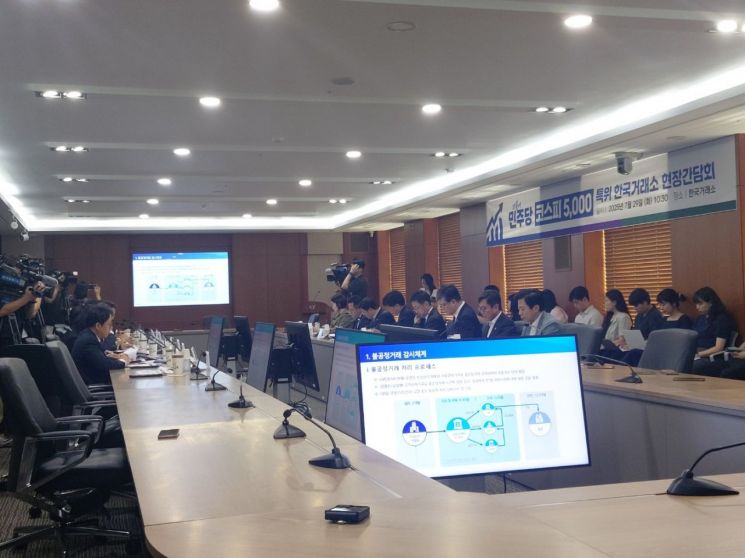 On the morning of the 29th, a KOSPI 5000 Special Committee onsite meeting was held at the Korea Exchange Seoul Office in Yeouido, Seoul. Photo by Jinyoung Kim
Oh added, "In the past, when criminal penalties were imposed for stock price manipulation, only the profits were confiscated, but now the principal is also subject to confiscation. The system is being improved so that those who participate in unfair trading face complete financial ruin." He emphasized, "I will continue to express my commitment to consistent system improvements until the current cynicism that 'only the intelligent escape the domestic stock market' turns into the conviction that 'only the intelligent invest in the domestic stock market.'"
There was also an opinion that, while legal and institutional improvements are important, restoring the lost trust in the capital market should come first. Kim Namgeun, a Democratic Party lawmaker, said, "Looking at representative cases that have undermined market trust, such as the Deutsche Motors stock price manipulation case, there are unclear aspects?such as why abnormal signs were not detected in the early stages, or whether, after detection, the investigation was intentionally delayed for ethical or procedural reasons." He called for a thorough investigation into a series of unfair trading incidents that have fueled market distrust.
Min Byungdeok, another Democratic Party lawmaker, also stated, "In the case of the Sambu Construction stock price manipulation allegations, I personally question whether the Exchange failed to detect abnormal signs in advance or simply did not do so." He stressed, "If investigations and measures only take place after a year has passed and after being pointed out by the National Assembly, then there is a fundamental problem with the system itself. The reasons why a series of stock price manipulation incidents were not detected in advance must be clearly identified so that future system development can earn trust."
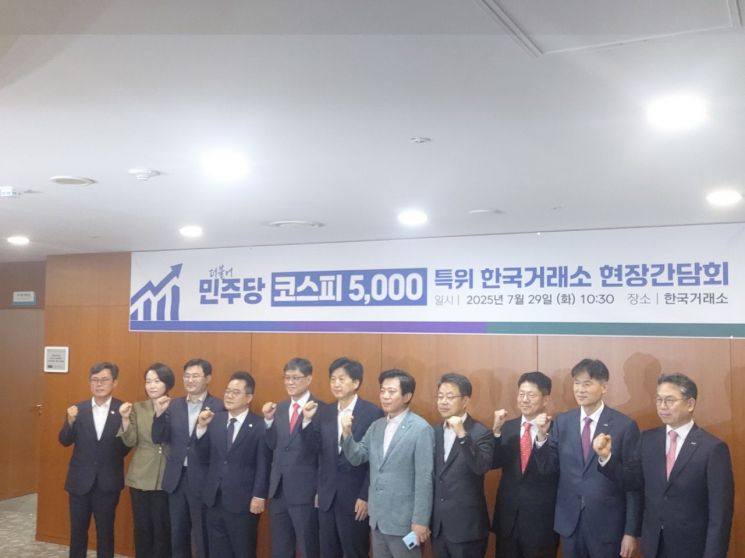 Oh Ki Hyung, chairman of the KOSPI 5000 Special Committee of the Democratic Party of Korea (center), is taking a commemorative photo with lawmakers after the KOSPI 5000 Special Committee onsite meeting at the Korea Exchange Seoul Office in Yeouido, Seoul, on the morning of the 29th. Photo by Jin Young Kim
On this day, the Korea Exchange unveiled specific action plans to eradicate unfair trading in the capital market. First, by October, the current account-based surveillance system will be converted to an individual-based system utilizing encrypted personal information. By the end of the year, artificial intelligence (AI) analysis functions will be enhanced to advance the market surveillance system, and in January next year, the market surveillance organization and personnel will be expanded. In addition, the Exchange mentioned strengthening sanctions standards for false disclosures and the timely delisting of insolvent companies.
Lee Soyoung, a Democratic Party lawmaker, commented, "When unfair trading occurs, it is important to eradicate it so that it cannot recur through various recovery measures," but also emphasized that policy requires a balance between penalties and incentives. Lee argued, "If the government and ruling party pursue policies based solely on regulation, achieving Kospi 5000 will be difficult." She added, "Last month, President Lee Jaemyung warned of strict crackdowns on unfair trading, but also mentioned incentives and tax reforms to encourage companies to increase dividends, which is in the same context."
She also pointed out that the message sent by the political sector to the market must be consistent. Lee said, "We say that money should move from real estate to the stock market, but if we provide a 60% cost deduction for real estate rental income while opposing tax benefits for dividend income as 'tax cuts for the rich,' it is questionable whether money will actually shift to the stock market." She stressed that the tax reforms being promoted by the party and government should not run counter to the purpose of separate taxation for dividend income. Previously, within the ruling party, there were conflicting opinions regarding a proposed tax reform to revert the 'major shareholder standard' for capital gains tax on listed stocks from the current 5 billion won to 1 billion won.
Meanwhile, in the political sector, a 'stronger' amendment to the Commercial Act, centered on the Democratic Party, is anticipated. The previous day, an amendment to the Commercial Act, which mandates cumulative voting for listed companies with assets of 2 trillion won or more and expands the separate election of audit committee members from at least one to at least two, passed the Legislative and Judiciary Committee's subcommittee. The Democratic Party plans to process the amendment at the plenary session on August 4, after passing it through the full meeting of the Judiciary Committee.
© The Asia Business Daily(www.asiae.co.kr). All rights reserved.


















