108 Steps and Wooden Bridge: A Primal Forest Ecological Trail
Orodae, Where Dew Forms Even at Noon in Midsummer
Endless Scenic Views All the Way to Yongso, the Source of Sueocheon Stream
As the heatwave continues following heavy rains, the city of Gwangyang has recommended Eochi Valley as a summer healing destination where visitors can escape the scorching sun and enjoy the tranquility of nature with a unique activity called "waterfall-mung."
Eochi is a place name that comes from the Sino-Korean transliteration of "Neurinjae" or "Neujae," referring to a gently winding mountain pass that circles around the mountainside. Eochi Valley, one of the four major valleys of Baegunsan Mountain, is part of the sixth course of the Baegunsan hiking trail, which was designated in 2021 as one of Jeonnam's "Forests You Want to Walk." The valley features scenic spots such as Gusi Waterfall, Orodae, and Yongso, places believed to have been frequented by Taoist hermits, creating a beautiful natural landscape.
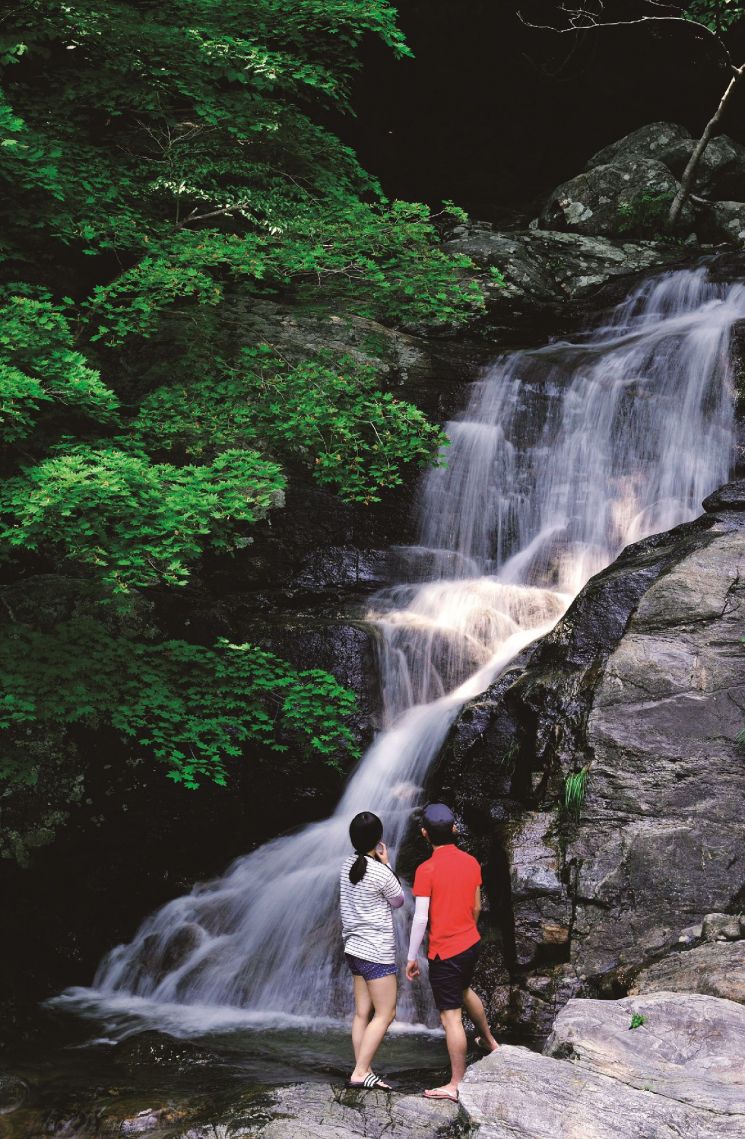
In particular, Gusi Waterfall, located at the end of the ecological exploration trail, powerfully lives up to the legend that its waters never run dry, even during severe droughts, as it continuously pours out dazzling spray with a thunderous roar and relentless force.
Visitors who have just emerged from the pristine primeval forest and the striking rock formations along the ecological trail find themselves mesmerized by the overwhelming sight of water cascading down at Gusi Waterfall, named after a livestock feeding trough ("Gusi" or "Guyu") due to its long, carved shape. Many find themselves unconsciously falling into a state of "waterfall-mung" as they take in the spectacle.
About 700 meters up the forest road from Gusi Waterfall, there is a wide rock inscribed with the characters "Orodae," meaning "noon dew terrace," so named because dew forms here even in the heat of midsummer. The name "Orodae" is derived from the first characters of Danojeol (Dano Festival) and Hanrojeol (Hanro Festival), symbolizing that in the past, scholars and poets would visit during these two festivals to enjoy the arts and nature.
Directly below Orodae lies Yongso, the source of the Sueocheon stream. It is said that during droughts, rain rituals performed here would bring abundant rainfall.
Lee Hyunju, head of the Gwangyang City Tourism Department, said, "Eochi Valley is well known not only for its royal azaleas in spring and its autumn foliage, but also as a refreshing summer healing destination to escape the heat," adding, "I hope visitors will come here with their loved ones, immerse themselves in the mysterious legends, and find time to relax and rejuvenate."
© The Asia Business Daily(www.asiae.co.kr). All rights reserved.

















