Paju City Launches Feasibility Study and Master Plan for Dome Stadium Project
Key Initiative for Realizing a "Self-Sufficient City of One Million"
Poised to Become a Future Growth Engine Integrating Culture, Tourism, and Economy
Paju City in Gyeonggi Province has taken its first significant step toward creating a sports and culture convergence complex centered around the construction of a dome stadium.
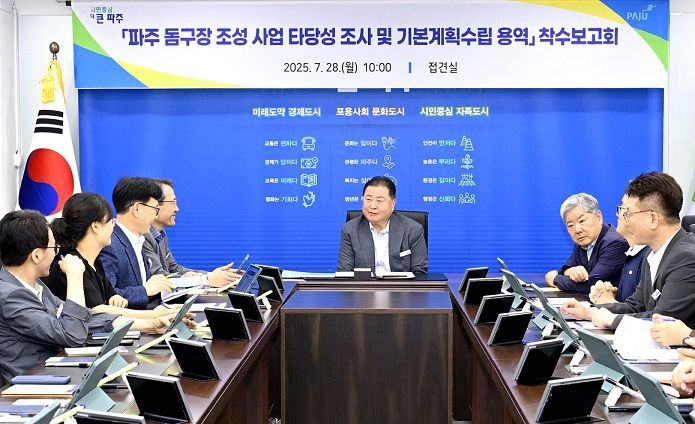 Paju Mayor Kim Kyungil is holding the kickoff meeting for the "Feasibility Study and Basic Plan Establishment Service for the Paju Dome Stadium Construction Project" on the 28th. Provided by Paju City
On July 28, Paju City held a kick-off meeting for the 'Feasibility Study and Master Plan Establishment for the Paju Dome Stadium Construction Project,' where the city listened to the opinions of related organizations on the future direction and implementation strategies for the project, according to an announcement made on July 29.
This study aims to establish a concrete implementation plan for the dome stadium project, which is being pursued as a core strategy for Paju City's vision of becoming a self-sufficient city with a population of one million. The goal is to conduct a feasibility review and to develop a comprehensive master plan.
At the meeting, Paju Mayor Kim Kyungil, along with representatives from the Korea Baseball Organization (KBO), Paju City Tourism Corporation, and Paju Sports Council, discussed the need for collaboration and practical implementation strategies according to the roles of each organization. Topics included the integration with urban development projects, revitalization of local sports through the construction and operation of the dome stadium, and the long-term development direction of Korea's baseball industry.
This study will be carried out over approximately 10 months, with completion targeted for around April 2026. The main tasks include: ▲ reviewing the feasibility of constructing the dome stadium ▲ analyzing the suitability of the location and economic viability ▲ determining the appropriate project scale and establishing implementation methods ▲ developing investment attraction strategies to secure private capital ▲ designing future operation and management plans. In particular, the study will conduct a multifaceted analysis on the potential use of the facility as a complex space where sports and culture converge, as well as on sustainable operation models.
To strategically promote the dome stadium project, Paju City established a dedicated organization earlier this year and has been steadily advancing preparatory procedures, such as forming consultative bodies with related organizations and conducting preliminary basic research.
Notably, in May, as part of efforts to secure feasibility and operational models, the city visited Es Con Field in Hokkaido, Japan, to observe the design, development, and operation of an advanced dome stadium as a leading international example.
Paju Mayor Kim Kyungil emphasized, "The dome stadium is more than just a sports facility; it will be a core infrastructure that comprehensively drives Paju's future industries, tourism, culture, and employment. As a state-of-the-art complex space available 365 days a year, it will become the heart of Paju as a representative sports city."
He added, "I hope this study will serve as the starting point for turning the dream of attracting a dome stadium into a concrete and achievable plan, and that all departments and organizations will work together as one team to pursue it meticulously and boldly."
© The Asia Business Daily(www.asiae.co.kr). All rights reserved.

















