In the first half of this year, 617 cases involving a total of 2,680 kilograms of narcotics were detected at the national border. This amount is sufficient for 89.33 million people to use simultaneously, based on the standard methamphetamine single dose of 0.03 grams.
The Korea Customs Service announced the "2025 First Half Drug Smuggling Detection Status" on July 29. Compared to the same period last year, the number of drug smuggling cases detected in the first half of this year increased by 70%, while the total weight increased by 800%. In terms of weight, this marks the largest scale ever recorded.
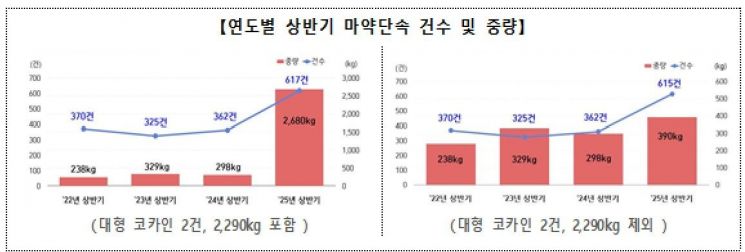
Even excluding two large-scale cocaine smuggling cases?one at Gangneung Okgye Port in April (1,690 kilograms) and another at Busan New Port in May (600 kilograms), totaling 2,290 kilograms?the total quantity of narcotics detected in the first half of this year still increased by 31% compared to the same period last year. This indicates that the increase in detected quantity cannot be attributed solely to these large-scale smuggling cases.
This is also distinct from recent annual figures: 370 cases and 238 kilograms in 2022, 325 cases and 330 kilograms in 2023, and 362 cases and 298 kilograms in 2024, which showed relatively small differences.
The Korea Customs Service analyzes that the increase in drug smuggling from Central and South America, as well as from North America and Europe, has contributed to the larger number of cases detected in the first half of this year.
In fact, based on weight, the main regions of origin for narcotics smuggled into Korea were, in order: Central and South America, Asia, North America, and Europe.
In Central and South America, the number of detected cases increased from 4 cases and 29 kilograms in the first half of last year to 9 cases (up 125%) and 2,298 kilograms (up 7,824%) in the first half of this year. In North America, the number increased from 89 cases and 64 kilograms to 216 cases (up 143%) and 110 kilograms (up 72%). In Europe, the number changed from 72 cases and 33 kilograms to 68 cases (down 6%) and 96 kilograms (up 191%). In most regions, both the number of cases and the total weight increased significantly.
The Korea Customs Service analyzes that, in the case of Central and South America, the so-called "balloon effect" caused by the United States and Canada strengthening their border controls has led local drug organizations to increasingly attempt to enter new markets such as Asia, resulting in more frequent attempts to smuggle drugs into Korea.
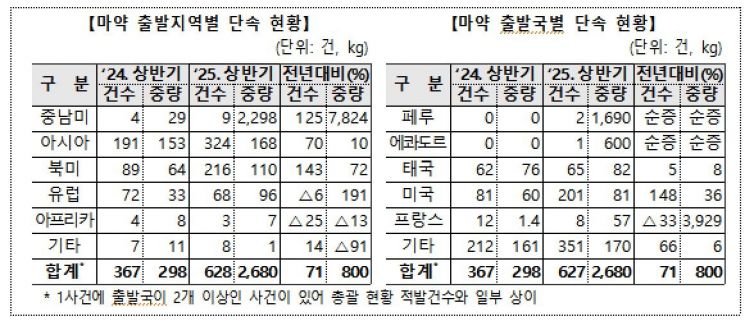
Central and South America has already been a region where large-scale, one-off drug smuggling using ships has been detected. This year, large-scale drug smuggling cases occurred consecutively at Gangneung Okgye Port (originating from Peru) in April and at Busan New Port (originating from Ecuador) in May.
By type, the largest quantities of narcotics detected were cocaine, methamphetamine, ketamine, and cannabis, in that order. Among these, the detected quantity of cocaine increased by 80 times compared to the first half of last year. The increase in cocaine smuggling is not limited to Korea but is observed as a trend throughout the entire Asian region.
Supporting this, the United Nations Office on Drugs and Crime (UNODC) recently released a report stating that "cases of Asia being used as a final destination or transit route for cocaine are increasing."
Analysis of drug trafficking routes shows that attempts to smuggle drugs using travelers and express cargo are increasing, while attempts using international mail are decreasing. The increase in smuggling via travelers and express cargo appears to be largely due to a rise in smuggling for personal consumption. Conversely, attempts to bring in narcotics via international mail have declined as smuggling has shifted to express cargo and other methods.
Lee Myunggu, Commissioner of the Korea Customs Service, stated, "For two consecutive years, the number of domestic drug offenders has exceeded 20,000, indicating that illegal narcotics are deeply infiltrating all areas of our society. The Korea Customs Service will take the lead in fundamentally blocking the illegal importation of narcotics to realize a safe society free from drugs."
© The Asia Business Daily(www.asiae.co.kr). All rights reserved.


















