U.S. exports to China to drop by $101 billion... Major hit to soybeans and more
South Korea's automobile exports alone to decrease by $13.5 billion
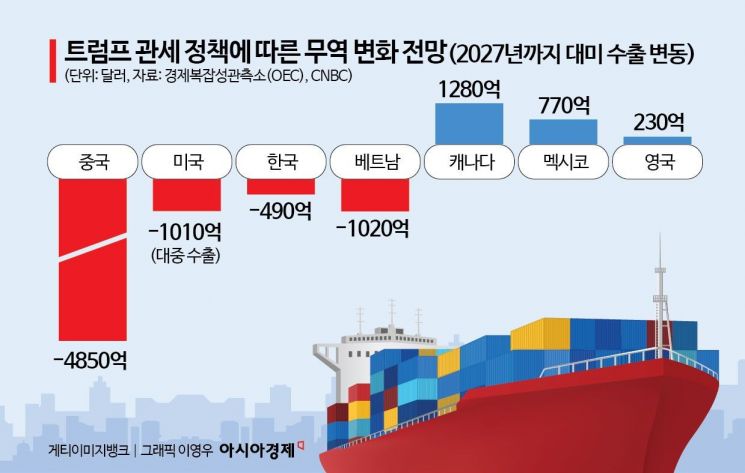
If President Donald Trump's current tariff policy remains in place, it is projected that Chinese exports to the United States will decrease by $485 billion (approximately 675.2655 trillion won) by 2027. U.S. exports to China are also expected to decline, as are exports to the United States from countries such as South Korea that are linked to China's supply chain.
On the 28th (local time), U.S. economic media outlet CNBC reported these findings based on a global trade simulation by the Observatory of Economic Complexity (OEC).
By product category, exports of Chinese broadcasting equipment and computers are expected to decrease by $59.2 billion and $58.7 billion, respectively.
Although the impact is not as severe as for China, U.S. exports to China are also projected to decrease by $101 billion over the same period. By product, soybeans (-$10 billion), integrated circuits (-$7.44 billion), crude oil (-$7.33 billion), petroleum gas (-$6.36 billion), and automobiles (-$5.09 billion) are expected to be hit the hardest. By state, exports to China from Texas, California, and Oregon are expected to see significant declines. Among these, Texas is a region with strong Republican support. Among U.S. companies, those with a high proportion of imports from China, such as Walmart, Costco, Dole Fresh Fruit, and Amazon, are expected to be affected.
Currently, the United States applies a 30% tariff on Chinese goods, while China imposes a 10% tariff on U.S. goods. However, including previously imposed tariffs, the United States applies an average tariff of 51% on Chinese imports, and China imposes an average tariff of 32.6% on U.S. imports. After a period of triple-digit tariff wars, the two countries are in a temporary truce. On this day, they met in Stockholm, Sweden for the third round of high-level trade talks and discussed extending the suspension of additional tariffs at current levels for another three months until November.
It is not only China that will be affected. Countries linked to China's manufacturing economy are also expected to feel the impact of the decline in Chinese exports to the United States. Vietnam, which China has used as a detour route for exports to the United States, is estimated to see its exports to the U.S. decrease by $102 billion by 2027.
South Korea's exports to the United States are predicted to decrease by $49 billion by 2027. In particular, exports of automobiles?a key export item for South Korea?are expected to decrease by $13.5 billion. This projection assumes a tariff rate of 15 to 20% is applied.
On the other hand, some countries are expected to see their exports to the United States increase. Canada’s exports will rise by $128 billion, and Mexico’s by $77 billion. The United Kingdom, which was the first to sign a trade agreement with President Trump, will see its cumulative exports to the United States increase by $23 billion. Cesar Hidalgo, founder of Datawheel and professor at Toulouse School of Economics, who developed the OEC Tariff Simulator, said, "In many scenarios, countries will naturally tend to reorganize their trade relationships with the United States."
During the trade war truce with the United States, China is expanding trade with several countries, including ASEAN (Association of Southeast Asian Nations). According to the OEC, the country with the largest increase in trade with China is Russia, with an expected increase of $69.8 billion. In addition, trade with Vietnam ($34.4 billion), Saudi Arabia ($28 billion), South Korea ($27.9 billion), Australia ($24.6 billion), and Japan ($21.4 billion) is also expected to rise.
Carlos Gutierrez, former Secretary of Commerce under the George W. Bush administration, commented that the current trade turmoil is a temporary phenomenon in the history of global trade, but warned, "Protectionism never protects. It saps a country's vitality."
© The Asia Business Daily(www.asiae.co.kr). All rights reserved.

















