150 Missiles Expended During Israel-Iran Conflict
Only 10 Replenished Per Year... Concerns Over Stock Shortages
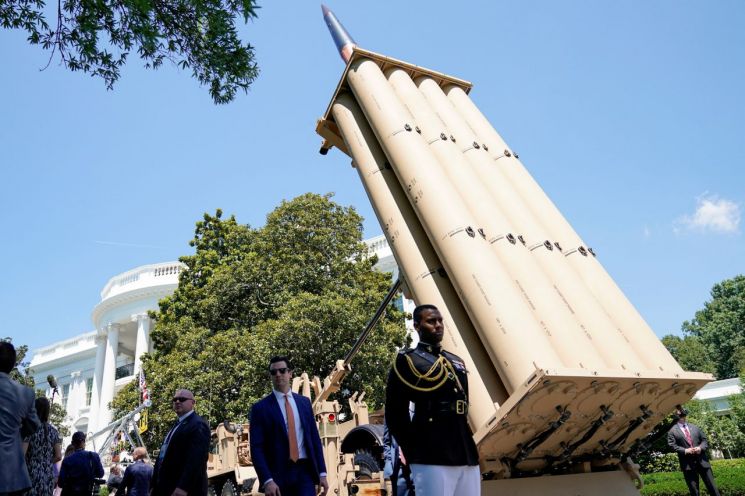 An image of a THAAD (Terminal High Altitude Area Defense) battery exhibited at an exhibition held at the White House in the United States in 2019. Photo by Reuters
It has been reported that more than 25% of the U.S. stockpile of THAAD (Terminal High Altitude Area Defense) missiles was depleted during the recent 12-day conflict between Israel and Iran. As the annual replenishment rate for THAAD missiles is just over 10 units, this significant reduction in stock has raised concerns that the operational readiness of THAAD defense systems deployed in various locations, including South Korea, may be compromised.
150 Missiles Expended in 12-Day Israel-Iran Conflict... "25% of Stockpile Used"
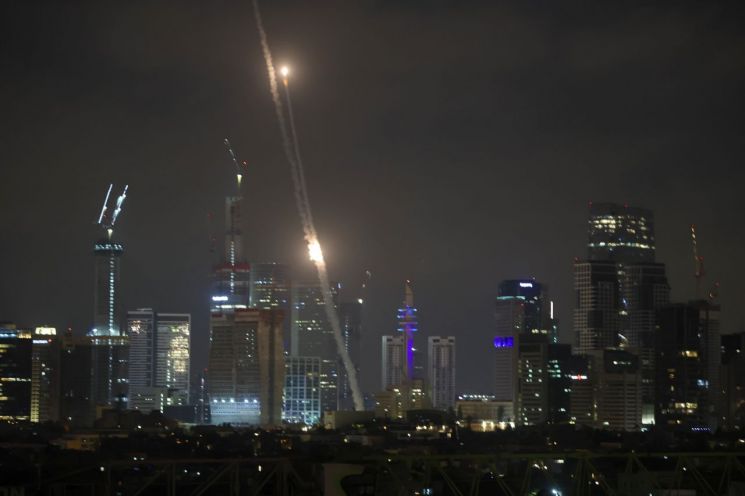 In June, an Israeli air defense missile intercepting an Iranian ballistic missile in Tel Aviv, Israel. Photo by EPA Yonhap News
On the 28th (local time), CNN cited U.S. Department of Defense sources, reporting that "the U.S. military expended 100 to 150 THAAD missiles during the 12-day conflict between Israel and Iran this past June," and that "this represents 25% of the total THAAD missile stockpile." A large number of missiles were reportedly used to intercept Iran's ballistic missiles and unmanned aerial vehicles (drones).
Previously, from June 13 to June 25, Israel and Iran engaged in a large-scale bombing operation over 12 days, deploying ballistic missiles, drones, and fighter jets to attack each other's capitals and major cities. During this period, Iran launched more than 570 missiles and suicide drones, and the Israeli military succeeded in intercepting approximately 86% of them.
It is known that U.S. THAAD missiles were heavily utilized to intercept Iranian ballistic missiles. THAAD is a mobile battery system capable of intercepting enemy ballistic missiles and drones by launching missiles in stages?from outside the Earth's atmosphere to medium-range, intermediate-range, and short-range targets. Each battery consists of six launchers and 48 interceptor missiles, with 95 personnel assigned per battery. The manufacturer is Lockheed Martin, and according to the U.S. Missile Defense Agency (MDA), the price per missile is $12.7 million (approximately 17.6 billion KRW).
Currently, the U.S. military possesses a total of nine THAAD batteries, with seven of them reportedly deployed and operational. Five batteries are stationed in Texas for homeland defense, one in Guam, and another in South Korea, operated by U.S. Forces Korea. Last year, two of the Texas-based THAAD batteries were sent to Israel.
U.S. Department of Defense Purchases 10 Missiles Annually... Concerns Over THAAD Battery Stock Shortages
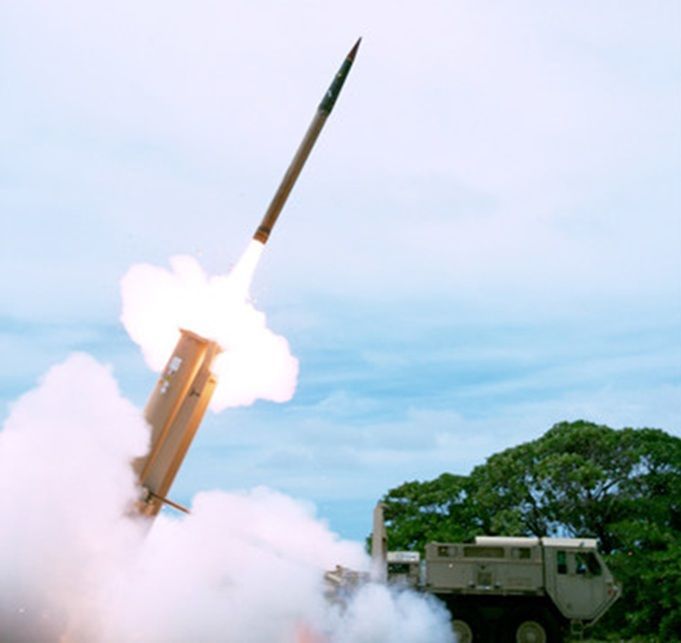
With a large number of THAAD missiles expended at once during the Israel-Iran conflict, concerns are growing that there may be a shortage of THAAD battery stockpiles deployed worldwide in the future. Since the U.S. military replenishes only about 10 THAAD missiles per year, a prolonged conflict in the Middle East could further increase consumption and potentially deplete the stockpile.
During the last fiscal year (October 1, 2023?September 30, 2024), the U.S. Department of Defense purchased 11 THAAD missiles from Lockheed Martin, and it plans to purchase 12 more during this fiscal year (October 1, 2024?September 30, 2025). The high unit price of a THAAD missile?over 17 billion KRW per missile?and the lengthy production time make it difficult to replenish large quantities at once.
Nevertheless, the U.S. Department of Defense has completely denied any issue regarding a shortage of THAAD missiles. Department of Defense spokesperson Kingsley Wilson stated at a briefing on the 27th (local time), "The U.S. military possesses the strongest force in history and is fully equipped to carry out any mission, anywhere in the world, at any time," adding, "If further proof is needed, one only needs to look at Operation Midnight Hammer and the complete elimination of Iran's nuclear capabilities."
CNN reported, "A Department of Defense official refused to provide information on THAAD stockpiles, citing operational security concerns, and emphasized that they are maintaining readiness to respond to all threats." However, missile defense experts have pointed out that the U.S. may not be able to sustain the enormous spending on THAAD and that there is serious concern over the acute shortage of THAAD missiles.
© The Asia Business Daily(www.asiae.co.kr). All rights reserved.



















