AI Overview Feature Appears in 18% of Search Queries
US Search Marketing Firm Conductor Analyzes 118 Million Cases
AI Answers First by Processing Existing Web Information
Original Creators Push Back: "Decreased Traffic and Revenue Loss"
These days, it is common to see AI-generated summary answers placed at the very top of Google search results, ahead of blogs or news articles. This is Google's 'AI Overview' feature, which displays information summarized by AI directly to users, even if they do not click on any links. While this makes information more accessible and faster to obtain, it has sparked controversy over 'free-riding,' as it deprives original content creators of both traffic and revenue. The structure is becoming entrenched where the creators of the content disappear, and only AI-processed summaries remain.
According to a report released this month by the American search technology company Conductor, about 18% of searches out of 118 million keywords worldwide displayed an AI Overview summary answer. This figure represents an increase of 112% compared to April and 29% compared to May, respectively. By sector, the exposure rate of AI summaries was highest in IT services (38%), healthcare equipment and supplies (36%), and educational services (35%). In other words, in these fields, users see AI-generated summaries first in 3 to 4 out of every 10 searches.
AI Overview is not automatically attached to every search query. Google explained, "If a query is simple, we judge that the existing search results are sufficient, and we only show AI Overview for queries that are complex or require further explanation." Google's proprietary AI model, Gemini, is used to make this determination. For example, simple information such as 'weather' or 'exchange rate' is displayed in the traditional format, but for more complex questions that require consideration of multiple conditions, such as 'low-carb desserts that diabetics can eat,' an AI summary is provided.
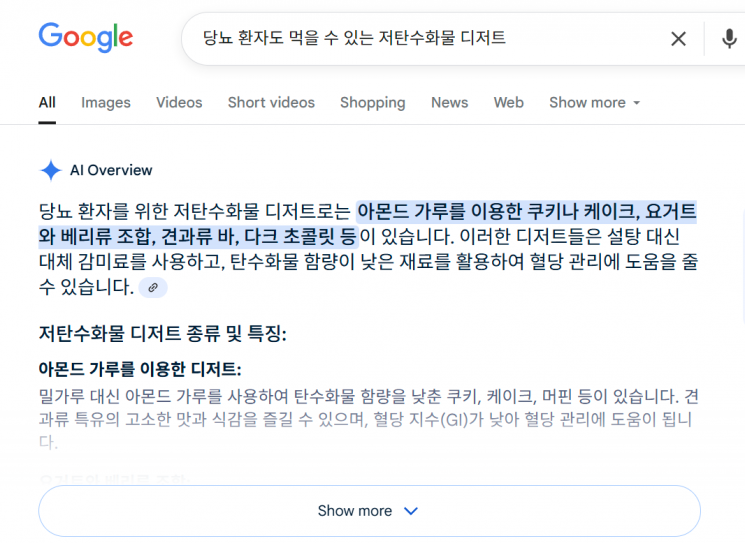 Google's 'AI Overview' is one of the core features of the search engine, providing AI-generated summary information at the top of search results based on the user's query. Photo by Google screen capture
The AI Overview feature was officially launched in May of last year, and currently supports more than 40 languages in over 200 countries worldwide. In a blog post this May, marking one year since the feature's launch, Google stated, "People are more satisfied with search results and search more frequently when using AI Overview. In major markets such as the United States and India, the types of searches where AI Overview is applied have increased by more than 10%."
However, the problem is that these changes may pose a crisis for existing content creators. When AI processes and presents information in the middle, users are less likely to click through to the original website, resulting in a decrease in both visitor numbers and revenue.
In fact, there is growing criticism around the world that although AI learns from and summarizes existing web content, it does not provide sufficient compensation or clear source attribution to the original creators.
In Europe, in June of this year, the Independent Publishers Alliance filed an antitrust complaint with the European Commission against Google, arguing that "AI Overview has significantly reduced publishers' traffic, readership, and revenue."
There is also strong backlash in the United States. In May of last year, the News Media Alliance, representing 2,200 media outlets, sent a letter to the Federal Trade Commission and the Department of Justice, requesting an investigation and claiming that "Google is using publishers' content to operate AI Overview without permission or compensation." In September of the same year, seven leading media experts at Harvard University's Nieman Journalism Lab also expressed concern, stating that "Google is repackaging content and republishing it without source attribution or revenue sharing."
Korea is no exception. The Korea Newspaper Association recently filed a complaint with the Fair Trade Commission, claiming that Naver's generative AI search service, 'AI Briefing,' similar to Google's AI Overview, unfairly used news content. The issues raised include unauthorized copying, distortion of the original context, and lack of source attribution.
An Jung-sang, adjunct professor at Chung-Ang University's Graduate School of Communication, pointed out, "If users get answers directly from the search results page, it is inevitable that traffic to the websites providing the original content will decrease," adding, "It is an ironic situation where the original creator of the information is actually marginalized."
© The Asia Business Daily(www.asiae.co.kr). All rights reserved.

















