"Tariffs to Be Set at 15-20% Range"
Basic Tariff Effectively Raised from 10% to 15%
Trump Cites Limits of Individual Negotiations with 200 Countries
On July 28 (local time), U.S. President Donald Trump announced that the United States would impose a flat tariff of 15-20% on countries that have not signed trade agreements with the U.S. With Japan and the European Union (EU) having accepted a 15% tariff in their trade agreements with the U.S., the basic tariff that the U.S. applies to the rest of the world has effectively been raised from the previous 10% to at least 15%.
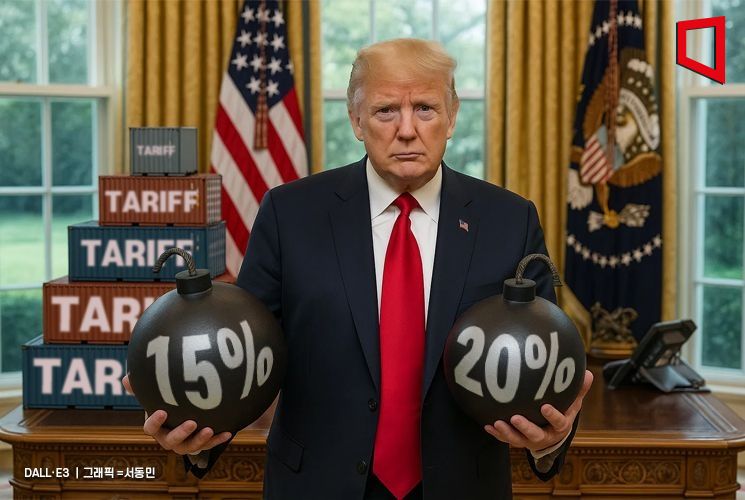
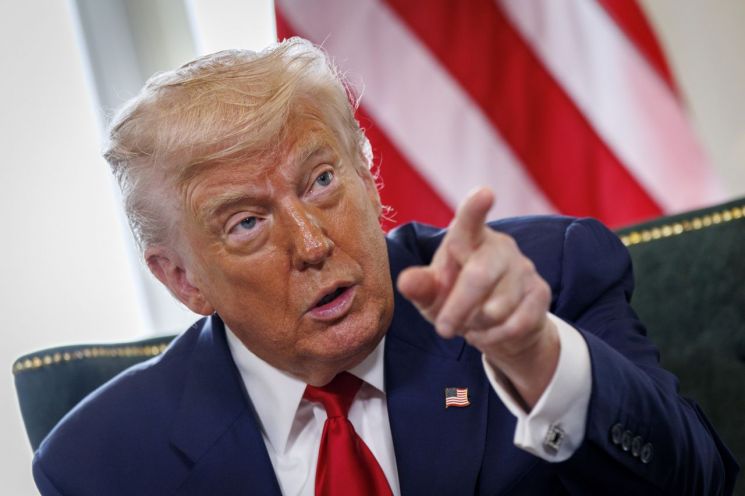
President Trump, speaking to reporters during a summit with U.K. Prime Minister Keir Starmer in Turnberry, Scotland, said, "It looks like tariffs will be set at around 15-20% worldwide," and added, "It will probably be 15% or 20%, one of those two." He also remarked, "I just want to be nice."
He further stated, "We will impose tariffs on the rest of the world," emphasizing, "If you want to do business in the United States, you have to pay." He explained that it is inevitable to apply a flat tariff to trading partners, saying, "We can't just sit and finalize 200 individual negotiations."
Earlier in April, President Trump announced a basic tariff of 10% on all countries, along with reciprocal tariffs reflecting each country's trade barriers, and has since been negotiating with various countries. With the expiration of the tariff deferral measure approaching on August 1, Japan and the EU have concluded negotiations with the U.S., and both will be subject to a 15% tariff. When asked by reporters the day before the conclusion of negotiations whether the EU could secure better terms than the 15% tariff, President Trump flatly replied, "That's not possible."
Currently, the U.S. is running a trade surplus, and only the U.K., which was the first to reach an agreement, is exceptionally subject to a 10% tariff. Considering President Trump's remarks and the recent flow of trade agreements, there is a prevailing assessment that the "15% tariff" has effectively become the new standard set by the U.S.
President Trump's comments came at a time when negotiations with major countries, including Korea, have yet to be finalized. Starting with the U.K., the U.S. has so far concluded trade agreements with Japan, the EU, Vietnam, Indonesia, and the Philippines. Negotiations are ongoing with Korea, Canada, and Mexico ahead of the implementation of reciprocal tariffs on August 1.
In this situation, for Korea, reaching an agreement below the "15% tariff" accepted by Japan and the EU is the ultimate goal in negotiations. However, in reality, it is difficult even to settle at the 15% level for both reciprocal tariffs and automobile tariffs. Since Japan and the EU have already accepted the 15% tariff in their negotiations with the U.S., it is virtually impossible for Korea, which is lagging in negotiation speed, to secure more favorable terms, no matter how many additional concessions are offered. Even the 15% tariff would require large-scale investments and market openings, as was the case with Japan and the EU, and there is a possibility that Korea could face additional demands, essentially as a "latecomer penalty." Previously, Japan presented a $550 billion investment plan in the U.S., while the EU pledged to purchase $750 billion worth of U.S. energy and make $600 billion in new investments. Korea is also using increased U.S. investment, market openings for agricultural products, and cooperation in shipbuilding as negotiation cards in an effort to lower its current 25% tariff to 15%.
Meanwhile, President Trump, addressing China, which began its third round of high-level trade talks with the U.S. on this day, pressured Beijing by pointing out that Japan, Indonesia, and the Philippines have opened their markets to the U.S., saying, "(China should) open its market as well." He specifically mentioned Japan's concessions, noting, "Japan has never opened its rice market to any other country before."
Regarding the imposition of item-specific tariffs on foreign pharmaceuticals, he said, "An announcement will be made soon."
© The Asia Business Daily(www.asiae.co.kr). All rights reserved.


















