18 Out of 20 Stations Flooded, Over 72,000 Cubic Meters of Rainwater Inundate Site
137 Water Pumps Mobilized for Drainage; Construction to Resume After Inspection
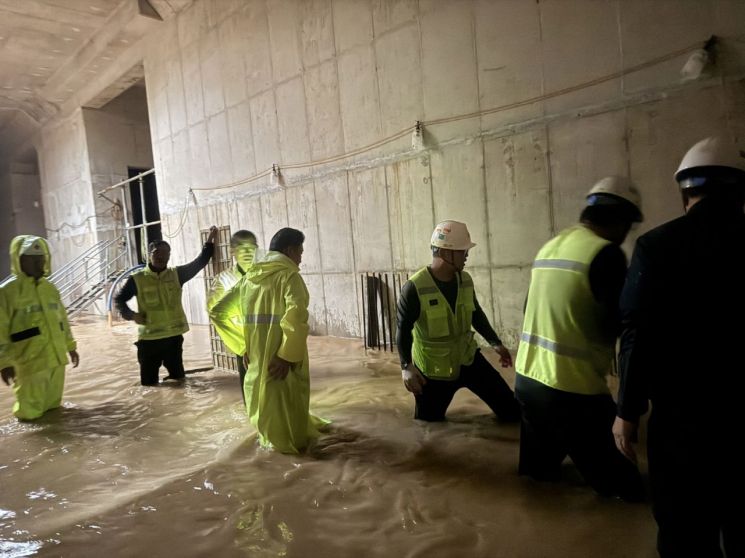 The Gwangju Metropolitan Rapid Transit Corporation has recently deployed 137 pumps to drain rainwater and is carrying out restoration work including repairing damaged interior facilities and cleaning after 18 out of 20 stations under construction on Metro Line 2 were flooded due to extreme heavy rain. Provided by Gwangju Metropolitan City
Restoration work is underway at the construction site of Gwangju Urban Railway Line 2, where 18 out of 20 stations were flooded due to the extreme heavy rainfall that hit Gwangju from July 17 to 19.
According to the city on July 28, 137 water pumps have been mobilized to quickly drain the rainwater, and repairs and cleaning of the damaged internal facilities are in progress. The city plans to conduct a safety inspection after assessing the extent of the flood damage and completing restoration work, before resuming construction.
Recently in Gwangju, record-breaking rainfall reached a daily maximum of 426 mm and a cumulative total of 528 mm, resulting in flooding at 18 out of 20 stations under construction for Urban Railway Line 2.
Rainwater rushed into the underground structures under construction, filling the main structures and the first and second basement levels of the stations with approximately 72,000 cubic meters of water. This volume is enough to submerge ten soccer fields to a depth of one meter. In particular, at stations located in low-lying areas, rainwater from the surrounding area pooled and rose up to the station entrances, resulting in flooding depths of up to 19 meters.
Fortunately, when the heavy rain warning was issued on July 17, 914 construction workers and 134 pieces of equipment were quickly evacuated to the surface, so there were no casualties or equipment damage.
The Urban Railway Construction Headquarters, together with the construction company and the supervisory team, mobilized 137 water pumps to drain the rainwater and implemented 24-hour patrols across the entire Line 2 section to ensure rapid restoration of flood damage and prevent safety accidents.
As a result, drainage work at most stations has been completed, and repairs and cleaning of internal facilities damaged by the rainwater are ongoing. The construction company has begun to accurately assess the extent of the damage. The city plans to resume construction after completing restoration and repair work and conducting a safety inspection at the construction site.
The Urban Railway Construction Headquarters stated that once construction is complete, flooding at stations will no longer occur, even in heavy rainfall events like this one. This flooding was caused by the temporary inflow of rainwater through the road decking, work passages, and the upper parts of external entrances at the construction sites. Once construction is finished, most routes for rainwater to enter the interior will be blocked. The headquarters emphasized that any rainwater entering through stations and ventilation shafts connected to the outside will be continuously drained using sump pits and pump facilities, so there is no concern about future flooding.
The Urban Railway Construction Headquarters is also continuing site patrols to prevent ground subsidence, potholes, and water leakage in water and sewage pipes near the construction site, which may occur after heavy rainfall. In addition, if potholes are discovered around the construction site, emergency repairs will be carried out immediately.
Oh Younggeol, head of the Urban Railway Construction Headquarters, said, "Rapid restoration is underway in the flooded sections inside the station structures," and added, "We will make every effort to ensure the safe construction of the urban railway by continuously inspecting and responding to any issues such as potholes that may occur in above-ground sections."
© The Asia Business Daily(www.asiae.co.kr). All rights reserved.

















