Gyeonggi Province launched the “Gyeonggi Climate Platform” (climate.gg.go.kr), an integrated environmental information management and analysis system, on July 28.
The Gyeonggi Climate Platform is the first high-precision, comprehensive climate, environment, and energy platform developed by a local government in South Korea. It integrates and analyzes various types of environmental information, including aerial LiDAR, satellite imagery, artificial intelligence (AI), and big data, and provides this information to users.
Gyeonggi Province plans to open this information to the public, businesses, and residents, positioning the platform as a central hub for “digital climate governance” through public-private cooperation.
On the same day, Gyeonggi Province held a launch event for the Gyeonggi Climate Platform at the provincial government office in Gwanggyo, Suwon. The event included discussions on ways to vitalize the platform with climate and environmental experts from the Gyeonggi Research Institute, Gyeonggi Climate Crisis Response Committee, Korea Institute of Civil Engineering and Building Technology, Korea Institute of Geoscience and Mineral Resources, Korea Environment Institute, and Climate Solution.
Development of the Gyeonggi Climate Platform began in December 2023 and was completed in July 2025.
The main services provided include: ▲ carbon emissions and absorption by region ▲ metropolitan urban ecological status maps ▲ spatial information such as energy consumption by building unit ▲ analysis of renewable energy generation ▲ climate management services for small and medium-sized enterprises ▲ climate disaster status and risk area prediction, among others.
Public institutions can utilize the policy support information system of the Gyeonggi Climate Platform for policy formulation. For example, by integrating spatial information such as aerial LiDAR and satellite imagery, they can designate landslide-prone areas and establish disaster response measures. In addition, the platform enables scientific data analysis-based decision-making and tracking of carbon neutrality goal implementation through carbon absorption and emission management, as well as spatially based solar and carbon information.
Businesses can use the climate management service to receive support for international standard-based carbon accounting and energy management services without requiring specialized knowledge or separate investments. By simply registering basic workplace information, data is automatically entered, and the company’s carbon emissions and energy diagnosis reports are provided immediately. In particular, by analyzing electricity usage patterns, the platform recommends the most cost-effective electricity rate plans, enabling businesses to reduce their electricity bills.
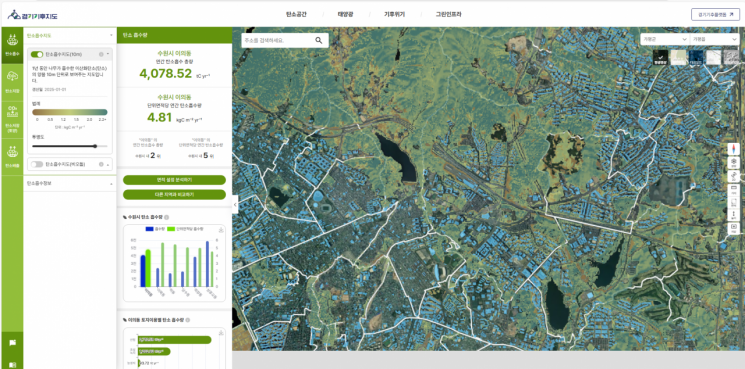
Residents can access climate crisis information, such as climate risk assessment results for their surroundings categorized by grade, and carbon neutrality status, providing practical information for voluntary climate crisis response. For example, by searching for a region they plan to visit, users can view the current landslide risk grade or extreme rainfall risk grade for that area. If the area has a history of landslides or there are forecasts for heavy rain or typhoons, users can adjust their visit plans accordingly. On days when a heatwave warning is issued, users can easily locate nearby heatwave shelters on the map.
Additionally, the Gyeonggi Climate Platform provides a carbon spatial map. Users can view annual carbon emissions per unit area for each region, which can serve as a basis for encouraging climate action in daily life, such as using public transportation or saving energy. Through solar panel installation simulations for building rooftops and unused land, users can also experience the tangible economic benefits of adopting renewable energy.
The Gyeonggi Climate Platform features a collaborative space (LAB) for developing data-driven AI models, including generative AI. Through OpenAPI and AI models, users can organize data and perform secondary tasks. An English version of the platform is also being prepared. Anyone can access the platform by visiting the online address (climate.gg.go.kr).
Ko Youngin, Vice Governor for Economy of Gyeonggi Province, stated at the event, “Securing highly reliable data is a prerequisite for solving climate issues,” and added, “By integrating climate and energy data, the Gyeonggi Climate Platform will serve as a ‘comprehensive climate diagnosis report’ that presents optimal climate crisis response strategies in the future.”
Meanwhile, Kim Dongyeon, Governor of Gyeonggi Province, announced the plan to establish a climate crisis response platform in August 2023, stating, “A platform will be created where you can see at a glance the amount of energy and carbon emissions from each building in Gyeonggi Province, the level of carbon reduction, and the potential capacity for renewable energy production.”
Gyeonggi Province is currently pursuing the “Three Major Climate Projects of Gyeonggi,” which include the Gyeonggi Climate Platform, the climate satellite scheduled for its first launch in November, climate insurance for all residents, and a resident benefit-sharing climate fund.
© The Asia Business Daily(www.asiae.co.kr). All rights reserved.

















