Tariff Rate Reduction as Leverage: Maximum Pressure on U.S. Investment
Deadline and Target Reduction Rate of 15%: Final Tug-of-War with the U.S.
Deputy Prime Minister for Economic Affairs and Minister of Economy and Finance Koo Yooncheol and U.S. Treasury Secretary Scott Besant will sit down at the negotiating table on the 31st. This will be the first and last round of talks, taking place just one day before the mutual tariff imposition deadline (August 1) announced by President Donald Trump. Unlike Japan and the European Union (EU), which reached agreements after a total of eight rounds of high-level negotiations, or China, where an agreement is within reach, this is effectively Korea's first high-level tariff negotiation. This meeting will serve to finalize the negotiation draft prepared over the weekend by Minister of Trade, Industry and Energy Kim Jeonggwan and Chief Trade Negotiator Yeo Hangoo, whose ministry is responsible for trade. The main agenda items are expected to include the scale of Korean investment in the U.S., cooperation in the shipbuilding industry?considered Korea's strategic bargaining chip?and further opening of the agricultural and livestock market.
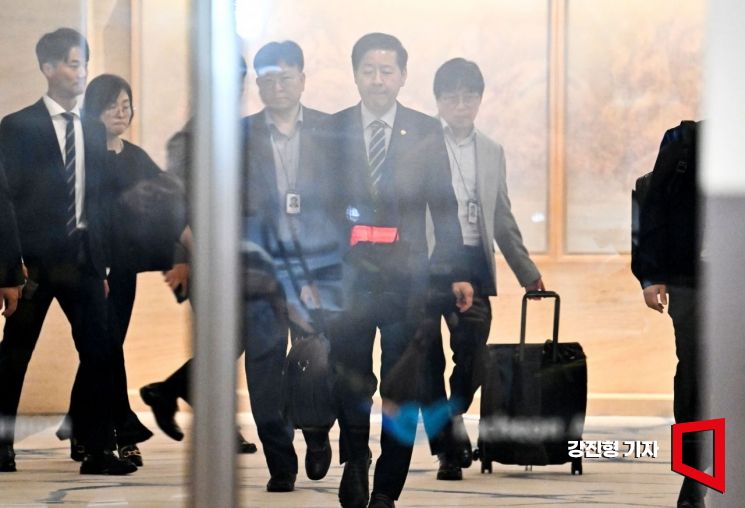 On July 24, when the US requested a sudden postponement of the Korea-US 2+2 trade talks, Deputy Prime Minister and Minister of Economy and Finance Koo Yoonchul canceled his departure and left Incheon International Airport Terminal 2. 2025.7.24. Photo by Kang Jinhyung
Tariff Rate Reduction as Leverage: Maximum Pressure on U.S. Investment
Korea is reportedly not planning to increase its investment in the U.S. beyond $100 billion (approximately 138 trillion won). However, the U.S., leveraging tariff rate reductions as a bargaining chip, is expected to exert maximum pressure on Korea. The U.S. has argued that while Korea's economy is about one-third the size of Japan's?which pledged $550 billion in investment in the U.S.?Korea's trade surplus with the U.S. stood at $69.9 billion at the end of last year, similar to Japan's $69 billion. This amounts to a demand that Korea present an investment proposal equivalent to Japan's. Previously, on the 22nd (local time), President Trump repeatedly revised the investment amount agreed upon by working-level officials during negotiations with Japan, adding as much as $150 billion. After concluding the tariff negotiations with Japan, President Trump openly pressured Korea to increase its investment in the U.S., stating, "You can pay money and lower tariffs."
Both the $550 billion agreed to by Japan under President Trump's pressure and the $400 billion reportedly first proposed by the U.S. to Korea are considered unrealistic burdens for Korea, suggesting that reaching an agreement on the amount will be difficult. It also remains to be seen whether Korea's existing investment plans?including Hyundai Motor's official announcement in March of a $21 billion investment in the U.S. through the construction of a steel mill in Louisiana?will be included in Korea's investment pledge. A government official stated, "Since Korea does not have the capacity to increase its investment in the U.S. to the level of Japan or the EU ($600 billion), the key will be to find a mutually satisfactory agreement and bargaining card in areas where Korea has strengths, such as shipbuilding."
From the outset of the high-level tariff negotiations, the U.S. has pushed for "expanded balance" as the main framework, making further opening of the agricultural and livestock market a key agenda item. The expanded balance strategy aims to correct the trade deficit by increasing Korea's imports and investments without reducing Korean exports. In this process, the U.S. is demanding major concessions, such as the import of 30-month-old beef and increased rice imports. On the 26th, the Presidential Office announced that agricultural products are included in the tariff negotiation items between Korea and the U.S., raising speculation that there may be room for negotiation on the additional opening of the agricultural and livestock market, which had previously been considered a red line. Minister of Trade, Industry and Energy Kim Jeonggwan reportedly presented a more advanced proposal on agricultural and livestock market opening to the U.S. side during working-level negotiations over the weekend. With U.S. Secretary of Commerce Howard Lutnick stating that tariffs on semiconductors based on Section 232 of the Trade Expansion Act "are expected to be announced in two weeks," semiconductor tariffs are also likely to be a key issue in the Korea-U.S. tariff negotiations. In addition, security issues such as defense cost-sharing adjustments and advanced technology cooperation are expected to be widely discussed at the negotiation table. On the 31st, Minister of Foreign Affairs Cho Hyun will also meet with his U.S. counterpart, Secretary of State Marco Rubio.
Deadline and Target Reduction Rate of 15%: Final Tug-of-War with the U.S.
In the early morning, the European Union (EU) also reached an agreement with Japan on a 15% tariff rate, making 15% Korea's target as well. If the agreement is successful, the tariff rate Korea will receive will be 15%. The Korean government aims to reach an agreement at the 15% rate that the U.S. has decided to apply to the EU and Japan. The Presidential Office has been holding a series of meetings over the weekend, sharing updates from the negotiation site in the U.S. and formulating strategies. However, since Korea has been pushed to the back of the negotiation queue behind China and the EU?Washington's primary negotiating partners?and is entering the talks just one day before the mutual tariff imposition deadline, conceding all key negotiation points such as the "deadline" and "target reduction rate" to the U.S., the situation is extremely disadvantageous. Therefore, Korea cannot afford to let its guard down until the very end.
Experts point out that President Trump, who is seeking reelection, will want to secure achievements he can tout domestically, so Korea should find ways to minimize its actual losses while offering cards that Trump can claim as successes. Yang Jooyoung, Director of Trade Policy at the Korea Institute for Industrial Economics and Trade, said, "Given that President Trump learned from his first term that China did not fulfill its agricultural purchase commitments under the U.S.-China trade agreement, it will be crucial for Korea to present concrete and actionable plans for when, how, and in what manner it will implement its investment (import) commitments in response to President Trump's demands."
© The Asia Business Daily(www.asiae.co.kr). All rights reserved.


















