Institutionalizing a Financial Foundation Gains Momentum
"Budget Alone Is Not Enough"
Laying the Groundwork for Practical Cooperation
As the deadline for tariff negotiations between South Korea and the United States approaches, the establishment of a new fund to enhance the effectiveness of cooperation in the shipbuilding industry is drawing attention. Both the ruling and opposition parties have proposed special laws for the shipbuilding industry, each including provisions for the establishment of a statutory fund to support practical cooperation such as technology transfer and joint construction. With increasing demand for Korea-US cooperation, there is a growing movement in Korea to institutionalize a financial foundation that can support joint investment and cost-sharing.
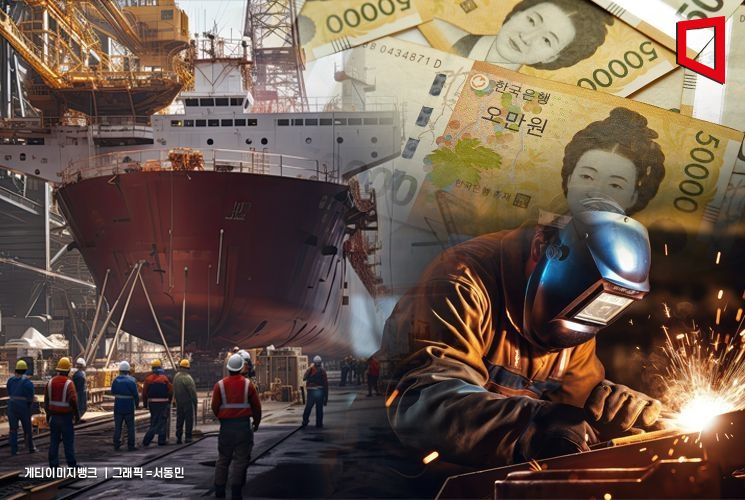
According to the National Assembly's legislative information system on July 28, Kim Gi-hyeon, a lawmaker from the People Power Party, submitted the "Shipbuilding Industry and Shipbuilding Technology Promotion Act" on July 23 as the lead sponsor. This is the first special law for the shipbuilding industry proposed by the opposition since the inauguration of the Lee Jaemyung administration, and together with the "Future Shipbuilding Industry Special Act" submitted by Heo Seongmu of the Democratic Party on July 7, it marks the first time that both parties have submitted related bills. By designating the shipbuilding industry as a strategic industry, both ruling and opposition parties are responding to trade issues through an institutionalized support system.
Heo's bill focuses on providing national-level support for the entire shipbuilding industry, including demonstration support for autonomous and eco-friendly ships, defense exports, offset procurement, technology transfer, international joint development, and MRO (maintenance, repair, and overhaul). In particular, it includes a plan to establish the "Maritime Defense Export Promotion Fund" as a statutory fund to provide the financial foundation for these initiatives. The intention is to ensure stable cooperation projects with the United States through a permanent fund system linked to the National Finance Act, rather than through one-off support.
The reason the fund provision is receiving attention is that it can support the willingness to cooperate with a structure that enables practical action. Rather than simply presenting a policy direction, it establishes an institutional mechanism through which the government can partially compensate the risks and costs that companies must bear when technology transfer or joint construction is actually required. This can serve as a clear signal of Korea's commitment to cooperation for the US side and can also have a real impact on strengthening Korea's negotiating position.
Democratic Party lawmaker Lee Eonju also proposed the establishment of a fund in the "Advanced Shipbuilding Industry Competitiveness Enhancement Act" submitted in March. In connection with the tariff negotiations, a provision that draws attention is the government's support for part of the construction costs of ships ordered by domestic shipping companies through the Marine and Fisheries Fund. This is evaluated as a negotiation logic that can induce orders to domestic shipyards to maintain the production base, while transferring technology but retaining construction capabilities within Korea.
Heo emphasized, "It is difficult to manage the transition of the shipbuilding industry with only the budget," and added, "Establishing a fund is necessary for continuous and stable support." A representative from Kim's office also stated, "It is time for policy responses across the entire shipbuilding industry, including taxation and finance," and "This bill will also send a positive signal in the negotiations." However, since similar special laws for major industries such as semiconductors, secondary batteries, and displays are already pending in the National Assembly's Trade, Industry, Energy, SMEs, and Startups Committee, there is a possibility of controversy over fairness if only the shipbuilding special law is passed independently. A National Assembly official said, "Several industries may be discussed as a package at once."
The Ministry of Trade, Industry and Energy stated that it has not officially reviewed the establishment of a fund or the creation of a joint fund. However, it did reveal that internally, it has considered such ideas at an unofficial level by referencing overseas cases such as the US SHIPS Act (Shipyard Investment Act). An official from the ministry said, "No specific funding structure or negotiation plan has been finalized."
Nevertheless, the view that the shipbuilding industry is an exceptional case with sufficient legislative validity is spreading. This is because, regardless of order performance, structural crises such as labor shortages, the withdrawal of partner companies, and delays in the transition to smart yards have accumulated, and China is catching up even in eco-friendly high value-added ship technology. An industry official said, "Shipbuilding is an industry with a clear cycle, so it is important to secure basic strength to prepare for downturns."
There is also a recognition that cooperation with the United States will not be easy. Industry insiders say, "Since the US shipbuilding ecosystem has collapsed, simple cooperation has its limits," and "A multi-layered approach, including shipyard acquisition, technology transfer, and dispatch of personnel, must be pursued simultaneously." In particular, while the transfer of core technologies is difficult, it is generally agreed within the industry that know-how related to the construction and operation of smart yards can be shared.
© The Asia Business Daily(www.asiae.co.kr). All rights reserved.

















