Frequent Proposals via Hotline with Professional Organizations
Three Deregulation Measures from First Half Now Implemented
Improved Criteria for Household Division in Water Billing, and More
The Seoul Metropolitan Government is launching a "365 Regulatory Innovation Hotline" in collaboration with professional organizations to pursue strong deregulation measures. The aim is to move away from the traditional approach, which relied on civil servants to identify regulatory issues, and instead to establish a system for discovering and improving regulations in partnership with a diverse range of professional organizations.
On July 28, the Seoul Metropolitan Government announced that through the "365 Regulatory Innovation Hotline," it will maintain ongoing communication with professional organizations across a total of nine sectors, including architecture, transportation, welfare, economy, and environment.
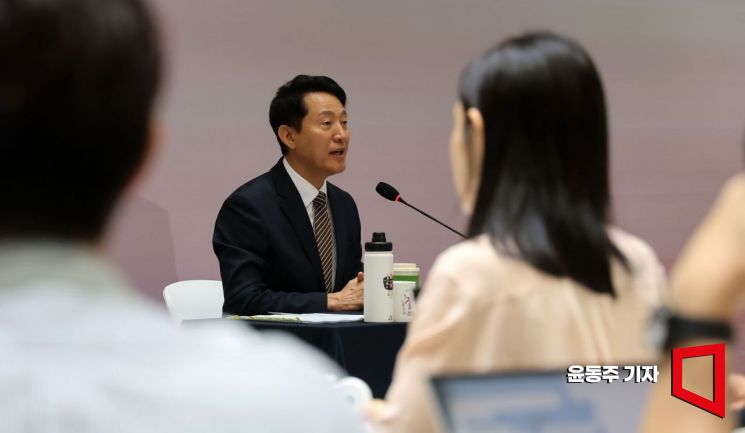 Seoul Mayor Oh Sehoon holds a press conference on the 3rd anniversary of his inauguration at Seoul City Hall on July 16, 2025. Photo by Yoon Dongju
First, the city will establish dedicated email addresses for each sector to receive suggestions at any time. It also plans to designate dedicated teams for regulatory improvement in each field in order to create a rapid response system. Email suggestions will be accepted for all types of regulations, including laws, ordinances, internal guidelines, as well as "shadow regulations" and "behavioral regulations" that lack legal basis. The regulatory improvement departments will regularly review the content and assess the necessity for action.
By September, the Seoul Metropolitan Government will hold individual meetings with professional organizations at least twice a week, and from August, it will also organize integrated meetings by industry and region to actively identify joint regulatory issues.
On this day, the Seoul Metropolitan Government also announced the implementation of three deregulation measures designed to resolve inconveniences and issues in citizens' daily lives. First, for multi-family housing complexes that use a single water meter, water fees will now be calculated based on the actual number of resident households rather than the number of units approved in the building permit. Previously, in such housing complexes, if there were many households, the water fee was calculated by multiplying the usage per unit (based on the building permit) by the number of households, with discounts applied to ease the burden. However, when the actual number of resident households was lower, residents could not file for household division, and even if they belonged to vulnerable groups, they were unable to receive water fee discounts if the actual number of households was less than the number listed in the building permit.
The city will also improve the process for supporting Hanok repair costs and extend Saturday operating hours at city-run senior welfare centers. As part of the 22nd deregulation measure, "Extension of Public Facility Usage Periods," starting August 1, the closing time for Saturday operations at 19 city-run senior welfare centers in Seoul will be extended from 1:00 p.m. to 6:00 p.m.
The "Enforcement Rules of the Ordinance on the Promotion of Hanok and Other Architectural Assets in Seoul" have also been revised, simplifying the procedure for supporting Hanok repair costs. Previously, after completing repairs, Hanok owners had to submit a report to the district office, undergo document review, and go through a committee process, which sometimes delayed the payment of support funds. With this improvement, the process is expected to be significantly shortened. From now on, Hanok owners will submit the completion report directly to the Seoul Metropolitan Government, eliminating the district office step. Upon receipt of the report, the city will conduct on-site inspections and document reviews simultaneously, and finalize the support amount through a review by an expert committee.
Jung Sanghoon, Director General for Planning and Coordination at the Seoul Metropolitan Government, stated, "It is most important that deregulation brings about practical and tangible changes in citizens' lives," and added, "We will continue to pursue regulatory innovation that citizens can feel in their everyday lives, injecting vitality into people's livelihoods and the economy."
© The Asia Business Daily(www.asiae.co.kr). All rights reserved.

















