One Month After 6.27 Regulations: Checking Seoul's Apartment Market
Transaction Volume in Seoul Apartments Down 78% Compared to a Month Ago
Increase in Seoul Apartment Sale Prices Also Slightly Reduced
Jeonse Exit Loan Limited to 100 Million Won... Growing Housing Anxiety for Tenants
"After the loan regulations, it's as if cold water was poured over the market. Inquiries from buyers have completely stopped." (A realtor in Haengdang-dong, Seongdong-gu)
"Sellers are not lowering their asking prices, and buyers are canceling transactions, saying they can't get loans." (A realtor in Chang-dong, Gangbuk-gu)
One month after the implementation of the 6·27 loan regulations, the number of apartment transactions in Seoul has plummeted and buying sentiment has weakened. This phenomenon has been particularly pronounced in areas with clusters of high-priced apartments. While a halt in transactions can lead to price declines, sellers are holding out, resulting only in a reduced pace of price increases. In the jeonse and monthly rental market, as landlords' access to funds has been blocked, anxiety among jeonse tenants about their housing situation has grown even further.
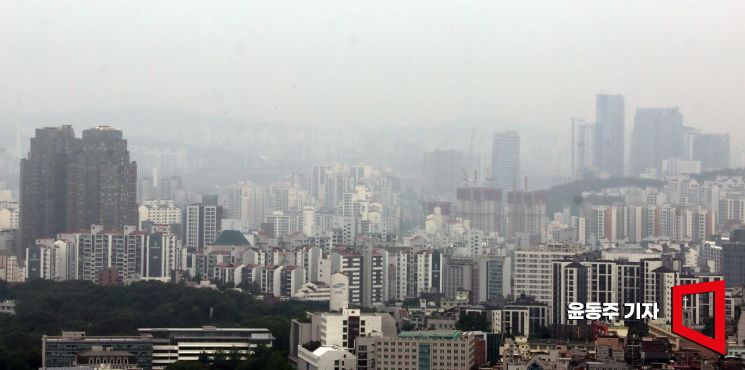 Photo of an apartment complex in Mapo District viewed from Namsan, Seoul. 2025.06.27 Photo by Dongjoo Yoon
Transaction Volume Down 78% Compared to a Month Before Loan Regulations
According to the Ministry of Land, Infrastructure and Transport's actual transaction price system on the 28th, the number of apartment sales in Seoul during the month after the loan regulations (June 28 to July 26) was 2,848, which is over 10,000 fewer than the 13,079 transactions in the month before the regulations (May 28 to June 27). The transaction volume dropped by 78.2% in just one month.
The rate of increase in sales prices has also slowed. According to KB Real Estate's July housing price trends, Seoul apartment prices rose by 1.28%. This is a smaller increase compared to the previous month, which had recorded the highest rate since 2021 at 1.43%.
The index reflecting buyers' outlook on real estate prices has turned to a 'decline.' The Seoul sale price outlook index was 98.0 in July, down 35.9 points from the previous month's 133.9. An index below 100 means that the proportion of those expecting a price drop is higher. A monthly drop of more than 35 points is the largest ever recorded.
Buyers Step Back, Sellers "Waiting and Watching"
In areas such as the three Gangnam districts, Mapo, and Gangdong, where buying sentiment had been strong before the loan regulations, buyer interest has waned. With the mortgage loan limit capped at 600 million won, it has become difficult to purchase properties priced over 2 billion won.
The head of realtor C in Apgujeong-dong, Gangnam-gu, explained, "There are no transactions at all. There aren't many urgent sales, and while some sellers are lowering their asking prices slightly, even a 500 million won price cut isn't enough to sell right now." A representative from realtor D near Jamsil-dong, Songpa-gu, also said, "Before the loan regulations, there were buyers coming to see Jamsil Els 84㎡ units listed at 3.3 billion won, but now demand has dropped significantly. Since the regulations, some properties are being listed for urgent sale at 100 to 200 million won cheaper. However, homeowners are generally choosing to wait and see how the regulations play out and are putting off transactions for now."
However, there is no clear downward trend in prices. A representative from realtor E near Olympic Park Foreon in Gangdong-gu said, "There have been cases where people gave up buying homes in other areas because they couldn't sell their own due to the loan regulations, but asking prices are still soaring. Homeowners are not in a hurry, and since some deals are still happening even at higher prices, they are not lowering their prices."
The head of realtor F in Seongsan-dong, Mapo-gu, said, "Although the market is in a lull, people have experienced various real estate policies and regulations before, and they believe this loan regulation won't last long since it was introduced in a supply-constrained situation. Sellers are also reluctant to adjust prices and are trying to hold out as long as they can."
"Blocking Jeonse Exit Loans Is Excessive"
Confusion is growing in the jeonse and monthly rental market. As the limit for landlords' jeonse tenant exit loans has been lowered to 100 million won, landlords are finding it difficult to return deposits, increasing anxiety among tenants.
The head of realtor G in Ichon-dong, Yongsan-gu, said, "Some landlords are now considering selling their homes because getting loans has become difficult and they need to return deposits to tenants. There was even a case where someone was worried their home might go to auction as the jeonse exit loan was restricted and the lease expiration was approaching."
The head of realtor H in Banpo-dong, Seocho-gu, pointed out, "For owners of two homes, jeonse exit loans are not available at all, so there are cases where tenants cannot move because they can't get their deposits back. This seems to only cause conflict between landlords and tenants, so this part needs to be corrected."
Experts: "Transaction Decline Will Continue"
Experts believe that the decline in transactions will continue and that the pace of price increases will remain limited. Yoon Sumin, real estate specialist at NH Nonghyup Bank, said, "While previous loan regulations targeted the three Gangnam districts, this time the regulations have had more impact on Mapo, Seongdong, and Gangdong. I think the results are in line with the goal of stabilizing the rate of price increases. Going forward, I expect government regulations may focus more on jeonse loan restrictions. The most necessary measure is, without question, increasing supply."
Ham Youngjin, head of the real estate research lab at Woori Bank, predicted, "The decline in transaction volume will likely last at least one or two more quarters. The market needs time to adjust to the loan regulations. The delay in interest rate cuts is also affecting the recovery of transaction volume. In regulated areas, I expect some demand-suppression policies to continue. Since demand keeps flowing into Seoul, I think there will be complex measures in the future, including those to resolve unsold homes in regional areas."
© The Asia Business Daily(www.asiae.co.kr). All rights reserved.
![Clutching a Stolen Dior Bag, Saying "I Hate Being Poor but Real"... The Grotesque Con of a "Human Knockoff" [Slate]](https://cwcontent.asiae.co.kr/asiaresize/183/2026021902243444107_1771435474.jpg)
















