Oversupply and Plunging Demand Impact the Market
Secondhand Vessel Transactions Also Slow Down
HMM Expected to Report Weak Performance
Although the shipping industry is entering its peak season, there are growing concerns that it may fall into a slump as global shipping rates have declined for seven consecutive weeks. As market sentiment has cooled, even the volume of secondhand vessel transactions has recently slowed down.
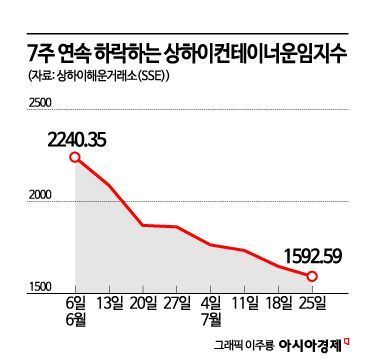
According to the shipping industry on July 28, the Shanghai Containerized Freight Index (SCFI), which reflects the freight rates on global shipping routes, stood at 1,592.59 last week, marking a decline for the seventh consecutive week. This represents a drop of 54.31 points compared to the previous week’s 1,646.90. The continued decline in shipping rates is fueling a sense of crisis, especially as the industry has entered the traditionally strong third quarter. Typically, the SCFI rises from the end of June, just before the third quarter, until just before the off-season fourth quarter, but this year the situation is not favorable.
Both 'increased supply' and 'decreased demand' are cited as reasons for the falling rates. On the supply side, a large number of vessels ordered during the COVID-19 pandemic are being deployed on shipping routes, further driving down rates. According to Korea Ocean Business Corporation (KOBC), the total predicted container ship fleet for this year is 3.28 million TEU (1 TEU is one 20-foot container), an increase of 6.3% compared to last year. This is the highest value among the projected growth rates for 2026 to 2028 (3.2% to 5.1%), indicating signs of oversupply.
Logistics demand is observed to be dropping sharply due to the impact of U.S. tariff policies. As 'front-loading exports' (shipping goods before tariffs are imposed) driven by tariff uncertainties have effectively ended in the second half of this year, demand has shifted to a downward trend. In the second quarter, demand had temporarily increased as a surge of front-loaded shipments from China entered the market. According to shipping information provider Vizion, on May 14, right after the U.S.-China tariff agreement, container bookings for the China-to-U.S. route reached 21,530 TEU, a 277% increase compared to the previous week.
As a result, even HMM, the largest shipping company in Korea, is expected to post weak results. According to financial information provider FnGuide, HMM’s operating profit for the second quarter is projected to be 393.8 billion KRW, a decrease of 38.9% compared to the same period last year. An HMM official stated, "The volume of shipments from Asia, which surged in April and May, has dropped sharply since last month. Even during the industry’s peak season, the SCFI continues to show weakness, so it will be difficult for this year’s results to improve compared to last year."
As market conditions continue to deteriorate, inventories of secondhand vessels are piling up. According to the 'First Half 2025 Ship Sale and Purchase Market Trends' report published by KOBC on July 24, the number of container ship transactions in the first half of this year fell by 24.8% compared to the same period last year, clearly indicating a weakening market. The report stated, "While sellers are actively listing vessels for sale, buyers are bidding only selectively. It is highly likely that cautious, price-focused transactions will continue going forward."
© The Asia Business Daily(www.asiae.co.kr). All rights reserved.


















