Weekly Training Council Meetings to Discuss Return Plans
Ensuring Continuity of Training and Addressing Role Division with PA Nurses
Patient Groups: "Apologies Needed for Collective Action Holding Public Lives Hostage"
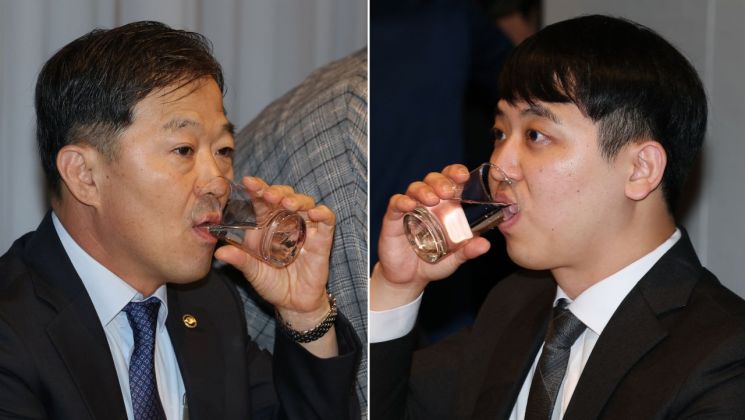 On the 25th, Lee Hyunghun, the 2nd Vice Minister of Health and Welfare (left), and Han Sungjon, the Emergency Committee Chairman of the Korean Intern Resident Association (Daejeonhyeop), attended the first meeting of the training council held at the Plaza Hotel in Jung-gu, Seoul. Photo by Yonhap News
According to the medical community on July 28, following the concrete plans for the return of medical students next month, it is expected that residents will return to hospitals and resume their training in September. If this happens, the medical gaps that occurred after residents collectively resigned in February last year in opposition to the increase of 2,000 medical school seats will be filled one by one.
The government and the medical community launched a 'training council' for residents on July 25 to discuss their return, and agreed to hold weekly meetings to coordinate specific conditions for their reinstatement. Lee Hyung-hoon, the Second Vice Minister of Health and Welfare, said, "We will communicate and cooperate to establish a plan for the return of residents to training that meets the expectations of the public."
The key issue is how many residents will actually return. It is already known that a significant number of residents have chosen military service or employment at private clinics, opting to remain as general practitioners rather than specialists. Many have also entered the dermatology and cosmetic fields with the goal of opening their own practices, so even if recruitment notices for residents are posted, the number of applicants may be lower than expected.
A resigned resident from a regional university hospital said, "Medical students and residents also suffered due to the previous administration's unilateral policy push, so measures to normalize the situation should not be dismissed as preferential treatment," and added, "Rather than being exploited as a high-intensity, low-wage workforce as before, more residents are likely to choose whether to continue their training based on their own circumstances."
There is also the issue of dividing roles with Physician Assistant (PA) nurses who have been filling the vacancies left by residents. In some hospitals, as internal discussions continue on how to redefine the roles of PA nurses if residents return, it has been reported that nurses are expressing dissatisfaction and anxiety.
A nurse at a university hospital in Seoul said, "When the medical-government conflict first began and there was a shortage of hands, even ward nurses were forced to receive PA training and were assigned to operating rooms," and added, "Now that we have finally adjusted, we are being told to return to three-shift ward work. It makes me feel like we are only used when needed and then discarded."
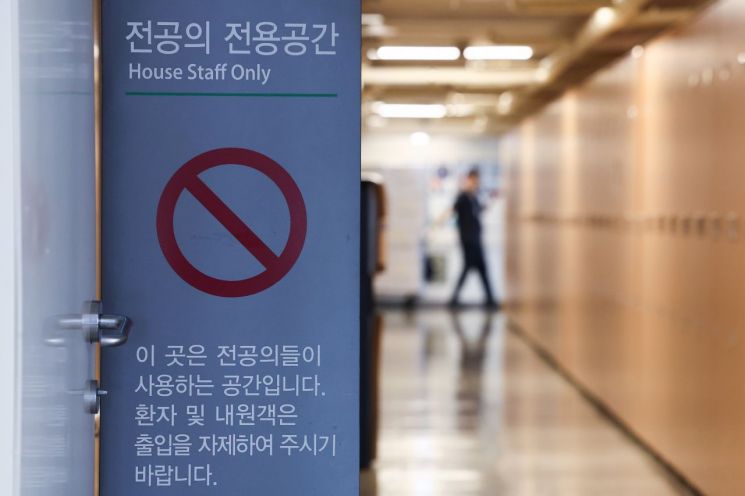 As residents who had left medical sites due to legislative conflicts reached an agreement on their demands for return discussions, a signboard indicating a resident-only area was installed at a large hospital in downtown Seoul on the 20th. Photo by Yonhap News
The government is also considering a plan to allow resigned residents who have not yet completed military service to return to hospitals and postpone enlistment until after they finish their training. Residents, upon resignation, are immediately classified as waiting for conscription and must enlist as soon as they are notified. However, if they return to hospitals, they are requesting to defer enlistment until training is complete, and if they have already enlisted, to be allowed to return to their previous hospital after discharge.
However, at present, if all residents are allowed to defer enlistment, there are concerns that there will be a shortage of military doctors and public health doctors for the next two to three years, creating gaps in the military medical system.
Patient organizations point out that there has also been a deep rupture in the trust between doctors and patients, which is fundamental to medical practice. The Korea Alliance of Patients with Severe and Rare Diseases stated in a declaration, "The irresponsible collective action of medical students and residents caused staffing shortages in essential and emergency medical fields, forcing patients to lose treatment opportunities and risk their lives," and added, "We express deep concern about the repeated reality of apologies and preferential treatment without accountability for actions that hold the lives of the public hostage."
© The Asia Business Daily(www.asiae.co.kr). All rights reserved.


















