Over Seven Years, Typhoons, Heavy Rain, and Floods Accounted for the Largest Share of Wind and Flood Insurance Payouts at 32%
Followed by Heavy Snow at 25% and Strong Winds at 18%
Recently, the damage caused by natural disasters due to abnormal weather such as heavy summer rains and typhoons has been increasing.
On the 27th, the Korea Insurance Development Institute analyzed accident statistics from the past seven years for wind and flood insurance (wind and flood · earthquake disaster insurance) and found that last year’s wind and flood insurance payouts reached 93.4 billion KRW, the highest amount ever recorded. This figure surged fourfold compared to the previous year.
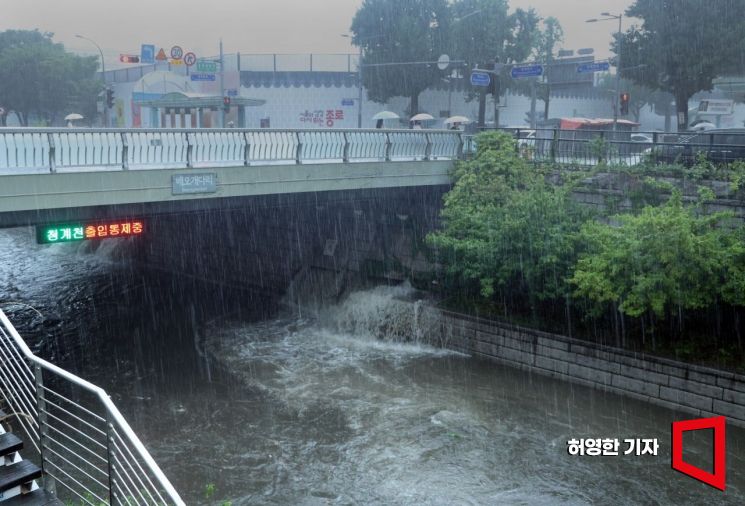 On the morning of the 17th, when heavy rain fell in the metropolitan area, rainwater poured into a tributary of Cheonggyecheon in Seoul, causing water to overflow onto the Cheonggyecheon walkway, resulting in restricted access.
Wind and flood insurance is a policy that allows owners of houses, greenhouses, commercial buildings, and factories (limited to small business owners) to receive coverage for property damage caused by natural disasters, with the government subsidizing between 55% and 100% of the insurance premium. Low-income households living in disaster-prone areas can receive a full 100% subsidy for their premiums.
Currently, seven non-life insurance companies are offering this policy: Samsung Fire & Marine Insurance, DB Insurance, Hyundai Marine & Fire Insurance, Meritz Fire & Marine Insurance, KB Insurance, Hanwha General Insurance, and NH NongHyup Property & Casualty Insurance.
Among insured properties, greenhouses that are directly exposed to natural disasters saw insurance payouts reach 82.4 billion KRW last year, a 5.7-fold increase from the previous year.
Looking at insurance payouts for natural disasters over the past seven years, typhoons, heavy rain, and floods that occur during the summer accounted for the largest share, with 70.6 billion KRW, or 32% of the total. This was followed by heavy snowfall (25%) and strong winds (18%).
Typhoon and flood damage was concentrated in July and September (typhoons 90%, heavy rain and floods 71%). Heavy snowfall damage was most frequent in November.
Recently, natural disasters have tended to be more severe, with extreme rainfall or heavy snow occurring in a short period and concentrated in specific areas, making caution increasingly necessary.
For typhoons, major damage occurred in Jeju and the Yeongnam region, which are the main paths of typhoons. Heavy rain and floods occurred nationwide. Strong winds and heavy snowfall were concentrated in the Seoul metropolitan area and central regions.
Heo Chang-eon, President of the Korea Insurance Development Institute, said, "Due to recent climate change, weather-related observations such as temperature and precipitation are breaking historical records every year, and there are no regions in the country that are safe from natural disasters. As unexpected natural disasters are occurring frequently around the world, it is essential to prepare in advance through insurance."
© The Asia Business Daily(www.asiae.co.kr). All rights reserved.

















