"Careful Consideration Needed in Legislative Debate on the 'Yellow Envelope Act'"
More than half of foreign companies investing in Korea perceive the country’s labor-management relations as confrontational.
On July 27, the Korea Economic Research Institute announced the results of a domestic labor market perception survey conducted by Mono Research, a public opinion research agency, targeting 439 foreign-invested manufacturing companies in Korea with more than 100 employees (100 companies responded). According to the survey, 57.0% of respondents viewed labor-management relations in Korea as confrontational.
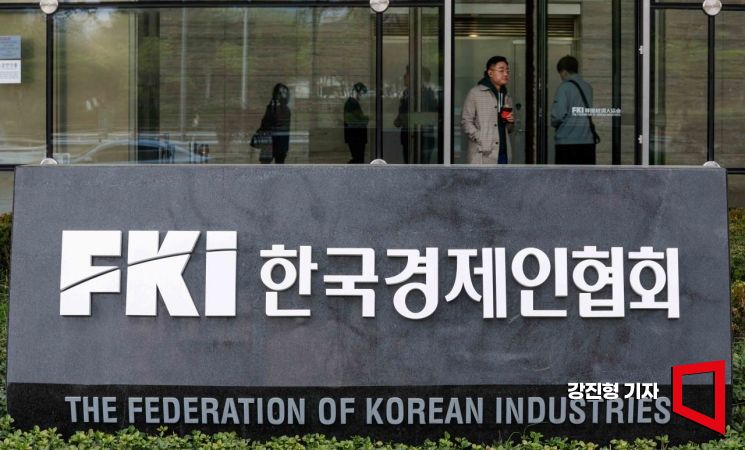 Employees of tenant companies are moving at the Korea Economic Association in Yeouido, Seoul. Photo by Kang Jinhyung
When asked to rate the level of labor-management cooperation in various countries, with Korea set at 100, respondent companies assessed the United States at 122.0, Germany at 120.8, Japan at 115.0, and China at 83.8. With the exception of China, most countries were perceived as having a higher level of cooperation than Korea. In addition, when asked about their perception of the Korean labor market, 64.0% described it as “rigid,” far surpassing the 2.0% who described it as “flexible.” Many respondents also viewed Korea’s labor regulations as strict.
Eight out of ten foreign-invested companies (81.0%) answered that they consider the labor market environment?including labor-management relations and labor regulations?as an important factor when establishing mid- to long-term business plans in Korea. Notably, 13.0% of foreign-invested companies responded that, due to strengthened regulations in labor, industry, and safety?such as working hour restrictions and the Serious Accidents Punishment Act?over the past decade, they have considered withdrawing from or downsizing their business operations in Korea. The Korea Economic Research Institute stated, “Given that the foreign-invested company closure rate this year is around 3.2%, the fact that 13.0% of companies have considered withdrawal or downsizing is not a small proportion,” and analyzed that “excessive labor regulations can serve as an obstacle to attracting foreign investment.”
Foreign-invested companies cited the following as the most urgent issues to address in union activities: political strikes linked to higher-level unions (35.0%), strike behaviors such as workplace occupation (26.0%), and combative activities that reject dialogue and compromise (18.0%). The most challenging aspects were identified as: difficulties in employment adjustments such as dismissal or reassignment (34.0%), rigid working hour systems such as the 52-hour workweek (22.0%), and inflexible wage systems such as minimum wage and seniority-based pay (12.0%).
Lee Sangho, Head of the Economic and Industrial Division at the Korea Economic Research Institute, stated, “Korea’s confrontational labor-management relations and rigid labor market regulations impose significant burdens on workforce management and reduce investment attractiveness.” He also pointed out, “The proposed amendments to Articles 2 and 3 of the Trade Union Act, currently under discussion in the National Assembly, may increase uncertainty in the business environment and undermine the stability of labor-management relations.”
© The Asia Business Daily(www.asiae.co.kr). All rights reserved.
![Clutching a Stolen Dior Bag, Saying "I Hate Being Poor but Real"... The Grotesque Con of a "Human Knockoff" [Slate]](https://cwcontent.asiae.co.kr/asiaresize/183/2026021902243444107_1771435474.jpg)
















