Academic Record-Based Admissions: Average of 2.7 Simultaneous Acceptances
2026 Early Admission Applications Begin on September 8
With approximately 40 days remaining until the application period for the 2026 academic year university early admission, it has been revealed that last year, successful early admission applicants were accepted to an average of 2.4 universities simultaneously. Analysts attribute this to applicants using two or three of their six application opportunities to apply to universities where they felt admission was highly likely. Experts advise that applicants should develop admission strategies that take into account both vacancies resulting from overlapping acceptances and additional admissions to fill those vacancies.
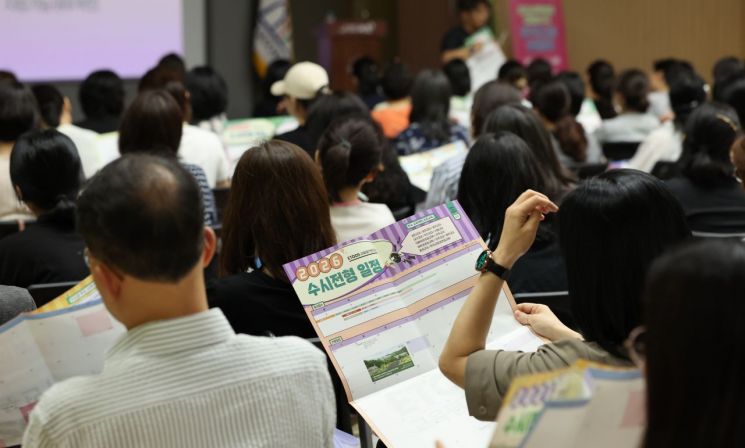 On the 18th, parents are looking at materials at the '2026 College Admission Early Decision Dream Briefing' held at Seocho District Office in Seocho-gu, Seoul. Photo by Yonhap News
On July 27, Jongro Academy analyzed data from the university admission information portal 'Where to Go' regarding the 2025 academic year additional admissions for early admission at 201 universities nationwide. The analysis showed that last year, successful early admission applicants were accepted to an average of 2.4 universities simultaneously. The additional admission figure refers to the number of students admitted to fill vacancies created when initially accepted students choose to enroll at other universities.
For the 2025 academic year, the total number of early admission slots at the 201 universities was 173,954. However, due to the need to fill vacancies caused by overlapping acceptances, the actual number of students admitted through additional admissions reached 248,380. This resulted in an additional admission rate of 142.8%. This phenomenon occurs because, under the early admission system, a single student can be accepted to multiple universities at the same time.
Applicants can apply to up to six universities for early admission. Even students who are not initially accepted can be admitted later through additional admissions when other students decline offers due to overlapping acceptances. Last year, a total of 74,426 students were admitted through this process.
By admission type, students accepted through the academic record-based admission process were accepted to an average of 2.7 universities, while those accepted through the comprehensive admission process (commonly known as 'hakjong') were accepted to an average of 1.9 universities. This suggests that the academic record-based process, which focuses on high school grades, has a relatively higher acceptance rate compared to the comprehensive process.
By region, early admission applicants in the Seoul area were accepted to an average of 2.2 universities, those in the Gyeongin area to 2.3 universities, and those in other regions to 2.5 universities. In particular, among the 39 universities in the Seoul area, there were 29,057 early admission slots, but 34,308 students were actually admitted through additional admissions. The additional admission rate reached 118.1%.
Looking at additional admission rates by admission type, the academic record-based process had the highest rate at 165.7%, with successful applicants being accepted to an average of 2.7 universities. In contrast, the comprehensive process had a lower additional admission rate of 91.1%, with successful applicants accepted to an average of 1.9 universities.
For academic record-based admissions at universities in the Seoul area, successful applicants were accepted to an average of 2.8 universities. By academic field, applicants in the humanities were accepted to an average of 2.9 universities, while those in the natural sciences were accepted to an average of 2.6 universities.
A representative from Jongro Academy stated, "With early admission applications opening in September, it is important for applicants to understand the patterns of simultaneous and additional acceptances, as well as the flow of waiting list numbers, in order to develop a strategy that works to their advantage." The representative added, "A strategic approach that considers both the likelihood of initial acceptance and the possibility of being admitted through additional admissions is necessary."
The application period for early admission for the 2026 academic year is scheduled to take place over three days, from September 8 to September 12.
© The Asia Business Daily(www.asiae.co.kr). All rights reserved.
![Clutching a Stolen Dior Bag, Saying "I Hate Being Poor but Real"... The Grotesque Con of a "Human Knockoff" [Slate]](https://cwcontent.asiae.co.kr/asiaresize/183/2026021902243444107_1771435474.jpg)
















