On-site at the 'Data Regulation Innovation Roundtable for Becoming a Top 3 AI Power'
AI and Data Companies and Experts Participate
Various Proposals Including Policy Insurance and Data Pension System
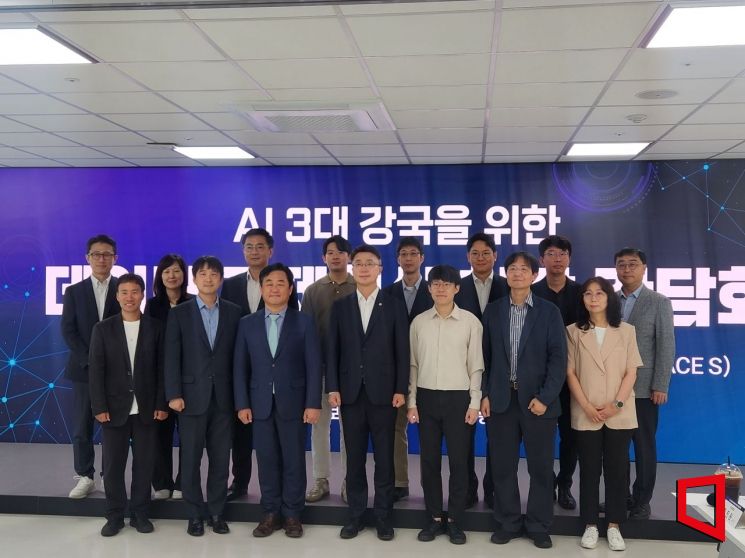 On the morning of the 25th, at SW Maestro in Mapo-gu, Seoul, the 'Data Regulation Innovation Meeting' took place. Photo by Park Yujin
"Even if we want to develop artificial intelligence (AI) models, we do not have data to train them. We do not know where public data is located, nor whether we are allowed to use it. If we use it carelessly, there is a high risk of lawsuits."
On July 25, at the SW Maestro Training Center in Mapo-gu, Seoul, the 'Data Regulation Innovation Roundtable for Becoming a Top 3 AI Power' was held. AI and data companies gathered at the event unanimously expressed their frustration over barriers to data access and ambiguous regulations. While the government announced its intention to consider institutional improvements based on empirical testing, such as regulatory sandboxes, the industry emphasized, "Now, we need concrete implementation and clear guidelines."
Kim Sunghoon, CEO of Upstage, said, "To improve AI model performance, we want to use Korea-specific data such as textbooks, college entrance exams, and civil service exams, but there is nowhere that tells us how to purchase it or what the price is. If a 'data pension system' similar to copyright royalties were created, we would actively use it."
Jung Jinwoo, Director at the video AI startup Twelve Labs, stated, "Original broadcast footage and CCTV?high-quality original videos?are key to improving AI performance, but due to privacy controversies, we often cannot use them. There is no clear standard for what constitutes de-identified information."
He also added, "The current closed 'data safe zones' are not at all suitable environments for training foundation models. It is urgent to switch to a flexible training environment based on private cloud."
The companies especially voiced, "There is no time." The industry requested that the government quickly establish an empirical testing environment through regulatory sandboxes or amendments to enforcement decrees, since legislation would take at least a year.
Choi Hongseop, CEO of Maum AI, said, "Time is the most important resource for becoming a top 3 AI power," and emphasized that while long-term tasks such as legal revisions should proceed in parallel, effective short-term measures must be mobilized so that training can begin immediately. He requested, "If there are aspects that can be opened up at the enforcement decree level?such as allowing training but deferring utilization?please pursue them." He also suggested, "Please consider introducing a policy insurance system that guarantees against litigation risks related to AI data training, so that startups are not discouraged by legal uncertainties."
In response, Ryu Jemyoung, Second Vice Minister of the Ministry of Science and ICT, said, "AI competitiveness depends on data, and the government is preparing to create an institutional foundation for securing and utilizing it. We will lead a social consensus based on empirical testing, including regulatory sandboxes."
© The Asia Business Daily(www.asiae.co.kr). All rights reserved.

















