First Introduced This Year... Up to 750,000 Won Support Per Elevator
City, City Council, KEPCO, and Elevator Safety Agency Sign Business Agreement
Reduce Consumption by Up to 30%... Full Implementation Begins in August
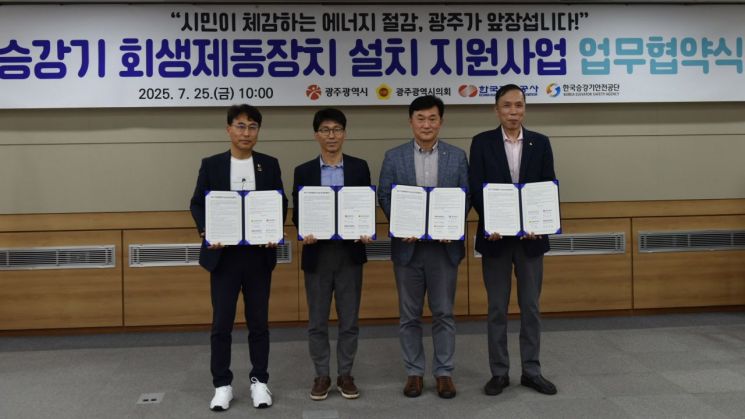 Gwangju City signed a business agreement on the 25th in the city council's main conference room with the City Council, Korea Electric Power Corporation Gwangju Jeonnam Headquarters, and Korea Elevator Safety Agency Honam Regional Headquarters to promote the "Elevator Regenerative Brake Installation Support Project." Photo by Gwangju City
Gwangju City is implementing a "carbon-neutral elevator" project aimed at reducing electricity costs and achieving greenhouse gas reduction.
On July 25, Gwangju City signed a "business agreement for the promotion of elevator regenerative braking device installation support project" at the City Council's main conference room, together with the City Council, Korea Electric Power Corporation Gwangju-Jeonnam Headquarters, and Korea Elevator Safety Agency Honam Regional Headquarters.
This project, introduced for the first time this year by Gwangju City to achieve carbon neutrality and respond to the climate crisis, focuses on installing regenerative braking devices in apartment elevators, where electricity consumption is concentrated, to recycle wasted energy and improve power usage efficiency.
According to the agreement, the city and city council will provide administrative and financial support, considering the high proportion of apartment residents in the region. Korea Electric Power Corporation will be responsible for project operation and financial support, while the Korea Elevator Safety Agency will provide technical and promotional support, establishing a cooperative system. Through joint public-private efforts, the installation of regenerative braking devices will be further expanded.
The elevator regenerative braking device is a system that recycles electricity generated by the elevator motor during operation into another circuit's power supply, reducing power consumption by 10 to 30 percent. Previously, electricity generated during elevator descent was dissipated as heat through a resistor, but with the regenerative braking device, this electricity is converted into common-use electricity through an inverter and can be used for other facilities within the building.
This project will be fully launched starting with an open call for participants in August, with the goal of supporting the installation of a total of 200 elevators. Gwangju City will provide 250,000 won per elevator for installation costs, and Korea Electric Power Corporation will provide between 300,000 and 500,000 won per elevator.
Details of the open call can be found on the Gwangju City and Korea Electric Power Corporation websites. Application documents will be handled by the Korea Electric Power Corporation Gwangju-Jeonnam Headquarters, streamlining the application and support process. For further information, inquiries can be made to the Gwangju Metropolitan City Energy Industry Division.
Choi Taejo, Director of the Artificial Intelligence Industry Division, said, "The elevator regenerative braking device is more than a simple accessory; it is a smart solution that enhances urban energy efficiency. This agreement will be an important and meaningful step toward making Gwangju a sustainable green city."
© The Asia Business Daily(www.asiae.co.kr). All rights reserved.
![Clutching a Stolen Dior Bag, Saying "I Hate Being Poor but Real"... The Grotesque Con of a "Human Knockoff" [Slate]](https://cwcontent.asiae.co.kr/asiaresize/183/2026021902243444107_1771435474.jpg)
















