Korean Nuclear Society: "The World Is Racing to Develop SMRs
The Special Law Will Give Wings to Our Technological Capabilities"
"This is a future investment law aimed at achieving three goals at once: securing South Korea's energy security, driving economic growth, and responding to the climate crisis."
The Korean Nuclear Society held a press conference at the Press Center in Jung-gu, Seoul, on the 25th and emphasized, "Although we possess world-class nuclear power technology, the current legal system is centered on large-scale nuclear power plants, which is insufficient to support the rapid development and commercialization of small modular reactors (SMRs)." The society called for the swift enactment of a special law for SMRs.
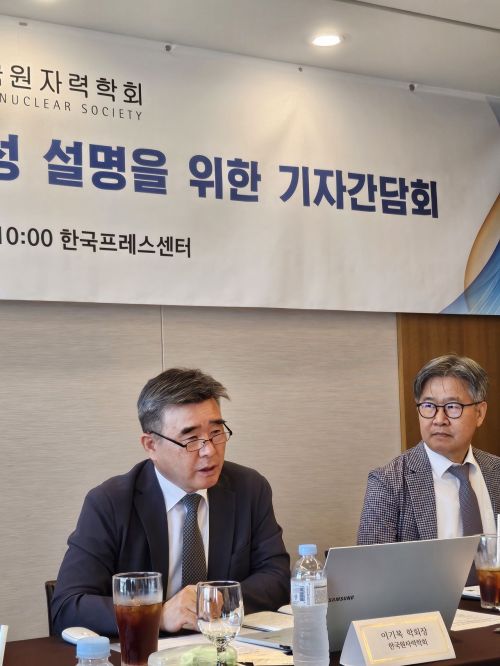 Lee Gibok, President of the Korean Nuclear Society (left), and Moon Juhyun, Vice President, are speaking at a press conference urging the enactment of a special law on Small Modular Reactors (SMR) on the 25th at the China Press Center in Seoul. Photo by Kim Jonghwa
An SMR is an integrated reactor with an electric output of 300 megawatts (MWe) or less, which can be manufactured in modular form at factories. Due to its small size, it is easy to assemble and transport, making mass production possible. It can be installed at existing power plant sites or even inside operating factories without the need to select a separate site.
Additionally, SMRs apply the 'passive safety concept,' which allows the reactor to maintain a safe state using only natural forces, without external power or operator intervention. This is considered to make SMRs more than 1,000 times safer than large reactors, drawing attention as a next-generation core industry. In 2012, South Korea obtained the world’s first standard design approval for an SMR, called SMART.
The Korean Nuclear Society stated, "In May, U.S. President Trump signed an executive order for the 'Deployment of Advanced Reactor Technologies for National Security,' and the United Kingdom established the Great British Nuclear (GBN) in 2023. The world is now in a race to develop SMRs." The society added, "The SMR special law will bridge this speed gap and provide an institutional foundation to give wings to our technological capabilities," urging for the bill to be enacted swiftly.
Accordingly, the National Assembly, including Democratic Party lawmaker Hwang Jungah, has proposed three SMR special bills to support the development of SMR technology and the growth of related industries. However, some environmental groups are opposing the bills, arguing that the economic feasibility and safety of SMRs have not been verified.
The Korean Nuclear Society explained the expected benefits of enacting the SMR special law: securing a technological edge and early commercialization, industrializing SMR exports and creating national wealth, building a robust nuclear ecosystem, and achieving stable carbon neutrality.
Lee Kibok, president of the Korean Nuclear Society, stated, "To successfully commercialize SMRs and achieve export goals, we must ensure the establishment of a strong 'one-team control tower,' institutionalize a fast-track process for SMR licensing, secure demonstration sites and strengthen local acceptance, and guarantee stable and bold financial support."
The society also expressed concern that if the SMR special law fails to pass, South Korea could lose out on the global SMR market worth 100 trillion won annually, and the collapse of the nuclear ecosystem could devastate the nuclear industry, which was worth 32 trillion won as of 2023, thereby negatively impacting the national economy.
Lee emphasized, "We possess technology recognized by the world. What remains is to create an environment where our technology can thrive globally." He urged, "We ask both the ruling and opposition parties to come together and quickly pass the optimal SMR special law."
© The Asia Business Daily(www.asiae.co.kr). All rights reserved.

















