"Changes in the Order of the Korean Peninsula and a Reexamination of Wonsan"
The Institute for Far Eastern Studies at Kyungnam University held the 17th Samcheong Forum on the afternoon of July 24 in the main conference hall of the Peace Hall.
At the forum, Ahn Byungmin, an invited research fellow at the Institute for Far Eastern Studies at Kyungnam University, gave a presentation titled "Changes in the Order of the Korean Peninsula and a Reexamination of Wonsan," providing an analysis of the Wonsan-Kalma Coastal Tourist Area, which has long been a major project for North Korea.
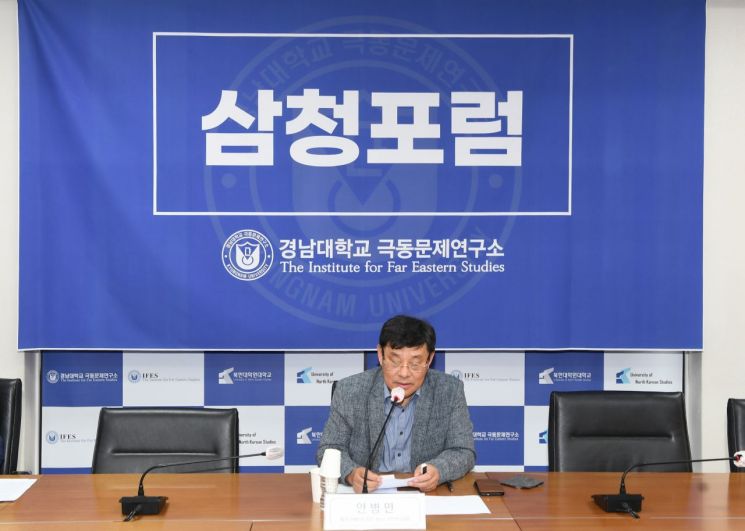 Byungmin Ahn, Invited Research Fellow, Institute of Far Eastern Studies, Gyeongnam National University.
Research Fellow Ahn cited several regional strengths as the reasons Wonsan was selected for development: optimal climate, excellent accessibility, abundant tourism resources, and its international character due to many significant modern and contemporary historical events in Northeast Asia. He explained that for these reasons, all three generations of North Korean leaders?Kim Il-sung, Kim Jong-il, and Kim Jong-un?have favored Wonsan.
He explained that, in developing the tourist area, North Korea benchmarked overseas marine tourism destinations such as Singapore, Cuba, and Spain. To enhance accessibility, the regime has focused on building large-scale transportation infrastructure, including the introduction of tolls on the Pyongyang-Wonsan expressway, the construction of a new expressway between Wonsan and Hamhung, the modernization of the railway between Wonsan and Kumgangsan, and the opening of Wonsan-Kalma Airport.
However, Research Fellow Ahn expressed significant skepticism about the likelihood of the tourist area's success. He pointed out that accessibility, including the transportation network, remains weak, and that the climate suitable for marine tourism is also limited, with the period suitable for swimming in the sea being only about one month per year. He also noted that attracting major foreign tourists from countries such as China and Russia is difficult compared to competing destinations, due to lower appeal and higher costs.
Research Fellow Ahn predicted that regardless of North Korea's intentions, the future of the Wonsan-Kalma Tourist Area ultimately depends on cooperation between South and North Korea. He concluded his presentation by proposing the creation of a new tourism belt connecting Seoraksan, Kumgangsan, and Wonsan, as well as the activation of maritime cruises between South Korea (Busan, Sokcho), Japan (Niigata), North Korea (Wonsan), and Russia (Vladivostok).
After the presentation, there was an in-depth Q&A session with experts.
© The Asia Business Daily(www.asiae.co.kr). All rights reserved.

















