Eliminated by Disinfection in Boiling Water at 100°C
Food Poisoning Most Common in Restaurants During Summer
Experts Advise Thorough Hygiene Management
A study has found that even after washing cotton dishcloths with detergents and drying them for 12 hours, there is still a possibility of bacterial growth. Experts have recommended using disposable dishcloths to prevent food poisoning.
 Yuhan Kimberly 'Study on Hygiene Evaluation and Improvement Measures of Reusable Dishcloths' Results. Yuhan Kimberly
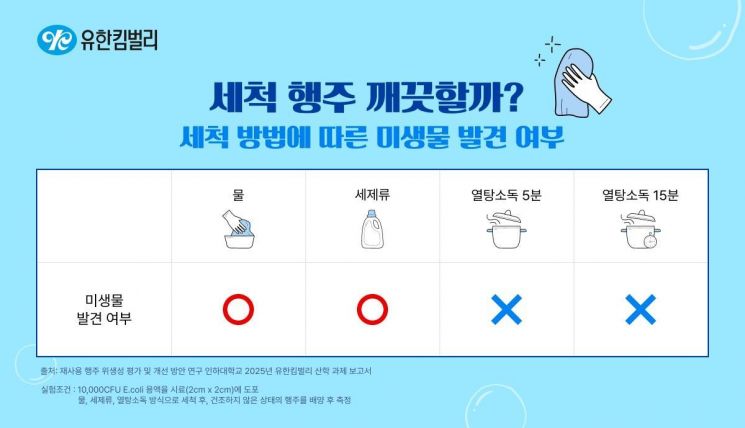
On July 25, Yuhan-Kimberly announced the results of a joint study with Inha University titled "Evaluation of Hygiene and Improvement Measures for Reusable Dishcloths." The study selected cotton dishcloths commonly used in restaurants and nonwoven disposable dishcloths, which were confirmed to be sterile immediately after opening, as the experimental groups. The experiment was conducted in the following order: microbial inoculation, washing (with water, detergents, or boiling water disinfection), and checking for bacterial growth according to indoor drying times.
The results showed that even when washed with commonly used detergents, bacteria were not completely eliminated from the dishcloths and remained present. Bacteria were observed even after 12 hours of drying, indicating the possibility of bacterial proliferation. In contrast, when the dishcloths were disinfected in boiling water at 100°C for more than 5 minutes, no bacteria were detected.
Considering that dishcloths are often reused multiple times in kitchen environments such as restaurants, the same process was repeated five times, and bacteria still remained. In particular, when dishcloths were left to dry indoors for several days, the residual microorganisms went through a lag phase as they adapted to the new environment and then, after a certain period, proliferated more than 10,000 times. This pattern was observed in both cotton and nonwoven dishcloths without distinction.
Baek Youngbin, a professor in the Department of Biotechnology at Inha University, explained, "In actual food service environments where food is present, there may be an even greater tendency for microbial proliferation than observed in this experiment." He added, "If thorough boiling disinfection and a clean drying environment are not maintained during the reuse of dishcloths, the risk of contamination increases." He further stated, "Since disposable dishcloths can be used in a sterile state when newly opened and then discarded, the risk of microbial contamination can be minimized. Therefore, in food service settings including restaurants and B2B food service sites, it is more suitable for food safety to use and replace disposable dishcloths."
According to annual food poisoning statistics published by the Ministry of Food and Drug Safety, the period with the highest incidence of food poisoning is from July to September, and the most common location is restaurants. An official from the Yuhan-Kimberly Seocho Research Institute explained, "This study has demonstrated that with commonly used cleaning methods in households as well as in food service businesses and restaurants, it may be difficult to completely remove bacteria from dishcloths." The official added, "In B2B food service establishments, maintaining a hygienic environment affects not only consumer health but also market competitiveness, so we will actively provide a variety of hygienic solutions such as WypAll and Scott Food Wiper products."
© The Asia Business Daily(www.asiae.co.kr). All rights reserved.

















