Discussion on Trade, Technology, and Security at Choi Jonghyun Academy Forum
Emphasis on 'Balance' in Diplomatic Policy... Redefining the Landscape with Technology
"Leading the AI Ecosystem Based on Manufacturing"… Experts Offer Recommendations
As global competition for technological supremacy intensifies, there have been calls for a fundamental shift in South Korea's diplomatic and trade strategies. Experts emphasize that, rather than relying solely on a simple 'export drive,' it is urgent for the nation to develop a comprehensive national-level strategy that integrates trade, technology, and security to respond both to the United States' technology alliance initiatives and China's push for ecosystem self-sufficiency.
The Choi Jonghyun Academy announced on the 25th that it had held a forum in Seoul on the previous day, the 24th, under the theme "Global Complex Crisis and South Korea's Diplomatic and Security Strategy." The forum discussed the need to redesign strategies toward China and the United States in light of the competition for leadership in artificial intelligence (AI) and semiconductor technologies, as well as related trade risks. Experts stressed that, as the United States and China each restructure alliances and ecosystems around technological supremacy, South Korea should not remain complacent in its current status as a manufacturing powerhouse but must shift its role to that of a 'strategic technology partner.'
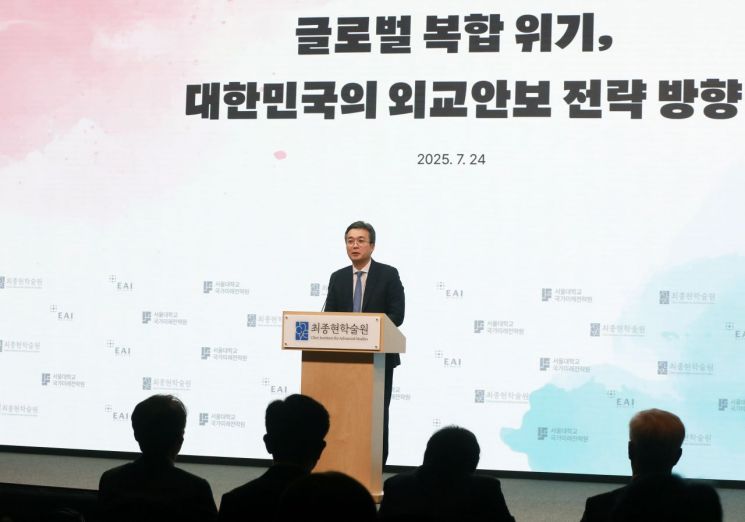 On the 24th, at the Korea Higher Education Foundation building in Gangnam-gu, Seoul, Kim Yuseok, president of the Choi Jonghyun Academic Institute, delivered the opening remarks at the forum titled "Global Complex Crisis, South Korea's Diplomatic and Security Strategy Direction." Choi Jonghyun Academic Institute
Kwon Seokjun, professor in the Department of Chemical Engineering at Sungkyunkwan University, analyzed, "China is building a high-speed AI ecosystem highway that encompasses all areas of semiconductors, including graphics processing units (GPUs), foundries, and manufacturing equipment." He added, "Through a triple subsidy system, China is internalizing production, consumption, and equipment." He further noted that "although there is still a gap in advanced technological capabilities, China is by no means lagging behind in terms of speed, capital, or talent," concluding that the threat posed by China will not be easily resolved in the short term.
The United States is also making its strategy more concrete by demanding technological partnerships from its allies. Professor Kwon stated, "The United States is responding by drawing its allies into a US-centered technology ecosystem through initiatives such as the 'Stargate Project' and the AI Action Plan." He emphasized, "South Korea must move beyond simply being a production base and expand its role to that of a strategic ecosystem designer."
Park Jonghee, professor in the Department of Political Science and International Relations at Seoul National University, stated, "The core of the AI competition lies not in individual technologies but in the capacity to design ecosystems." He emphasized the need for South Korea to establish its own 'third way.' He explained, "There needs to be an ecosystem in which the government acts as the infrastructure designer, large corporations share assets and platforms, and startups serve as high-risk innovation drivers." He also noted that "long-term investment is required to support such a system, including AI fab centers, data infrastructure, and GPU supply systems."
There was also a warning that, as China transitions to a 'full stack' approach and the United States pursues reshoring strategies simultaneously, South Korea could be marginalized on the global industrial map if it does not integrate its trade and technology strategies. Lee Sanghyun, Senior Research Fellow at the Sejong Institute, stated, "This is no longer an era for simple export strategies or reliance on specific alliances. Now is the time when all three pillars?self-strengthening, solidarity with value-sharing countries, and inclusion through connections with the Global South?are needed."
© The Asia Business Daily(www.asiae.co.kr). All rights reserved.
![Clutching a Stolen Dior Bag, Saying "I Hate Being Poor but Real"... The Grotesque Con of a "Human Knockoff" [Slate]](https://cwcontent.asiae.co.kr/asiaresize/183/2026021902243444107_1771435474.jpg)
















