"Tariff Rate Lowered to 15% with Japan's Market Opening and Investment"
'2+2 Consultations' Unilaterally Canceled, Increasing Pressure on South Korea
Korea-U.S. Industry Ministers' Meeting to Proceed as Scheduled Today
U.S. President Donald Trump stated on the 24th (local time) that Japan essentially paid money to purchase tariff reductions, and announced that the United States would lower tariffs for other countries as well if they make large-scale investments in the U.S. like Japan did. This remark came as the United States unilaterally canceled the 'U.S.-Korea 2+2 Trade Consultations,' which had been scheduled for the 25th, just two days before the meeting. Analysts interpret this as an attempt to pressure major trading partners, including South Korea, to make U.S.-bound investments at a level similar to Japan's.
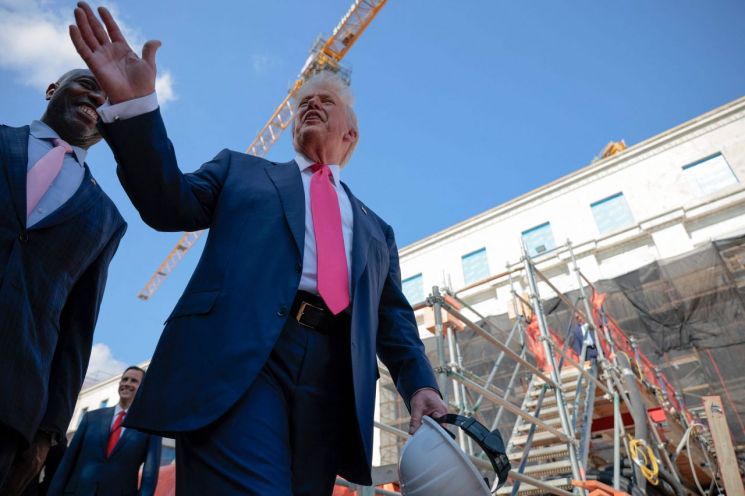
On this day, President Trump visited the renovation site of the Federal Reserve (Fed) building in Washington, D.C., and responded to a reporter's question, "If other countries pay money to the U.S., will tariffs be lowered?" by saying, "Yes. I will allow it."
This statement was made in the context of introducing the process of the U.S.-Japan trade agreement, which was concluded on the 22nd.
President Trump said, "Japan gave us $550 billion and we lowered tariffs slightly," adding, "After that, Japan agreed to open its economy (market)." He continued, "Japan provided both economic opening and payments (U.S. investment), and we lowered the tariff rate from 28% to 15%," emphasizing, "Japan basically purchased a tariff reduction." The mutually notified tariff rate before the agreement was 25%, but President Trump appears to have incorrectly mentioned it as 28% on this day. He particularly stressed that the investment promised by Japan was similar to a 'signing bonus' that is paid upfront upon contract signing, rather than a loan.
Previously, Japan promised an investment of $550 billion and agreed to partially open its rice and automobile markets in exchange for lowering the existing mutual tariff rate from 25% to 15%. For Japanese automobiles, the item-specific tariff was halved from 25% to 12.5%, and with the existing 2.5% tariff added, a total of 15% is applied.
Regarding negotiations with the European Union (EU), where a trade agreement is reportedly imminent, President Trump assessed that they are "going quite well." He added, "There are other countries as well," and "All of these are very large deals, and the United States will make enormous amounts of money."
Such remarks could exert considerable pressure on South Korea, where negotiations are ongoing. The previous day, the United States unilaterally canceled the U.S.-Korea 2+2 Trade Consultations via email just two days before the scheduled meeting. Although the official reason given was U.S. Treasury Secretary Scott Besant's personal schedule, there is speculation that dissatisfaction expressed during unofficial discussions regarding the scale of South Korea's investment and market opening may have played a role. In fact, it has been reported that the United States previously demanded that the South Korean government establish a $400 billion investment fund to revitalize U.S. manufacturing. In contrast, South Korea's investment plans with domestic companies in the U.S. only amount to $100 billion, and it is known that South Korea had set the expansion of rice imports and the allowance of beef imports over 30 months of age?both U.S. demands?as non-negotiable red lines in its negotiation plan.
Meanwhile, separate from the cancellation of the U.S.-Korea 2+2 Trade Consultations, South Korea proceeded as scheduled with trade negotiations with U.S. Commerce Secretary Howard Lutnick on this day. From the Korean side, Minister of Trade, Industry and Energy Kim Jeonggwan and Trade Minister for Industry Yeo Hangu attended.
Prior to the negotiations, Secretary Lutnick said in an interview with CNBC, "Like Europe, South Korea very, very much wants to conclude the negotiations," and added, "When South Korea read the agreement between the U.S. and Japan, they probably uttered expletives. Given that South Korea and Japan are wary of each other, you can imagine what South Korea thought after seeing Japan conclude its negotiations." This remark demonstrates that the United States recognizes the competitive relationship between South Korea and Japan, given their similar trade structures, and is strategically leveraging this dynamic in negotiations.
© The Asia Business Daily(www.asiae.co.kr). All rights reserved.

















