Special Exhibition at the National Museum of Korea for the 80th Anniversary of Liberation
"Conquering the World on Two Feet"
Eighteen Artifacts on Display, Including the Berlin Olympic "Bronze Helmet"
In the long, dark tunnel devoid of hope and dreams, marathon running offered a ray of hope to Koreans, like much-needed rain after a drought. Under colonial rule, Koreans could not stand on the podium under their own name, but Son Kee-chung took every opportunity to let the world know about 'KOREA.' An exhibition that looks back on his journey has now been prepared.
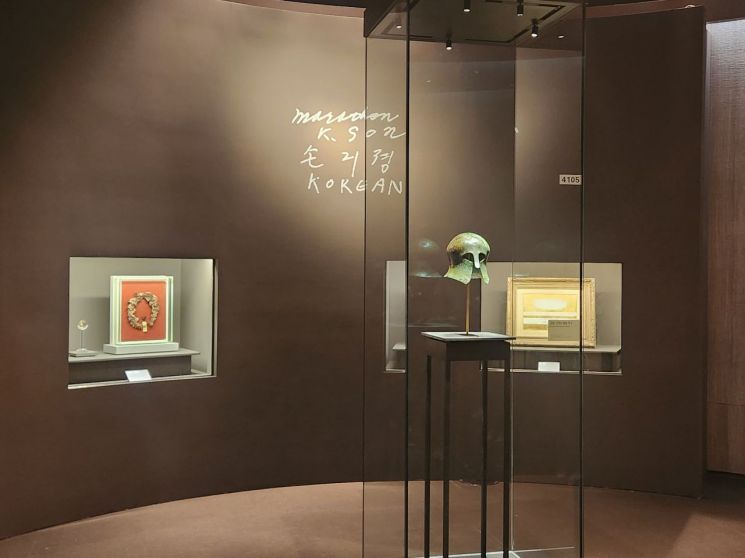 Special exhibition "Conquering the World on Two Feet" held in Donation Room 1 of the National Museum of Korea's permanent exhibition hall. Laurel wreath, bronze helmet, and plaque awarded to athlete Sohn Keechung for winning the Berlin Olympics are on display. Photo by Seo Mideum
The National Museum of Korea will host a special exhibition commemorating the 80th anniversary of Liberation titled "Conquering the World on Two Feet" in Donated Works Gallery 1, starting July 25. This special exhibition is designed to highlight the footsteps of Son Kee-chung (1912?2002) as they intertwine with the history of the Korean people. On August 9, 1936, he won the gold medal in the marathon at the Berlin Olympics, and later, as a marathon coach, he trained gold medalists. His trainees, Suh Yun-bok (1923?2017) and Ham Kee-yong (1930?2022), each won the Boston Marathon in 1947 and 1950, astonishing the world once again.
In 1947, Baekbeom Kim Koo (1876?1949) celebrated Suh Yun-bok's Boston Marathon victory by writing the calligraphy "Jokpae Cheonha" (meaning "Conquering the World with One's Feet"), which inspired the title of this exhibition, "Conquering the World on Two Feet." In that race, Korean runners also set a record by sweeping second place (Song Gil-yoon) and third place (Choi Yoon-chil).
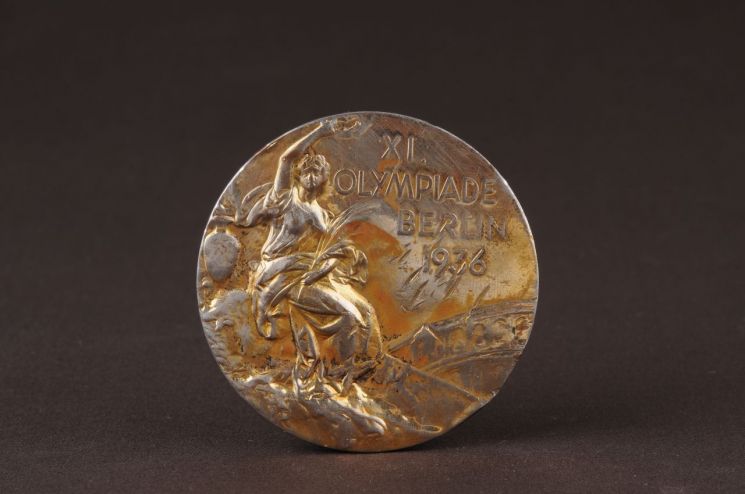
This exhibition brings together 18 items, including Son's Berlin Olympic victory prize, the "bronze helmet," as well as his "gold medal," "laurel wreath," and "winner's certificate," all in one place. The bronze helmet was donated to the National Museum of Korea by Son in 1994, who stated, "This is not mine alone, but belongs to our people." Other items on display have been brought from the Son Kee-chung Memorial Hall and other institutions for this exhibition.
Although Son stood on the Olympic podium under the Japanese flag, he made every effort to let people know that he was Korean, not Japanese, whenever he had the chance. When signing autographs, he would write "Son Gijeong" in Hangul. A postcard inscribed "Korean Son Gijeong," written immediately after his victory on August 15, 1936, will be unveiled at this exhibition.
This exhibition also features a video that uses AI technology to recreate Son's journey. It vividly depicts his youth, when he was forced to run under the Japanese flag in 1936, the achievements of his trainees who conquered the world under the name "KOREA" in 1947 and 1950, and his later years as a torchbearer at the 1988 Seoul Olympics. The exhibition will run until December 28.
© The Asia Business Daily(www.asiae.co.kr). All rights reserved.
![Clutching a Stolen Dior Bag, Saying "I Hate Being Poor but Real"... The Grotesque Con of a "Human Knockoff" [Slate]](https://cwcontent.asiae.co.kr/asiaresize/183/2026021902243444107_1771435474.jpg)

















