Results of the Supplementary Survey on Economically Active Youth Population
Record-High 36.0% of Young People Preparing for Private Sector Jobs
The proportion of young people preparing for civil service exams has dropped further compared to last year, reaching an all-time low. In contrast, the proportion preparing for employment at private companies has increased, widening the gap between the two. The average period it takes for young people to find their first job after graduation has slightly decreased to around 11 months, but the average tenure at their first job has become even shorter.
According to the “May 2025 Supplementary Survey on Economically Active Population for Youth” released by Statistics Korea on July 24, the youth population (aged 15 to 29) as of May was 7,974,000, a decrease of 200,000 from the previous year. Among them, the number of employed was 3,682,000, down 150,000 year-on-year, with the employment rate falling by 0.7 percentage points to 46.2%. The labor force participation rate among young people was 49.5%, a decrease of 0.8 percentage points from the same period last year.
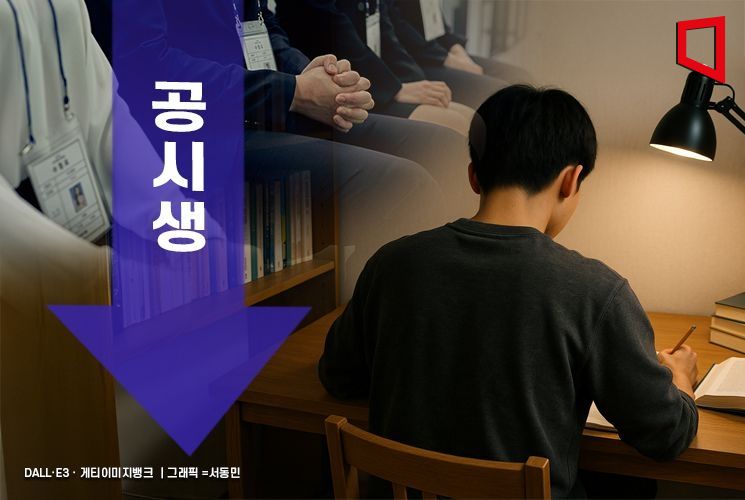
Among the 4,030,000 economically inactive youth, 14.5% (585,000) were preparing for employment exams, up 0.6 percentage points from the previous year. By field, the proportion preparing for civil service exams was 18.2%, a drop of 5.0 percentage points over the same period, marking the lowest level ever recorded. In contrast, the proportion preparing for employment at private companies rose by 6.3 percentage points year-on-year to 36.0%. This is the highest figure since this category was first included in the statistics in 2006. Song Junhaeng, head of the Employment Statistics Division at Statistics Korea, stated, “Last year, for the first time, the ranking between those preparing for private companies and those preparing for general civil service exams among youth was reversed, and this year, the gap is widening further.”
The average time it took for young wage earners to find their first job after graduation was 11.3 months, a decrease of 0.2 months from the previous year. However, the average tenure at their first job was 1 year and 6.4 months, which is 0.8 months shorter than the previous year.
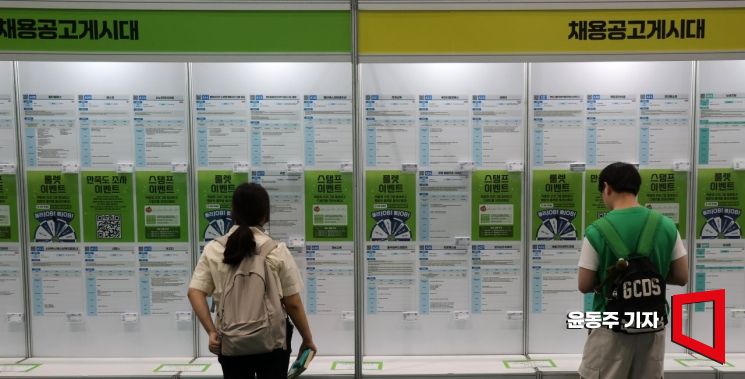 Job seekers visiting the Gangnam-gu Job Fair held at COEX in Gangnam-gu, Seoul, on the 5th are checking the job posting board. 2025.06.05 Photo by Dongjoo Yoon
By industry, the largest share of first jobs was in accommodation and food services at 16.3%, followed by manufacturing (13.1%), wholesale and retail (11.4%), and health and welfare (11.3%). By occupation, the proportions were highest for managers and professionals (25.9%) and service workers (24.6%).
Regarding the wage at their first job, the largest proportion earned between 2 million and 3 million won (39.7%), followed by those earning between 1.5 million and 2 million won (28.3%), and those earning between 1 million and 1.5 million won (11.1%). The most common reason for leaving their first job was dissatisfaction with working conditions, such as pay and working hours, accounting for 46.4%, which is an increase of 0.9 percentage points from the previous year.
The average time required for university graduates (including those from three-year programs or less) to complete their studies was 4 years and 4.4 months, an increase of 0.6 months compared to the same month last year. The average duration of leave of absence for those who had taken a break from school was 1 year and 10.2 months, a decrease of 0.3 months. The proportion of students who had work experience during their studies was 43.2%, a decrease of 0.4 percentage points. The main types of work experience were part-time employment (75.0%), full-time employment (9.8%), and school internships (7.9%).
The proportion of graduates with work experience after graduation was 86.4%, a slight increase of 0.2 percentage points. Among them, 27.3% responded that their most recent job was “very closely related” to their field of study, up 0.5 percentage points from the previous year.
© The Asia Business Daily(www.asiae.co.kr). All rights reserved.


















