Oh Sehoon Announces "Housing Supply Promotion Plan"
Aims to Shorten Average Redevelopment Project Period from 18.5 Years to 13 Years
"Processing Deadline System" Introduced Across All Redevelopment Stages to Monitor Delays
Pre- and Parallel Administrative Procedures, and Process and Conflict Management System Established
The Seoul Metropolitan Government has decided to shorten the total period from district designation to project completion by 5.5 years in order to accelerate the pace of housing supply. The goal is to reduce the time for designating a redevelopment district to 2 years, for establishing an association to 1 year, and for project implementation, management disposition approval, and relocation to 6 years. A system for process and conflict management will also be established to identify and resolve causes of project delays at an early stage.
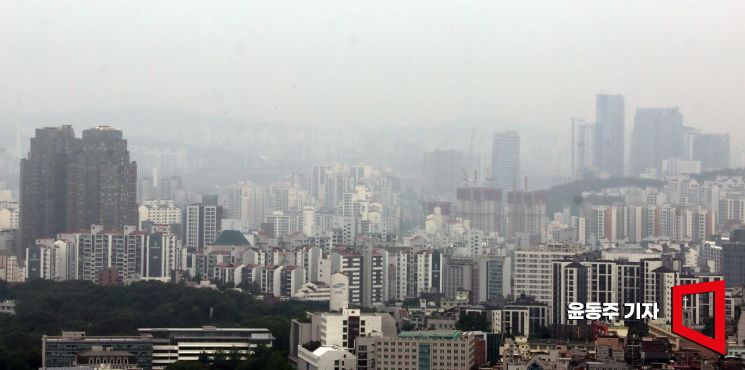 On the 27th, apartment prices in Mapo and Seongdong districts of Seoul rose at the largest rate since related statistics began to be published in 2013. The expectation that Seoul apartment prices will continue to rise is forecasted to sustain the upward trend for the time being. The photo shows the apartment complex in Mapo district as seen from Namsan, Seoul. 2025.06.27 Photo by Dongju Yoon
On the afternoon of July 24, Seoul Mayor Oh Sehoon visited the Sindang-dong District 9 area in Jung-gu to announce the "Housing Supply Promotion Plan," which contains strategies to accelerate redevelopment projects. The plan aims to reduce the average redevelopment project period from 18.5 years to 13 years. Measures to minimize delays in permits and project progress have also been prepared.
This policy focuses on "shortening the redevelopment project period" and "strengthening process management" to reduce project delays. Until now, the city has concentrated on expanding the designation of redevelopment districts through expedited integrated planning and deregulation. Going forward, the city plans to further accelerate the progress of redevelopment projects to increase supply by advancing groundbreaking and move-in schedules.
Seoul City to Reduce Total Redevelopment Project Period by 5.5 Years
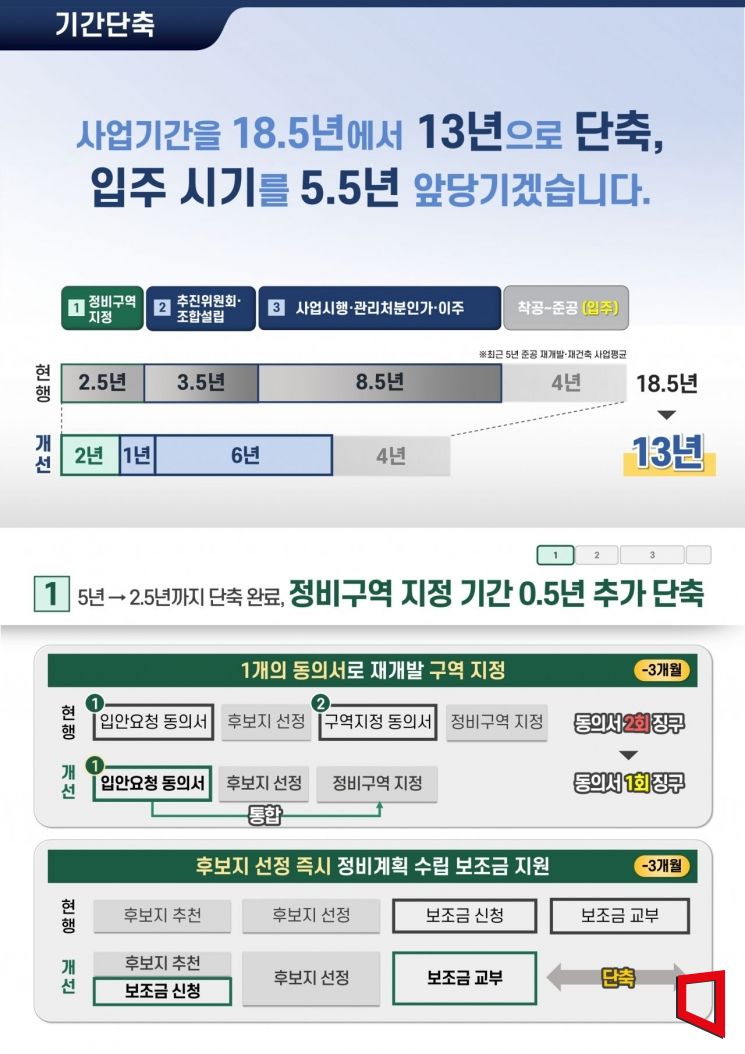
Seoul has set its redevelopment project period reduction targets as follows: reducing "redevelopment district designation" from 2.5 years to 2 years, "promotion committee and association establishment" from 3.5 years to 1 year, and "project implementation, management disposition approval, and relocation" from 8.5 years to 6 years.
Immediately after selecting a candidate site for expedited integrated planning redevelopment, the city will provide financial support for establishing the redevelopment plan and will omit the separate consent form for district designation, thereby shortening the period for district designation to 2 years. To expedite the next step?promotion committee and association establishment?the requirements and procedures for public subsidies will also be improved. Previously, subsidies were provided only after securing over 50% resident consent and completing the expedited integrated preliminary planning consultation. From now on, support will be provided immediately without the resident consent procedure. Through this, the city plans to shorten the association establishment period to within 1 year after district designation.
To allow various redevelopment project procedures to be processed simultaneously, a system for pre- and parallel administrative procedures will also be introduced. The period from association establishment to groundbreaking, which previously averaged 8.5 years, will be reduced to within 6 years. For example, appraisal firms will be selected in advance so that appraisals can begin immediately after project implementation approval, and the project implementation plan (draft) will be prepared in advance during integrated review so that the application for project implementation plan approval can be submitted immediately after the review is completed.
Implementation of "Processing Deadline System" Throughout All Redevelopment Project Stages
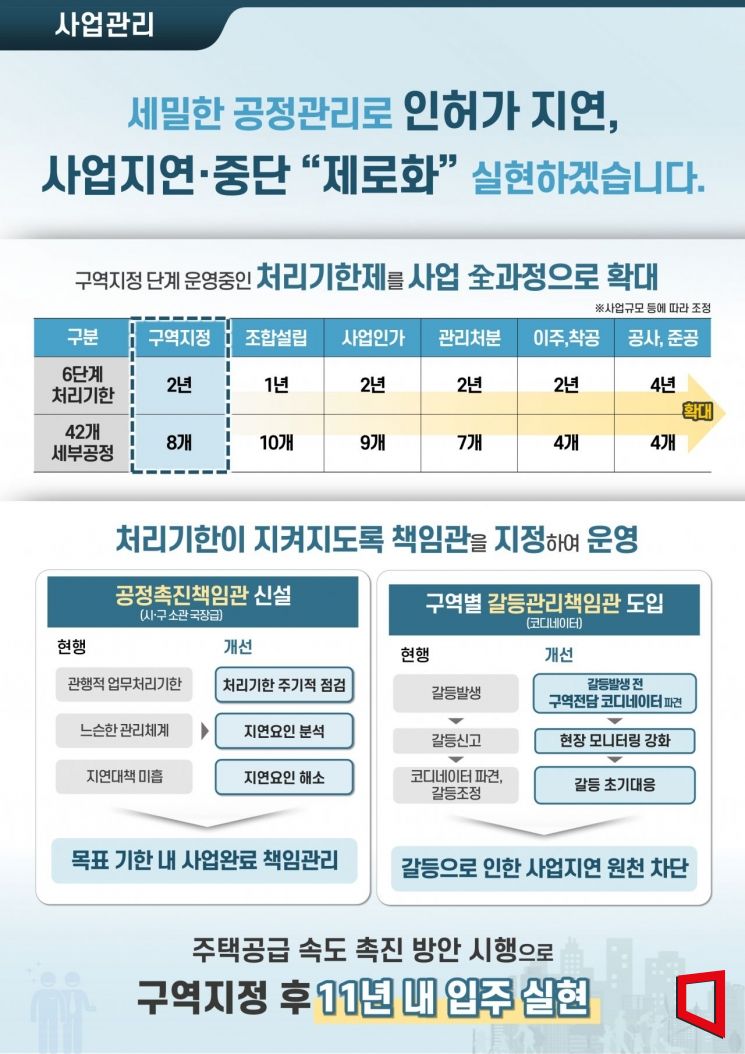
A meticulous process management system will also be operated to ensure that permits and groundbreaking proceed quickly and without delay after the redevelopment project begins. First, a "processing deadline system" will be introduced throughout all stages of the redevelopment project.
Previously, the processing deadline system was applied only at the district designation stage, but it will now be expanded to cover all six stages of the redevelopment project, from designation to construction and completion. Standard processing deadlines will be set for each of the six stages, and the process will be divided into 42 detailed steps to monitor for potential delays.
A "process promotion officer" and a "conflict management officer" will also be designated for each project site. A process and conflict management system will be established to identify potential causes of project delays during the permitting stage in advance and resolve them in real time. The process promotion officer will diagnose the causes and devise solutions for sites where deadlines are exceeded or schedules are delayed, helping to normalize the project. The conflict management officer will mediate and support project progress when conflicts arise in each district.
Since the introduction of expedited integrated planning in 2021, the city has selected a total of 241 redevelopment and reconstruction sites, totaling 378,000 housing units, and has designated 145 districts, totaling 194,000 units, as redevelopment districts. The city plans to designate a total of 312,000 units as redevelopment districts by June next year.
© The Asia Business Daily(www.asiae.co.kr). All rights reserved.



















