Besant, Bloomberg TV Interview
"Japan Received 15% Tariff Rate for Providing Innovative Financial Mechanism"
Reuters: "Japan to Purchase 100 Boeing Aircraft from the U.S."
On July 23 (local time), U.S. Treasury Secretary Scott Besant stated that a large-scale investment program in the United States played a decisive role in the conclusion of the trade agreement with Japan. As Japan, which has a trade structure similar to South Korea, preemptively concluded negotiations, the United States is now referencing the Japanese case to effectively pressure other countries to expand their investments in the U.S., thereby increasing the burden on the South Korean negotiation team.
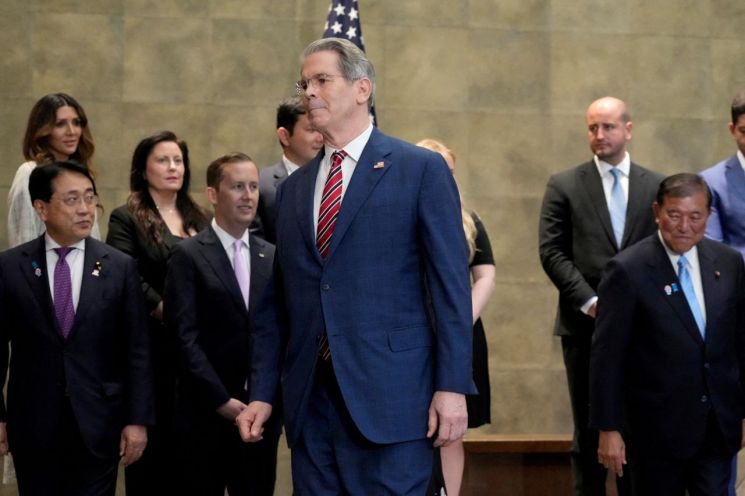
In an interview with Bloomberg TV on the same day, Secretary Besant was asked whether other trading partners could receive reciprocal tariffs at the same level as Japan. He responded, "They were able to receive the 15% rate because they were willing to provide this innovative financial mechanism."
Previously, the United States had notified South Korea of a 25% reciprocal tariff rate and the European Union (EU) of a 30% rate. Japan was also initially assigned a 25% reciprocal tariff rate, the same as South Korea, but succeeded in lowering it to 15% through negotiations.
The previous day, Japan agreed to a trade deal with the United States and pledged to launch a $550 billion (approximately 757 trillion won) investment program called the 'Japan Invest America Initiative.' This amount exceeds South Korea's annual budget for this year (673 trillion won). The program includes investments in various forms?such as equity investments, loans, and loan guarantees?across key economic security supply chains in the United States, including semiconductors, steel, shipbuilding, aviation, automobiles, and artificial intelligence (AI).
Along with this, Japan also agreed to partially open its agricultural and automobile markets, including rice, and succeeded in lowering the existing 25% tariff rate to 15%. In particular, for automobiles?the top Japanese export item to the U.S.?the item-specific tariff was halved from 25% to 12.5%, and with the existing tariff rate (2.5%) added, a total of 15% is now applied.
Secretary Besant emphasized, "They brought forward a U.S.-Japan cooperation plan that provides equity investment, credit guarantees, and financial support for major projects within the United States," and highlighted that Japan's foreign direct investment (FDI) pledge consists "entirely of new capital." Japan also promised to reinvest 90% of its investment returns in the United States.
The fact that Japan was able to secure tariff reductions in trade negotiations with the United States through a massive investment commitment is creating significant pressure for South Korea as well. With the reciprocal tariff suspension set to expire on August 1 and final negotiations with the U.S. scheduled for July 25, South Korea is now in a position where it must achieve an agreement at least equal to or better than what Japan secured. Especially since Secretary Besant explicitly cited investment in the U.S. as the core background of the U.S.-Japan trade agreement, there is widespread analysis that South Korea is highly likely to face demands for large-scale additional investments. Previously, it was reported that the United States had requested South Korea to establish a large investment fund to support the rebuilding of U.S. manufacturing. As Japan has made comprehensive concessions, the pressure is mounting for South Korea to present an equally substantial offer.
Meanwhile, Reuters Yonhap News, citing White House officials, reported that the U.S.-Japan trade agreement includes a plan for Japan to purchase 100 Boeing aircraft from the United States. Additionally, Japan agreed to increase its imports of U.S. rice by 75% compared to previous levels and to purchase a total of $8 billion worth of U.S. products across various sectors, including agriculture. In the area of defense spending, it was also agreed that Japan would increase its annual procurement of U.S. products from $14 billion to $17 billion.
© The Asia Business Daily(www.asiae.co.kr). All rights reserved.

















