Park Wansu, Governor of Gyeongnam Province, visited Hadong County, which suffered damage from heavy rainfall, following his inspections of Uiryeong and Hapcheon the previous day, to assess the flood situation. He also revisited Sancheong County, which experienced a large wildfire in March.
On July 23, Governor Park visited the collapsed embankment site of Hogyecheon in Okjong-myeon, Hadong County, as well as farms that suffered damage to strawberry seedling greenhouses.
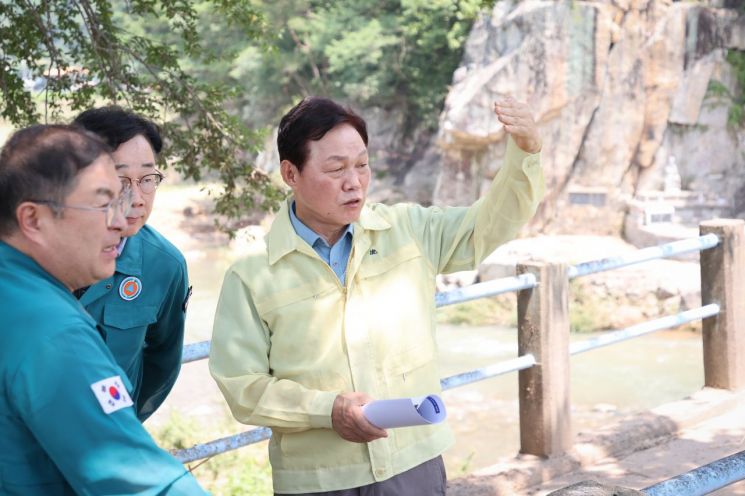 Park Wansu, Governor of Gyeongnam Province, is inspecting the collapsed embankment site of Hogyecheon in Okjong-myeon, Hadong-gun. Provided by Gyeongnam Province
The embankment of Hogyecheon collapsed when 646mm of rain fell in Okjong-myeon during the heavy downpour, causing the water level of the Deokcheongang River to rise rapidly due to the combined inflow from the upstream Sancheong area.
Approximately 200 meters of the embankment were lost, resulting in the flooding of 16 hectares of farmland, 50 vinyl greenhouses, and 2 houses.
At the site, four excavators have been deployed to stack sandbags for emergency repairs, and a permanent restoration is planned for the future.
Governor Park stated, "Flooding occurred at the point where Hogyecheon joins the Deokcheongang River," and emphasized, "Since Deokcheongang and Yangcheongang are rivers with large volumes of water and high flood risk, it is necessary to upgrade them to national rivers."
He further stressed, "To prevent floods like this from recurring, we will actively promote dredging of the Deokcheongang and Hogyecheon rivers."
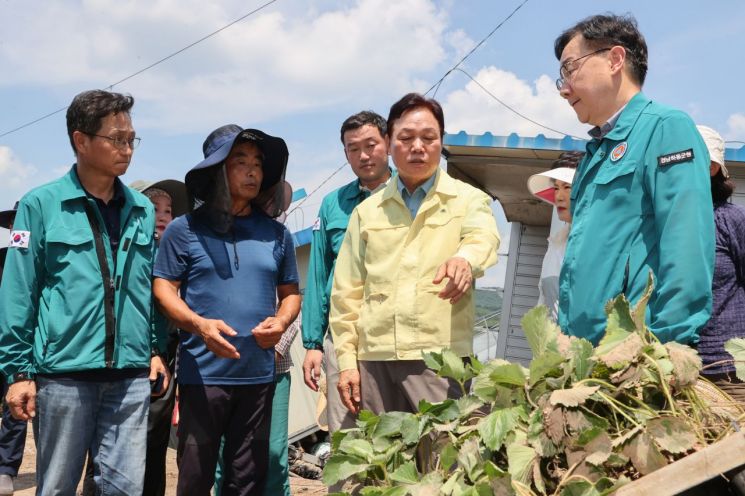 Park Wansu, Governor of Gyeongnam Province (center), is inspecting strawberry seedlings soaked in muddy water at a strawberry seedling greenhouse in Hadong County, which was damaged by heavy rain. Provided by Gyeongnam Province
Afterwards, Governor Park visited two farms that suffered flooding damage to their strawberry seedling greenhouses.
Due to the heavy rainfall, nine greenhouses covering an area of 0.8 hectares were flooded, resulting in 180,000 strawberry seedlings being damaged.
These farms are currently in a critical stage of growing seedlings, are not covered by insurance, and face a significant financial burden due to the high unit cost.
After inspecting the site, Governor Park instructed, "Since the damage to strawberry seedlings falls into a blind spot that is not eligible for compensation, request support from central government agencies and consider providing emergency funds at the provincial level based on additional investigations."
He also added, "Separate investigations should be conducted for facility damage and crop damage so that the province and the central government can each provide support accordingly."
At the site, there was a request for additional designation of special disaster areas for five regions: Okjong, Cheongam, Hwagae, Agyang, and Jeongnyang.
In response, Governor Park said, "The province will review the request and submit it to the central government."
He also instructed relevant departments to promptly establish measures for disaster victims, including households in long-term evacuation.
After inspecting the Hadong County area, Governor Park visited Sangji Village in Sicheon-myeon, Sancheong County, which suffered significant damage from a large wildfire in March.
At the site, Governor Park stated, "The province will do its utmost to alleviate the suffering of residents."
Gyeongnam Province announced that it is making all-out efforts for a comprehensive response to the recent heavy rainfall, including damage assessment, emergency repairs, and support for residents.
Currently, the province is working with cities and counties to enter data into the National Disaster Management Information System (NDMS), and based on the results of the damage assessment, plans to provide relief funds and establish recovery plans as follow-up measures.
So far, emergency repairs have been completed for 507 out of 966 damaged public facilities, accounting for 52.5%, and 91.8% of roads have been restored.
For emergency repairs, more than 8,946 personnel, including public officials, residents, and volunteer organizations, and over 2,354 pieces of equipment have been mobilized. Additionally, 1,159 military personnel, 2,465 firefighters, and 1,375 police officers have participated, accelerating the recovery process through joint efforts among civilians, government, military, and police.
Power outages have been restored by more than 99%, and 24 water tankers have been deployed to supply emergency water to areas experiencing water shortages.
All eight major telecommunication centers in the three counties have been restored, and 1,471 out of 1,543 mobile communication repeaters, or 95.3%, have been repaired.
© The Asia Business Daily(www.asiae.co.kr). All rights reserved.


















