The number of railway passengers in the first half of this year surpassed 72 million.
Korea Railroad Corporation (KORAIL) announced on July 23 that the combined number of KTX and regular train passengers in the first half of this year exceeded 72 million, setting a new record for the highest-ever transport volume.
According to KORAIL, the day with the highest number of passengers was May 3, the first day of the "golden holiday" that included Children's Day. On that day, train usage reached 540,000 passengers. The following day, May 4, saw 530,000 passengers using the trains.
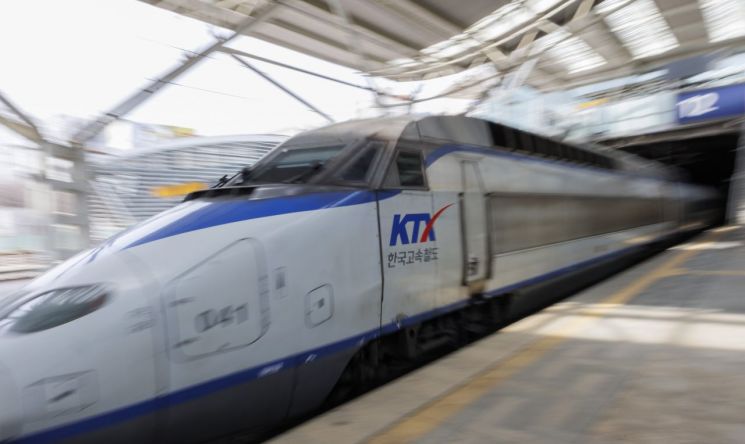
The station with the highest cumulative number of passengers in the first half was Seoul Station, with 118,000 passengers. This was followed by Dongdaegu Station (52,000), Daejeon Station (51,000), Busan Station (48,000), Yongsan Station (41,000), Gwangmyeong Station (34,000), Suwon Station (33,000), Osong Station (27,000), Cheonan-Asan Station (25,000), and Yeongdeungpo Station (20,000).
The station that saw the largest increase in passengers compared to the first half of last year was Bujeon Station. This station recorded a daily average of 3,000 passengers, representing a 2.2-fold increase year-on-year. This significant growth is largely attributed to the opening of new lines such as the Jungang Line and Donghae Line.
In addition, Gamgok Janghowon Station saw a 1.4-fold increase in passengers after introducing five round-trip shuttle bus services per day in cooperation with nearby universities.
The most frequently used train section in the first half was 'Seoul↔Busan', with a total of 3.69 million passengers. The 'Seoul↔Daejeon' section was the second most used, with 2.56 million passengers.
KORAIL transported a total of 2.5 million passengers on six new lines that opened since the end of last year, improving mobility for local residents and creating a denser nationwide railway network. The record-high number of train passengers in the first half of this year is also largely attributed to the impact of these new lines.
The newly opened lines include: Donghae Line (Gangneung~Bujeon, Gangneung~Dongdaegu), Jungang Line (Seoul/Cheongnyangni~Bujeon), Jungbunaeruk Line (Pangyo~Mungyeong), Seohae Line (Hongseong~Seohwaseong), Poseung~Pyeongtaek Line (Hongseong~Anjung~Pyeongtaek~Cheonan~Hongseong circular train), and Gyoe Line (Daegok~Uijeongbu).
Among these, the Donghae Line has served as a key transportation axis connecting Gangwon-do and Gyeongsang-do, contributing to the reorganization of the East Coast living sphere. The opening of the Samcheok~Yeongdeok section, which connected the previously separate Gangneung~Donghae and Pohang~Bujeon sections, also created a synergy effect.
For the Donghae Line section, the average daily number of passengers in the first half was 5,500, with a cumulative total of 992,000. The section with the highest number of passengers was the longest-distance section, Gangneung↔Bujeon, with an average of 445 passengers per day (7.9% share). In terms of distance, passengers traveling more than 100 km accounted for about 45% of all users, indicating a similar distribution between commuting and tourism purposes.
The Jungang Line emerged as a new north-south axis connecting Seoul and Busan after the opening of the Andong~Yeongcheon section at the end of last year, completing the entire Cheongnyangni~Bujeon route. The cumulative number of passengers in the first half was 987,000, with a daily average of 5,400.
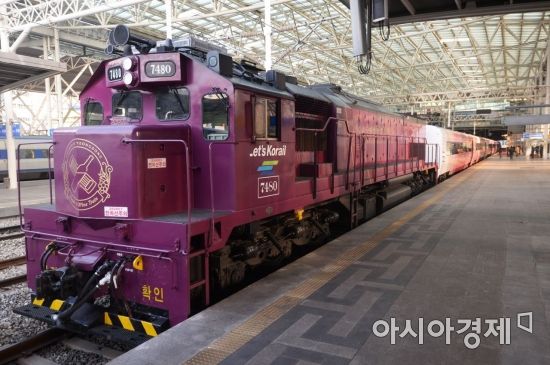 A tourist train themed around traditional Korean music and wine. This train operates twice a week as part of a strategy to revitalize tourism in the Yeongdong region. The itinerary departs from Seoul Station, visits wineries and traditional Korean music tourist sites in the Yeongdong area, and then returns to Seoul Station. Photo by Moon Honam munonam@
After the extension of the Jungbunaeruk Line to Mungyeong, the number of passengers increased by 68%, with a daily average of 1,600 and a cumulative total of 290,000 in the first half. The 'Pangyo↔Mungyeong' section accounted for 21% of the entire line's passengers. This is attributed to the fact that using the train saves at least 30 minutes compared to a car and more than 90 minutes compared to an intercity bus.
The cumulative number of passengers on the Seohae Line in the first half was 120,000. On the Gyoe Line (Daegok~Uijeongbu), which reopened after more than 20 years, a total of 100,000 passengers used the train, with a daily average of 600. After the number of daily train operations increased from 8 to 20 in April, the average daily number of passengers also rose to 745.
The cumulative number of passengers on the Daegyeong Line metropolitan railway in the first half was 2.53 million, with a daily average of 14,000. KORAIL analyzed that the opening of the Daegyeong Line generated about 8,000 new daily railway users in that section.
KORAIL also analyzed that, in addition to the opening of new lines, efforts to develop train travel products linked to popular tourist destinations and local festivals, as well as infrastructure expansion to attract tourists, contributed to the increase in train passengers. In fact, the number of train travelers in the first half of this year was 160,000, an increase of about 14% compared to the previous year.
A KORAIL official said, "As the railway network becomes denser, it can inject new vitality into local areas," and added, "We will continue to improve railway services so that the public can use trains more safely and conveniently."
© The Asia Business Daily(www.asiae.co.kr). All rights reserved.

















